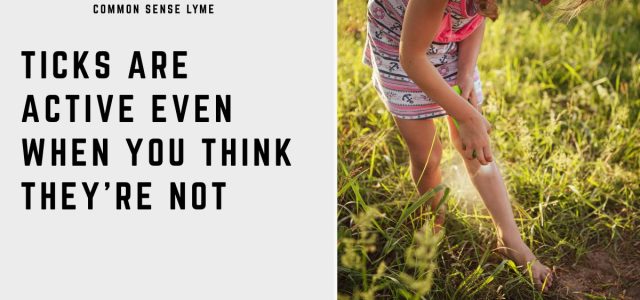
When Are Ticks Most Active? Why Lyme Disease Risk Lasts All Day
Ticks may search for hosts throughout much of the day—not just at dawn or dusk.
Questing behavior depends on survival and host-seeking activity rather than a strict schedule.
Understanding when ticks are most active may help patients recognize Lyme disease risk earlier.
When are ticks most active? Many people assume ticks only come out during certain times of day, but research suggests some ticks may actively search for hosts throughout much of the day.
Ticks must balance their need to find a host with the risk of drying out while waiting in the environment.
This behavior, known as questing, occurs when a tick climbs vegetation and waits with its front legs extended for a passing host.
When a person or animal brushes against the vegetation, the tick attaches.
Tick Questing Behavior in Natural Habitats
Most research on tick questing behavior has traditionally been conducted in laboratory settings.
“Ticks must balance the need to quest for blood meal hosts with the risk of desiccation, all on a fixed energy budget,” writes Thomas from Washington State University.
Thomas and colleagues investigated tick questing behavior in natural habitats across the northeastern United States.
The investigators found that nymph activity increased slightly during dawn and dusk, while larvae showed the opposite pattern. However, these findings were not consistently reproduced at other sites.
Questing behavior also appeared largely unaffected by temperature, humidity, light–dark cycles, or energy reserves.
“Rather it appears a fraction of ticks were questing most of the time, regardless of conditions,” Thomas writes.
“Our study suggests neither climatic conditions nor light–dark cycles have appreciable influence on tick questing behavior.”
Do Ticks Only Come Out at Certain Times?
Not necessarily.
While some ticks show mild increases in activity during dawn or dusk, others remain active across a wide range of environmental conditions.
This means tick exposure is not limited to morning or evening hours.
Understanding when ticks are most active is important because questing ticks may transmit infections including Lyme disease, Babesia, Anaplasma, and other tick-borne illnesses.
When Are Ticks Most Active During the Year?
Tick activity also varies by season.
- Spring through early summer: Nymph ticks associated with the highest Lyme disease risk
- Fall and early spring: Adult deer ticks
- Mild winter days: Possible tick activity when temperatures exceed 45°F
Nymph ticks are especially concerning because they are extremely small and difficult to detect.
Learn more about deer tick season and Lyme disease risk.
What This Means for Outdoor Exposure
Because ticks may remain active under many environmental conditions, individuals spending time outdoors should remain cautious in tick-endemic areas and take steps to prevent tick bites.
You do not need to be deep in the woods—or outside at a specific time—to be at risk.
Ticks may be present in backyards, parks, gardens, leaf litter, and trail edges while actively searching for hosts throughout the day.
Many Lyme disease patients never recall seeing the tick that bit them.
Clinical Takeaway
Ticks do not follow a strict schedule.
Some ticks may quest throughout much of the day, peak Lyme disease risk occurs during nymph season, and exposure may happen during routine outdoor activities.
Tick precautions should be used consistently—not just during certain times of day.
Frequently Asked Questions
When are ticks most active?
Ticks may remain active throughout much of the day, although some species show mild increases in activity at dawn and dusk.
What is tick questing?
Questing occurs when ticks climb vegetation and wait with extended front legs for a host to pass nearby.
Can ticks bite during the middle of the day?
Yes. Research suggests some ticks remain active regardless of time of day or environmental conditions.
When is Lyme disease risk highest?
Risk is highest during late spring and early summer when nymph-stage ticks are most active.
Can ticks survive in suburban environments?
Yes. Ticks are commonly found in yards, parks, gardens, and wooded edges.
Related Articles
- Ticks can survive a northern winter but can ticks survive a southern summer
- Have you been bitten by a partially fed tick?
- Don’t let your guard down on questing ticks in the South
- When Is Deer Tick Season? When Lyme Disease Risk Is Highest
References
- Thomas CE, Burton ES, Brunner JL. Environmental drivers of questing activity of juvenile black-legged ticks (Acari: Ixodidae): temperature, desiccation risk, and diel cycles. J Med Entomol. 2019.
- Awerbuch-Friedlander T, Levins R, Predescu M. The role of seasonality in the dynamics of deer tick populations. Bull Math Biol. 2005;67(3):467-486.
- Wężyk D, Dwużnik-Szarek D, Kowalec M, et al. Are you ready for the tick season? Spring dynamic of tick diversity and density in urban and suburban areas. Parasit Vectors. 2025;18:144.
Dr. Daniel Cameron, MD, MPH
Lyme disease clinician with over 30 years of experience and past president of ILADS.
Symptoms • Testing • Coinfections • Recovery • Pediatric • Prevention


It would appear from the complexity of treating Lyme Infected patients, that prevention education would help to stem the epidemic affecting some 700,000 victims, each year in the United States. How is it that the education is so lacking. The corona virus is receiving huge attention from the President Of the United States, but little news bulletins on the upcoming tick attack season.
Any time it is above freezing temperatures. The reports are based upon when folks show up in the emergency room, or when doctors report the case. Only ten percent of doctors report. Most reported cases were evidence of tick bites 30-60 days before the arrival at the medical Office. That growth in statistics has a lot to do with human activity out of doors , more than the activities of questing ticks. No people, No bites. Properly educated and protected outdoor activity is not reported either. No Bite, No Sick.