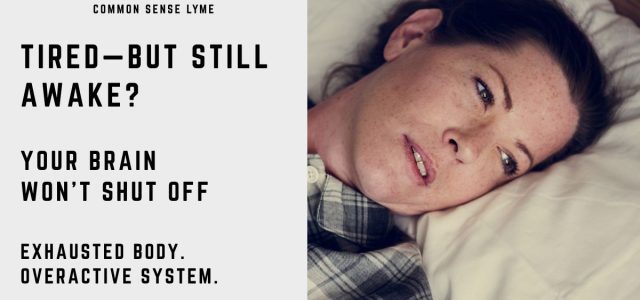
Why Lyme Patients Feel “Tired But Wired”
Lyme disease insomnia can leave patients exhausted but unable to sleep
Autonomic dysfunction and hyperarousal may keep the nervous system switched on
Understanding the pattern helps explain non-restorative sleep, brain fog, and fatigue
Lyme patients often describe the same confusing experience:
“My body is exhausted, but my brain won’t shut off.”
This tired-but-wired pattern is common in early Lyme disease, during treatment, and especially in patients with persistent symptoms after treatment. It is not simply psychological and not just poor sleep habits. It reflects physiologic shifts in the nervous system that Lyme disease can trigger.
What “tired but wired” means in medical terms
When patients say this, they are describing a split between body and brain — deep physical fatigue paired with a nervous system that stays switched on. They feel wiped out but mentally alert. Lights and sounds feel sharper. Their body wants sleep, but their system cannot settle.
Sleep specialists call this hyperarousal. Neurologists may describe central sensitization. Autonomic clinicians recognize sympathetic overactivation. Different terms, one experience: a nervous system that will not downshift.
Can Lyme disease cause insomnia?
Lyme disease can be associated with insomnia, including difficulty falling asleep, waking during the night, waking too early, or sleeping without feeling restored. For many patients, insomnia does not occur in isolation. It may appear alongside fatigue, pain, brain fog, sensory sensitivity, temperature swings, palpitations, and other symptoms of autonomic nervous system disruption.
In a specialty-clinic cohort of patients with chronic neuropsychiatric Lyme disease, sleep-related symptoms such as non-restorative sleep, hypersomnia, insomnia, fatigue, and loss of circadian rhythm were commonly reported. These findings should be interpreted carefully because the cohort was not designed to represent all Lyme disease patients, but they do reflect symptoms frequently described in clinical practice.
A 2025 literature review on neuropsychiatric manifestations of Lyme disease also noted that studies have reported sleep disturbances, anxiety, depression, cognitive complaints, and brain fog in some patients, while emphasizing that findings across studies remain mixed. This supports a balanced clinical view: insomnia can occur in Lyme disease, but clinicians should also evaluate other contributing factors and overlapping diagnoses.
How Lyme triggers autonomic dysregulation
Lyme disease may disrupt the autonomic nervous system (ANS), which helps regulate rest, alertness, heart rate, digestion, temperature control, and sleep–wake transitions. When this system becomes imbalanced, patients may experience:
- high sympathetic (“fight-or-flight”) tone
- low parasympathetic (“rest-and-restore”) recovery
This is the foundation of the tired-but-wired state. The body wants rest. The nervous system will not allow it.
Many patients also develop POTS-like symptoms — lightheadedness, palpitations, temperature swings, and exercise intolerance — all clues that the ANS is out of rhythm.
Hyperarousal: why Lyme disease can cause insomnia
Hyperarousal is the pattern where the brain stays active long after the body is done for the day. Patients lie in bed exhausted, yet thoughts speed up, internal “buzzing” appears, or their system feels “revved.”
Sleep becomes shallow and unrefreshing. Many patients meet clinical criteria for insomnia, even though the underlying problem may be physiologic rather than behavioral.
They wake just as tired as they were the night before. This is not “not trying hard enough.” It is the nervous system running too hot.
Circadian rhythm shifts in Lyme disease
Many Lyme patients notice their internal clock drifting. They feel sleepy in the afternoon, foggy in the morning, and then unexpectedly alert late at night. It is as if the body’s signals for “sleep now” and “wake now” start arriving at the wrong times.
Patients describe missing their usual “sleep window,” or getting a sudden burst of energy just as the day slows down. This is not just poor sleep hygiene — it is a physiologic shift in the sleep–wake rhythm that may appear when Lyme disease disrupts the nervous system.
The result is a schedule that no longer lines up with daily life: tired when they want to be awake, and wide awake when they desperately want to sleep.
Neuroinflammation and sensory reactivity
Lyme-related inflammation may make the brain more sensitive to input. Patients often say the “volume is turned up too high.” Sounds feel sharper. Lights seem brighter. Small stresses feel amplified.
This heightened sensitivity makes it harder to wind down. A nervous system that reacts quickly during the day may stay reactive at night — feeding the tired-but-wired cycle.
Why this is not simply anxiety
Patients are frequently told that the tired-but-wired state is simply anxiety, but their descriptions often tell a different story.
- “My mind isn’t worried — my body just won’t shut off.”
- “I’m tired, not afraid.”
- “I feel stuck in high gear.”
Although anxiety and Lyme disease can coexist, many patients describe physiologic activation rather than excessive worry. Hyperarousal, autonomic dysfunction, pain, inflammation, and disrupted sleep may all contribute to the sensation of being exhausted while remaining unable to relax or sleep.
Putting it all together
When I step back and look at the tired-but-wired pattern in Lyme disease, what stands out is how many systems are affected at the same time. The autonomic nervous system slips out of balance, leaving the “fight-or-flight” response running higher and longer than it should. The body’s restorative pathways never fully take over, so the brain stays alert even when it is supposed to slow down. The internal clock may drift off schedule, pushing alertness into the late evening and fog into the morning. At the same time, neuroinflammation and sensory hypersensitivity can make it harder for the nervous system to disengage.
Put together, these changes create a single lived reality for many patients: exhausted yet overstimulated. They are wide awake at midnight, foggy at noon, alert in quiet rooms, and never fully restored even after what should have been a full night’s sleep. It is no wonder that advice such as “improve your sleep hygiene” often provides only limited relief. For many patients, this is not primarily a behavioral problem—it reflects physiologic dysregulation.
Understanding this pattern helps patients feel heard and gives clinicians a clearer framework for evaluating fatigue, insomnia, autonomic symptoms, and sleep disruption in Lyme disease.
Frequently Asked Questions
Can Lyme disease cause insomnia?
Yes. Lyme disease may contribute to insomnia, including difficulty falling asleep, frequent nighttime awakening, or waking too early. Autonomic dysfunction, hyperarousal, pain, inflammation, and circadian rhythm disruption may all interfere with normal sleep.
Why do Lyme patients feel tired but wired?
Many patients experience an imbalance between the sympathetic and parasympathetic nervous systems. Their body feels physically exhausted, but their brain and nervous system remain unusually alert, making it difficult to relax or obtain restorative sleep.
Can autonomic dysfunction affect sleep?
Yes. The autonomic nervous system regulates the transition between wakefulness and sleep. When this system becomes dysregulated, patients may develop insomnia, non-restorative sleep, palpitations, temperature instability, dizziness, and other symptoms that interfere with recovery.
Does improving sleep hygiene cure the tired-but-wired feeling?
Healthy sleep habits remain important, but they may not fully address symptoms driven by autonomic dysfunction, inflammation, pain, or other physiologic factors associated with Lyme disease. Identifying and treating contributing medical conditions is often equally important.
Clinical Takeaway
The tired-but-wired pattern is a recognizable clinical experience reported by many Lyme disease patients. Although symptoms vary from person to person, autonomic dysfunction, hyperarousal, circadian rhythm disruption, neuroinflammation, and non-restorative sleep may all contribute to feeling physically exhausted while remaining unable to relax or sleep.
Recognizing this pattern can help patients and clinicians better understand why profound fatigue and insomnia often occur together in Lyme disease and why addressing the underlying physiologic contributors is an important part of recovery.
Related Articles
Learn more about related sleep and nervous system symptoms seen with Lyme disease.
Autonomic Dysfunction in Lyme Disease
Sleep Disorders and Lyme Disease
Brain Fog and Lyme Disease
POTS and Lyme Disease
Fatigue in Lyme Disease
References
- Bonnet MH, Arand DL. Hyperarousal and insomnia: state of the science. Sleep Med Rev. 2010;14(1):9–15.
- Raj SR. Postural tachycardia syndrome (POTS). Circulation. 2013;127(23):2336–2342.
- Cermakian N, Boivin DB. Human circadian rhythm disorders. Brain Res Rev. 2003;42(3):204–220.
- Perry VH, Holmes C. Microglial priming in neurodegenerative disease. Nat Rev Neurol. 2014;10(4):217–224.
- Woolf CJ. Central sensitization: implications for diagnosis and treatment. Pain. 2011;152(Suppl 3):S2–S15.
- Bransfield RC, Aidlen DM, Cook MJ, Javia S. A Clinical Diagnostic System for Late-Stage Neuropsychiatric Lyme Borreliosis Based upon an Analysis of 100 Patients. Healthcare (Basel). 2020;8(1):13.
- Šegždaitė G, Aliukonytė O, Pociūtė K. Neuropsychiatric Manifestations of Lyme Disease: A Literature Review of Psychiatric and Cognitive Impacts. Acta Med Litu. 2025;32(1):6–21.
Dr. Daniel Cameron, MD, MPH
Lyme disease clinician with over 30 years of experience and past president of ILADS.
Symptoms • Testing • Coinfections • Recovery • Pediatric • Prevention