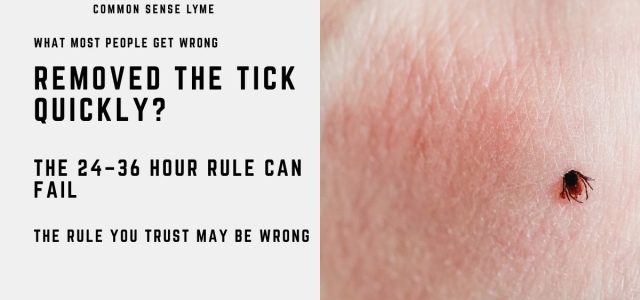
Can Lyme Disease Spread in Under 24 Hours? The Tick Bite Myth Explained
Can Lyme disease spread in under 24 hours? Yes—under certain conditions, transmission may occur faster than commonly believed.
Many people are told they are safe if a tick is removed within 24–36 hours. This widely repeated advice can lead to false reassurance.
While transmission often takes time, it is not guaranteed to require 24–36 hours. Some studies suggest infection may occur sooner, especially with partially fed ticks or certain co-infections.
For a broader overview, see Lyme disease symptoms guide.
Why the 24–36 Hour Tick Bite Myth Exists
The idea comes from early laboratory studies suggesting that Borrelia burgdorferi typically takes time to migrate from a tick’s midgut to its salivary glands.
However, these findings represent averages—not guarantees. Real-world conditions can vary, and transmission may occur more quickly than expected.
Evidence That Transmission Can Occur Sooner
Research has shown that Lyme disease transmission may occur in less than 24 hours under certain conditions.
- Animal studies demonstrate transmission in under 24 hours
- Partially fed ticks may transmit infection more rapidly
- Patients often underestimate how long a tick has been attached
A key limitation is that patients may not realize when tick attachment actually began. A tick may have been feeding for hours before it is noticed.
Co-Infections Can Spread Even Faster
Some tick-borne infections can be transmitted more quickly than Lyme disease.
- Anaplasma phagocytophilum — less than 24 hours
- Babesia microti — possibly within 24 hours
- Rickettsia rickettsii — within hours
- Ehrlichia species — possibly within 24 hours
- Borrelia miyamotoi — potentially faster transmission
- Powassan virus — minutes to hours
Learn more about Lyme disease co-infections.
Importantly, a single dose of doxycycline does not protect against all tick-borne infections. Babesia and Powassan virus, for example, require different considerations.
Why the Safe Window Assumption Can Lead to Delayed Care
Believing there is a guaranteed “safe window” after a tick bite can lead to:
- Delaying or declining preventive treatment
- Stopping symptom monitoring too early
- Ignoring early signs of infection
This contributes to Lyme disease misdiagnosis and delayed care.
A Better Approach After a Tick Bite
Every tick bite should be taken seriously.
Risk depends on multiple factors:
- Tick species
- Life stage
- Feeding duration
- Whether the tick had previously fed
The science is clear: a tick does not always need 36 hours to transmit infection.
Frequently Asked Questions
Can Lyme disease spread in under 24 hours?
Yes. Although transmission often takes time, studies suggest that Lyme disease may occasionally be transmitted in less than 24 hours, particularly with partially fed ticks.
Can co-infections spread faster than Lyme disease?
Yes. Powassan virus may be transmitted within minutes to hours, and infections such as Anaplasma, Ehrlichia, and Babesia may spread more rapidly than Lyme disease.
Does removing a tick within 24 hours eliminate the risk?
No. Early removal lowers the risk of infection, but it does not guarantee protection.
Does one dose of doxycycline prevent all tick-borne infections?
No. Single-dose doxycycline does not protect against all co-infections. Babesia and Powassan virus, for example, require different considerations.
Clinical Takeaway
The 24–36 hour rule is not a guarantee.
Transmission timing varies, and early removal reduces risk—but does not eliminate it.
When symptoms develop after a tick bite, Lyme disease and co-infections should still be considered, even if the tick was removed within 24 hours.
Related Articles
Single Dose Doxycycline: What Patients Aren’t Being Told
What to Do After a Tick Bite
Can You Have Lyme Disease Without Seeing a Tick Bite?
Powassan Virus Encephalitis
References
- Piesman J, Mather TN, Sinsky RJ, Spielman A. Duration of tick attachment and Borrelia burgdorferi transmission. J Clin Microbiol. 1987;25(3):557–558.
- Shih CM, Spielman A. Accelerated transmission of Lyme disease spirochetes by partially fed vector ticks. J Clin Microbiol. 1993;31(11):2878–2881.
- Shih CM, Pollack RJ, Telford SR, Spielman A. Delayed dissemination of Borrelia burgdorferi from the midgut of Ixodes dammini to the salivary glands. J Infect Dis. 1992;166(4):827–831.
- Des Vignes F, Piesman J, Heffernan R, Schulze TL, Stafford KC, Fish D. Effect of tick removal on transmission of Borrelia burgdorferi and Anaplasma phagocytophilum by Ixodes scapularis nymphs. J Infect Dis. 2001;183(5):773–778.
- Eisen L. Pathogen transmission in relation to duration of attachment by Ixodes scapularis ticks. Ticks Tick Borne Dis. 2018;9(3):535–542.
- Eisen L, Dolan MC. Evidence for the rapid transmission of pathogens by ticks. Ticks Tick Borne Dis. 2016;7(6):1065–1075.
- Falco RC, Fish D. Ticks parasitizing humans in a Lyme disease endemic area of southern New York State. Am J Epidemiol. 1988;128(5):1146–1152.
Dr. Daniel Cameron, MD, MPH
Lyme disease clinician with over 30 years of experience and past president of ILADS.
Symptoms • Testing • Coinfections • Recovery • Pediatric • Prevention



Nymphs may be able to transmit faster than adults – within 12 hours.
A study on the speed of transmission by infected ticks, Research Journal, Institut Pasteur 2018-09-07: https://www.pasteur.fr/en/research-journal/news/lyme-disease-study-speed-transmission-infected-ticks
MY EXPERIENCE:
The tick was on my hand and I saw it immediately after petting my dog. I removed it promptly. Called my dermatologist who had prescribed doxycycline for a previous tick bite. He said he couldn’t prescribe doxycycline every time I was bitten by a tick. This happened over 20 years ago.
Of course, I got very sick and consequently spent several years overcoming all of the ramifications of that non-treatment stance.
Luckily after getting very ill, I found you, Dr. Cameron! You prescribed all of the right treatments including intravenous antibiotic for several months.
You gave me my life back and I am forever grateful to you.
Thank you for giving everyone the information they need to overcome the lack of real treatment possibilities for Lyme disease. I wish more medical people were like you and did not just repeat all of the misinformation about Lyme disease that is out there and actually thought about what really happens. And realized how much is not known.
MY COMMENT STOPS HERE AND IS WRITTEN JUST FOR YOU, DR. CAMERON.
TO YOU, DR. CAMERON,
I am commenting on this article because in my experience the idea the tick must be embedded for 24 hours, or 12 hours or even 1 hour is completely false and has probably damaged many people.
I wish to remain anonymous, so will not give you my real name though you may figure it out.
Though I don’t expect to hear from you, I am giving you an unidentifiable email address in case you do decide you want to ask me something.
(Also, there aren’t any asterisks marking required fields though it is stated…Required fields are marked *)
The tick that bit me was attached for three hours at the most, and it transmitted FIVE diseases!