Extended Antibiotic Treatment for Lyme Disease: What Doctors Are Actually Prescribing
Many physicians prescribe longer Lyme disease treatment courses.
A large insurance study examined real-world antibiotic prescribing patterns.
Doctors often relied on clinical judgment beyond standard guidelines.
The Infectious Disease Society of America (IDSA) has long insisted that a maximum antibiotic course of 21 days is sufficient to eradicate the Lyme bacterium, while the International Lyme and Associated Diseases Society (ILADS) recommends a longer course of therapy with duration dependent on response to therapy. [1]
So, what treatment approach are physicians adopting in their own clinical practices? And how frequently are they prescribing multiple antibiotics to treat the disease?
A study by Tseng and colleagues, published in Clinical Infectious Diseases, aimed to answer those questions. The authors discovered “that the use of extended courses of antibiotics and multiple antibiotics in the treatment of Lyme disease has increased in recent years.”
Study Examined Real-World Lyme Disease Treatment Patterns
The study examined the incidence and patterns of prolonged antibiotic treatment in Lyme disease patients in 14 high-prevalence states in the Northeastern United States. The authors retrospectively analyzed health insurance claims for patients receiving Lyme disease treatment from 2010 to 2012. [2]
The 14 states included Connecticut, Delaware, Maine, Maryland, Massachusetts, Minnesota, New Hampshire, New Jersey, New York, Pennsylvania, Rhode Island, Vermont, Virginia, and Wisconsin.
Typically, studies only include Lyme disease patients who meet the Centers for Disease Control and Prevention’s (CDC) two-tier diagnostic testing criteria. However, the two-tier antibody testing approach has limitations because it requires positive results on both the ELISA and Western blot tests.
Previously, Wormser and colleagues concluded that only one-third of well-characterized Lyme disease patients could be confirmed by the CDC’s two-tier diagnostic criteria. [3]
Because this study was not restricted only to patients meeting two-tier testing criteria, it provides insight into actual treatment practices and may better reflect the broader population of patients treated for Lyme disease.
Extended Antibiotic Treatment Was Common
According to the study, 18% of Lyme disease patients were treated for more than 5 weeks, which the authors defined as extended therapy. The actual duration of antibiotic treatment was often much longer, averaging 86 days. Treatment duration ranged from 35 to 404 days.
Nearly half of Lyme disease patients (48.8%) were treated with more than 2 antibiotics.
Doxycycline was prescribed in as many as 74.4% of patients. Azithromycin was prescribed in as many as 11.5% of patients. Amoxicillin and cefuroxime were also commonly prescribed.
The study did not examine additional antibiotics such as minocycline and tetracycline, which are sometimes prescribed to treat other tick-borne illnesses.
The use of extended therapy also involved switching from one antibiotic to another and combining antibiotics. The study found that 43% of patients were switched from one antibiotic to another, while 18% received combinations of antibiotics.
Hundreds of Physicians Prescribed Longer Treatment Courses
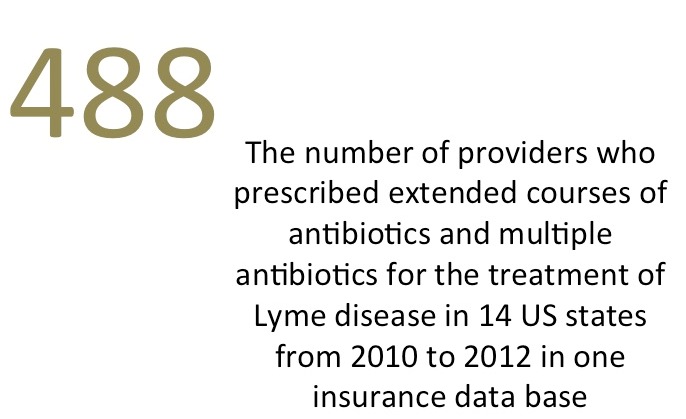
A relatively small group of physicians prescribed extended therapy for a significant percentage of Lyme disease patients. Sixteen doctors (3%) treated more than 20% of the Lyme disease patients who received extended antibiotic treatment.
However, the study also showed that hundreds of additional providers prescribed prolonged antibiotic therapy. In total, 472 doctors treated the remaining 80% of Lyme disease patients receiving extended therapy.
The authors did not address why these physicians prescribed treatment beyond the 21 days recommended by the 2006 IDSA guidelines. [1]
They also did not discuss that some clinicians recommend extended antibiotic treatment for selected patients based on a risk-benefit assessment and shared medical decision-making process. [4]
ILADS Guidelines and Shared Medical Decision-Making
The following excerpt from the ILADS evidence-based guidelines describes the individualized approach recommended for persistent symptoms:
“The clinical population of patients with persistent manifestations of Lyme disease is heterogeneous; therefore, the risk-benefit assessment needs to be done on an individualized basis, taking into account the severity of an individual’s persistent disease, their responsiveness to treatment, their ability to tolerate side effects associated with additional and potentially long-term treatment as well as their willingness to accept the risk associated with antibiotic treatment or, conversely, the level of their desire to avoid treatment-associated risk.” [4]
Medical societies continue to debate the optimal treatment regimen. In the meantime, physicians often rely on clinical judgment when treating Lyme disease patients with persistent symptoms.
The paper demonstrates that hundreds of doctors are choosing extended antibiotic treatment in an effort to successfully treat their Lyme disease patients.
FAQ: Extended Antibiotic Treatment for Lyme Disease
How long are antibiotics used for Lyme disease?
Standard treatment recommendations often range from 10 to 21 days, depending on the clinical presentation. However, some physicians prescribe longer courses for selected patients based on symptoms, treatment response, and clinical judgment.
Why do some doctors prescribe extended antibiotic treatment?
Some clinicians believe persistent symptoms, delayed diagnosis, co-infections, or incomplete recovery may justify longer treatment durations in selected patients.
Can Lyme disease patients receive more than one antibiotic?
Yes. The study found that many Lyme disease patients were treated with multiple antibiotics, including doxycycline, azithromycin, amoxicillin, and cefuroxime.
Do all medical societies agree on Lyme disease treatment duration?
No. Treatment duration remains an area of ongoing debate between medical organizations and clinicians treating Lyme disease.
Sources
- Wormser GP, Dattwyler RJ, Shapiro ED et al. The clinical assessment, treatment, and prevention of Lyme disease, human granulocytic anaplasmosis, and babesiosis: clinical practice guidelines by the Infectious Diseases Society of America. Clin Infect Dis. 2006;43(9):1089-1134.
- Tseng YJ, Cami A, Goldmann DA, DeMaria A Jr., Mandl KD. Incidence and Patterns of Extended-Course Antibiotic Therapy in Patients Evaluated for Lyme Disease. Clin Infect Dis. 2015.
- Molins CR, Ashton LV, Wormser GP et al. Development of a metabolic biosignature for detection of early Lyme disease. Clin Infect Dis. 2015;60(12):1767-1775.
- Cameron DJ, Johnson LB, Maloney EL. Evidence assessments and guideline recommendations in Lyme disease: the clinical management of known tick bites, erythema migrans rashes and persistent disease. Expert Rev Anti Infect Ther. 2014.
Dr. Daniel Cameron, MD, MPH
Lyme disease clinician with over 30 years of experience and past president of ILADS.
Symptoms • Testing • Coinfections • Recovery • Pediatric • Prevention


It is very exciting to see that more and more research seems to be taking place relating to Lyme disease diagnosis, complexity of symptoms, and range of treatment. Thank you for your consistent part in this.
Good to see science slowly starting to win out. Refer to science adn evidence based ILADS guidelines.
Good to see science slowly starting to win out. Refer to science and evidence based ILADS guidelines.
daniel, thanks for the report above and i noted you, betty maloney, and lorraine johnson wrote/published your latest study!! good deal 😉
9-8-15, i met betty mahoney 1st time in white bear, minn. when i heard nc bart expert, dr. ed breischwedt, sp, speak! she got me to the meeting place since i’m from IOWA.
thanks for my upper tonight; i posted it on lyme site i post in.
THANKS FOR ALL YOU DO DANIEL and serving as ilads pres/past pres. i can’t keep up whose pres. now..neuro lyme of 46.5 yrs.
bettyg, iowa activist
MISDIAGNOSED 35 yrs. by 40-50 drs.
UNACCEPTABLE!
This doesn’t answer anything about why it’s politicized. I’m getting tired of looking I’ve been looking for 45 minutes now and I can’t find a decent reason or even any reason really except that doctors are aligned with insurance corporations yeah well prove it I mean, I’m looking for hard research compared to other hard research what the hell? You guys are not helping. You’re not helping us understand why it’s politicized. In your article all you did was compared treatment modalities that’s all. That doesn’t answer anything. No wonder this whole thing is such a mess