Lyme Disease in Ohio: Cases Are Rising
Lyme disease cases in Ohio are rising sharply. Once considered a low-risk state, Ohio is now seeing a significant increase in reported infections—challenging long-standing assumptions about where Lyme disease occurs.
Recent data show thousands of cases annually, with a dramatic increase over the past decade. This shift suggests Lyme disease is no longer emerging in Ohio—it is already established.
Recent data from the Ohio Department of Health show 137 reported cases as of early 2026, with marked variation by county—reinforcing that Lyme disease risk is not evenly distributed across the state.
“If Lyme disease wasn’t supposed to be common in Ohio, why are cases increasing so quickly?”
• ~40 cases (2010)
• ~415 cases (2020)
• More than 2,800 reported cases in recent years
Earlier research had already suggested this trend was underway. A study from Ohio State University and the Ohio Department of Health documented the spread of black-legged ticks (Ixodes scapularis)—the primary vector of Lyme disease—across the state, laying the groundwork for what we are now seeing clinically.
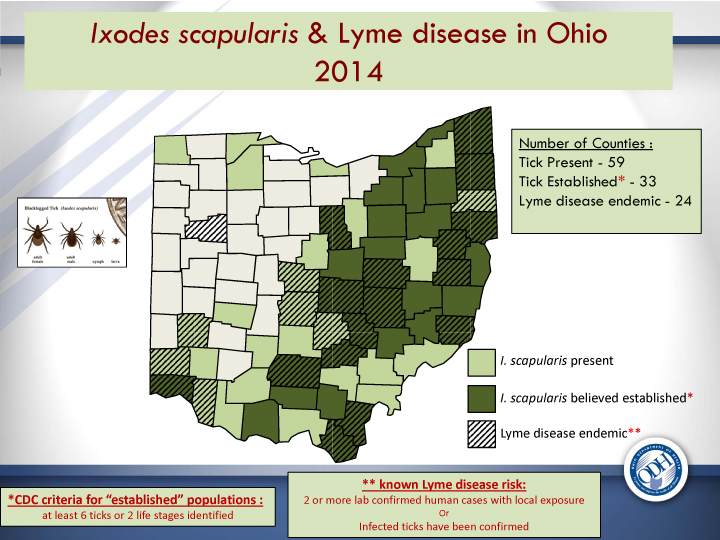
Deer tick distribution in Ohio (Glenn Needham)
Lyme Disease Is Now Established in Ohio
The study, published in Frontiers in Cellular and Infection Microbiology, found deer ticks in 57 of Ohio’s 88 counties as of 2012.
Researchers confirmed the full enzootic life cycle of Borrelia burgdorferi, the bacterium responsible for Lyme disease.
This means Lyme disease is no longer emerging in Ohio—it is established.
The presence of larvae, nymphs, and adult ticks indicates sustained transmission within the environment.
Why Ticks Are Spreading
The expansion of deer ticks in Ohio has been attributed to several factors:
- Migratory birds transporting infected ticks
- Deer movement across regions
- Human environmental changes
These factors allow Lyme disease to spread into areas previously considered low risk.
Do Ohio Ticks Carry Lyme Disease?
Yes. Black-legged ticks (deer ticks) in Ohio can carry Borrelia burgdorferi, the bacterium that causes Lyme disease. Infection rates vary by region and local tick populations, which is one reason Lyme disease risk differs from county to county.
As deer tick populations continue to expand, the likelihood of encountering infected ticks increases in many parts of the state.
The Surveillance Problem
Despite growing evidence, the CDC has historically classified Ohio as a non-endemic state.
This classification may underestimate actual risk.
Ohio’s own tick surveillance program—operating since 1983—provided valuable data but lost funding and was discontinued in 2012.
Without consistent surveillance, emerging risk may go unrecognized.
Why This Matters Clinically
Physicians often rely on CDC surveillance maps when assessing Lyme disease risk.
If a region is considered low risk, Lyme disease may not be included in the differential diagnosis.
This can lead to:
- Delayed diagnosis
- Missed treatment opportunities
- Progression to chronic illness
The consequences of under-recognition can be significant.
Understanding the limitations of Lyme disease testing and diagnosis may help clinicians recognize cases that fall outside traditional geographic assumptions.
The “Non-Endemic” Myth
At our practice, we have treated patients from across the United States—including those infected in states traditionally labeled as non-endemic.
Lyme disease does not respect geographic boundaries.
As tick populations expand, the concept of “non-endemic” regions becomes less reliable.
Wondering where Lyme disease risk is highest within Ohio? See which areas in Ohio are most affected.
Clinical Perspective
Clinicians should consider Lyme disease in patients with compatible symptoms—even in areas not officially recognized as endemic.
Geographic assumptions should not replace clinical judgment.
Early recognition and treatment remain critical to preventing long-term complications.
For more information on ticks and the diseases they transmit, visit About ticks and tick-borne diseases.
Frequently Asked Questions
Is Lyme disease common in Ohio?
Lyme disease has become increasingly common in Ohio as black-legged tick populations have expanded across much of the state.
Can you get Lyme disease from a tick bite in Ohio?
Yes. Black-legged ticks capable of transmitting Lyme disease are now established in many Ohio counties.
Which areas of Ohio have the highest Lyme disease risk?
Risk varies by county. Areas with established black-legged tick populations generally have higher risk.
Do Ohio ticks carry Lyme disease?
Yes. Deer ticks in Ohio can carry the bacterium that causes Lyme disease, though infection rates vary by region.
Why are Lyme disease cases increasing in Ohio?
Researchers attribute the increase to expanding tick populations, deer movement, migratory birds, and environmental changes that support tick survival.
Clinical Takeaway
Lyme disease is no longer considered an emerging infection in Ohio. Black-legged ticks are now established across much of the state, and reported cases have increased substantially over the past decade.
Clinicians and patients should consider Lyme disease when compatible symptoms occur after tick exposure, regardless of whether an area has historically been labeled non-endemic.
Related Articles
Where Is Lyme Disease in Ohio? Counties at Highest Risk
About Ticks and Tick-Borne Diseases
Lyme Disease Symptoms Guide
Lyme Disease Testing and Diagnosis
Prevention of Lyme Disease
References
- Wang P, Glowacki MN, Marrotte RR, Hazlett MJ, Zhang Y, Yao J, et al. Emergence of Ixodes scapularis and Borrelia burgdorferi, the Lyme disease vector and agent, in Ohio. Front Cell Infect Microbiol. 2014;4:70. doi:10.3389/fcimb.2014.00070
- Ohio Department of Health. Lyme Disease in Ohio: County-Level Data and Trends. Accessed 2026.
Dr. Daniel Cameron, MD, MPH
Lyme disease clinician with over 30 years of experience and past president of ILADS.
Symptoms • Testing • Coinfections • Recovery • Pediatric • Prevention