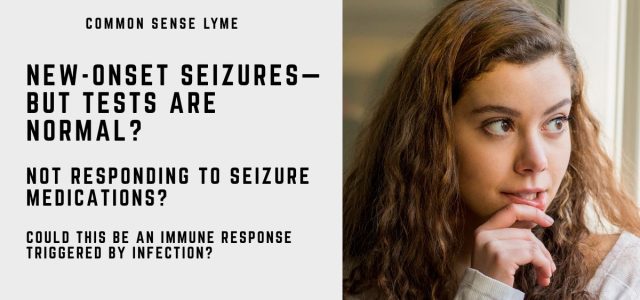
Autoimmune Epilepsy and Lyme Disease: When Seizures Don’t Respond to Treatment
Autoimmune epilepsy associated with Lyme disease is an emerging concept where seizures may be driven not only by infection—but by immune system activation.
“The seizures didn’t improve with medication—but something else was going on.”
A recent case report by Cipriano and colleagues describes two patients who developed severe, treatment-resistant seizures in temporal association with Lyme-associated illness—and improved only after immune-based therapy.
This pattern is also seen in patients with persistent Lyme disease symptoms, where standard explanations do not fully account for clinical presentation.
When Seizures Don’t Follow the Usual Pattern
Both patients—a 25-year-old man and a 14-year-old girl—developed new-onset seizures that did not respond to standard anti-seizure medications.
- Rapid onset of neurologic symptoms
- Seizures resistant to multiple medications
- Normal or inconclusive imaging and testing
- Symptoms worsening after starting antibiotics
These patterns suggest something beyond typical epilepsy.
Worsening After Antibiotics: A Clue?
In both cases, seizure activity worsened shortly after starting antimicrobial therapy.
The authors propose this may reflect an inflammatory response similar to a
Jarisch-Herxheimer reaction, where immune activation increases as bacteria are broken down.
Are the seizures driven by infection—or by the immune response to infection?
Evidence of Immune Involvement
- Hypogammaglobulinemia
- IgG subclass deficiencies
- Complement abnormalities
- Neural autoantibodies
These findings support an immune-mediated process.
Response to Immunotherapy
Both patients improved only after treatment with corticosteroids and IVIG.
What This Means for Lyme Disease
- Infection may trigger immune dysregulation
- The immune system may affect brain function
- Seizures may result from inflammation—not just infection
This aligns with patterns seen in
neurologic Lyme disease.
These challenges reflect why Lyme disease tests the limits of medicine.
Infection vs Immune Mechanisms: What’s Driving the Seizures?
Are seizures driven by persistent infection, immune activation, or both?
HSV is linked to autoimmune encephalitis. By contrast, Lyme-associated autoimmune epilepsy remains based on limited data.
- Neuroborreliosis: direct infection
- Autoimmune epilepsy: immune-mediated
Persistent infection cannot be excluded, particularly since antibiotics were continued alongside immunotherapy.
This raises whether combined antimicrobial and immune-modulating approaches may play a role in selected cases.
This aligns with persistent Lyme disease mechanisms.
Important Limitations
- Two cases only
- Non-standard Lyme testing
- Limited antibody validation
These findings are hypothesis-generating.
Clinical Perspective
Specialist evaluation is essential. Both patients underwent extensive workups to rule out structural, infectious, autoimmune, and metabolic causes.
Multidisciplinary care (neurology, infectious disease, immunology) is often required.
In clinical practice, I have also seen Lyme patients with a range of seizure presentations, from intermittent unexplained episodes to more persistent neurologic symptoms. These observations do not establish causation but highlight variability and the need for careful evaluation.
Together with emerging case reports, this underscores the need for further research into Lyme-associated neurologic and immune mechanisms.
Clinical Takeaway
Autoimmune epilepsy may occur in the setting of Lyme-associated illness in selected patients.
When seizures do not respond to standard treatment, immune-mediated mechanisms should be considered.
Recognizing these patterns may change diagnosis and treatment.
Frequently Asked Questions
Can Lyme disease cause seizures?
Rarely, but neurologic involvement is possible.
What is autoimmune epilepsy?
Immune-driven seizures affecting brain function.
Why worse after antibiotics?
Possible inflammatory response (Herxheimer-like).
Is this common?
No—these are rare cases.
References:
- Cipriano PM. Autoimmune epilepsy temporally associated with Lyme disease: A report of two cases. Cureus. 2026;18(3):e105228. doi:10.7759/cureus.105228. PMCID: PMC13075592.
Dr. Daniel Cameron, MD, MPH
Lyme disease clinician with over 30 years of experience and past president of ILADS.
Symptoms • Testing • Coinfections • Recovery • Pediatric • Prevention