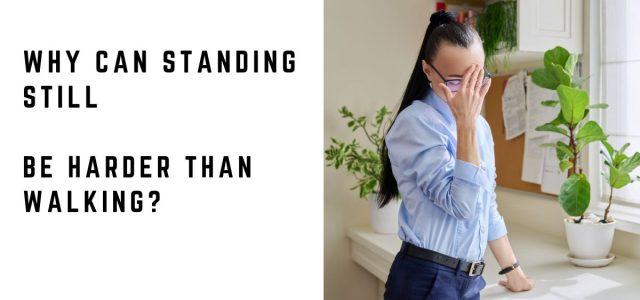
Why Can Standing Still Be Harder Than Walking?
Standing still can allow more blood to pool in the lower body
Walking activates muscles that help return blood toward the heart
Difficulty standing may be a clue to orthostatic intolerance or another medical problem
It can seem strange: you may be able to walk around a grocery store but feel dizzy, weak, foggy, or unwell after standing in the checkout line for ten minutes.
For some people, standing still really can be harder than walking.
The reason may involve the way the body maintains circulation while upright. When you stand, gravity shifts blood toward the legs and abdomen. Your nervous system, blood vessels, heart, blood volume, and muscles normally work together to maintain enough blood flow to the heart and brain.
Walking adds another important mechanism: the skeletal muscle pump. Each time the muscles in the legs contract, they compress nearby veins and help move blood back toward the heart.
When you stand relatively still, that pump is much less active.
For someone with autonomic dysfunction, low blood volume, orthostatic intolerance, medication effects, anemia, or another problem affecting circulation, the difference can become surprisingly noticeable.
What Happens to Your Circulation When You Stand Up?
Moving from lying or sitting to an upright position creates an immediate challenge for the cardiovascular system.
Gravity causes blood to shift downward into the legs and the blood vessels of the abdomen and pelvis. Research on orthostatic physiology suggests that roughly 500 to 800 mL of blood may be redistributed toward the lower body shortly after becoming upright.
This temporarily reduces the amount of blood returning to the heart.
The body normally compensates automatically. Sensors called baroreceptors detect changes in pressure and trigger adjustments in heart rate and blood-vessel constriction. These responses help maintain blood pressure, cardiac output, and blood flow to the brain.
Most people barely notice that any of this is happening.
But when these compensatory mechanisms are inadequate, remaining upright can produce symptoms.
Why Does Standing Still Make Blood Pool More Easily?
Quiet standing creates a particular circulatory challenge because gravity continues pulling blood downward while the leg muscles remain relatively inactive.
Blood can therefore accumulate in the veins of the legs and other dependent areas of the body.
This is known as venous pooling.
The longer someone remains upright without moving, the more important the body’s vascular and autonomic compensatory mechanisms become.
If enough blood remains in the lower body, less may return to the heart. That can reduce cardiac filling and, in susceptible individuals, contribute to reduced blood flow reaching the brain.
The result may not necessarily be fainting. Symptoms can be much subtler.
Why Can Walking Feel Better?
Walking changes the situation because the muscles of the calves, thighs, and other parts of the lower body repeatedly contract and relax.
Those contractions compress veins in the legs. One-way valves within the veins help direct blood upward rather than allowing it to fall back toward the feet.
This mechanism is often called the skeletal muscle pump.
The muscle pump helps increase venous return—the movement of blood back toward the heart.
Even relatively small movements can help. Shifting weight from one leg to another, flexing the calf muscles, marching in place, or walking may recruit the muscle pump more effectively than standing motionless.
This helps explain an observation that otherwise seems contradictory:
“I can walk through the store, but standing in line makes me feel terrible.”
The walking itself may be helping the circulation.
What Symptoms Can Happen During Prolonged Standing?
People who have difficulty tolerating prolonged standing may experience different combinations of symptoms, including:
- Dizziness or lightheadedness
- Weakness
- Brain fog or difficulty concentrating
- Blurred or dimming vision
- Palpitations
- Rapid heart rate
- Nausea
- Head pressure or headache
- Leg heaviness or aching
- Shakiness
- Sweating
- Feeling unusually hot
- Shortness of breath
- A feeling that fainting may occur
Symptoms may improve after walking, sitting down, lying down, or moving the legs.
That relationship to posture and movement can be an important diagnostic clue.
Why Is Standing in Line Such a Common Problem?
Standing in a checkout line, waiting at a reception desk, talking to someone while standing, taking a long shower, or standing during a ceremony can expose a problem that may not be obvious during ordinary walking.
The person is upright, but the leg muscles are doing relatively little work.
Some people unconsciously develop strategies to compensate. They may shift repeatedly from one foot to another, cross their legs, lean against a wall or shopping cart, tighten their leg muscles, pace, or look for somewhere to sit.
These behaviors may not simply reflect impatience or fatigue. Muscle contractions can help move pooled blood back toward the heart.
Could This Be Orthostatic Intolerance?
Possibly.
Orthostatic intolerance describes symptoms that develop or worsen when a person is upright and often improve when the person sits or lies down.
It is not a single disease.
Orthostatic intolerance can occur with several different conditions and physiologic patterns. Some patients develop an excessive increase in heart rate when upright. Others experience a fall in blood pressure. Still others can have significant orthostatic symptoms without dramatic abnormalities on routine heart-rate or blood-pressure measurements.
This is one reason a patient may say, “I feel much worse standing, but my blood pressure looks normal.”
The pattern of symptoms may therefore matter in addition to a single measurement.
Does This Automatically Mean POTS?
No.
Postural orthostatic tachycardia syndrome, or POTS, is one cause of chronic orthostatic intolerance, but difficulty standing still is not enough to diagnose POTS.
POTS has specific diagnostic criteria involving a sustained increase in heart rate after becoming upright, chronic orthostatic symptoms, and the absence of orthostatic hypotension or another explanation for the tachycardia.
Someone can have symptoms during standing for many other reasons.
Possible contributors include:
- Dehydration
- Reduced blood volume
- Orthostatic hypotension
- Medication effects
- Anemia
- Cardiovascular conditions
- Endocrine or metabolic problems
- Venous pooling
- Prolonged bed rest or deconditioning
- Autonomic dysfunction
- Infectious or post-infectious illness
The clinical context determines which possibilities deserve further evaluation.
Can Autonomic Dysfunction Make Standing More Difficult?
Yes.
The autonomic nervous system helps regulate heart rate, blood pressure, vascular tone, sweating, digestion, temperature regulation, and other functions that occur without conscious control.
When someone becomes upright, autonomic reflexes help constrict blood vessels and maintain circulation despite gravity.
If those responses are impaired or poorly coordinated, the body may have greater difficulty maintaining adequate circulation during prolonged standing.
Patients with symptoms that appear when standing may therefore notice dizziness, weakness, palpitations, brain fog, visual symptoms, or other problems that improve when they sit, lie down, or start moving.
Can Lyme Disease Be Associated With Orthostatic Symptoms?
Autonomic symptoms have been reported in patients with Lyme disease and in patients with persistent symptoms following treatment.
A 2024 review by Adler and colleagues discussed the possibility that autonomic dysfunction may contribute to symptoms in some patients with post-treatment Lyme disease syndrome. The authors noted substantial overlap between symptoms reported after Lyme disease and those seen in other infection-associated chronic illnesses involving autonomic dysfunction.
However, the authors also emphasized an important limitation: autonomic dysfunction has not yet been definitively established as a complication of Lyme disease in the medical literature, and research in this area remains limited.
Symptoms such as dizziness, palpitations, fatigue, cognitive difficulty, blurred vision, weakness, sweating abnormalities, temperature intolerance, and worsening symptoms while upright may justify evaluation for autonomic dysfunction when they occur in a patient with Lyme disease.
The presence of these symptoms does not establish that Lyme disease is responsible. Other potential causes still need to be considered.
Why Can Heart Rate and Blood Pressure Be Normal?
A normal office blood pressure does not necessarily reproduce what happens after several minutes of standing.
Timing matters.
Someone may feel well while seated in an examination room, have normal vital signs, and then become symptomatic after standing quietly for five or ten minutes.
In addition, not every form of orthostatic intolerance produces the same heart-rate or blood-pressure pattern.
This is why heart rate and blood pressure can provide different information during evaluation.
When symptoms consistently depend on posture, clinicians may consider orthostatic measurements obtained after lying down and again during several minutes of standing. More specialized autonomic testing may sometimes be appropriate.
What Details Can Help Your Doctor Recognize the Pattern?
A description such as “I get dizzy sometimes” provides less information than describing exactly what brings the symptom on.
Useful observations may include:
- How long you can stand before symptoms begin
- Whether walking feels easier than standing
- Whether sitting or lying down improves symptoms
- Whether heat makes the symptoms worse
- Whether symptoms are worse after meals
- Whether hydration changes the symptoms
- Whether your heart races when you stand
- Whether your legs become heavy, painful, red, or discolored
- Whether symptoms are worse in the morning or later in the day
- Whether symptoms began after an infection, medication change, illness, surgery, or prolonged period of inactivity
When symptoms come and go, tracking symptoms over time may help reveal a pattern that is difficult to recognize during a single office visit.
When Should Difficulty Standing Be Evaluated?
Occasional lightheadedness after standing rapidly can happen even in otherwise healthy people.
Repeated or significant symptoms deserve more attention, particularly when they interfere with ordinary activities such as showering, cooking, waiting in line, working, shopping, or standing during conversations.
Evaluation is especially important when symptoms include fainting, near-fainting, chest pain, significant shortness of breath, new neurologic symptoms, persistent rapid heart rate, or substantial changes in blood pressure.
The goal is not simply to assign an autonomic diagnosis. It is to determine whether dehydration, anemia, medication effects, cardiovascular disease, endocrine problems, autonomic dysfunction, infection-associated illness, or another condition could be contributing.
Frequently Asked Questions
Why can I walk but not stand still for very long?
Walking activates the muscles in the legs, which help pump venous blood back toward the heart. During quiet standing, this skeletal muscle pump is less active, allowing more blood to pool in the lower body. In people susceptible to orthostatic intolerance, that difference may produce dizziness, weakness, brain fog, palpitations, or other symptoms.
Why do I feel worse standing in line?
Standing in line combines upright posture with relatively little leg movement. Gravity continues shifting blood toward the lower body while the muscle pump remains less active. Some people therefore tolerate walking through a store better than waiting motionless at the checkout.
Does feeling sick while standing mean I have POTS?
No. POTS is one possible cause of orthostatic symptoms, but dehydration, low blood volume, orthostatic hypotension, anemia, medications, cardiovascular problems, autonomic dysfunction, and other conditions can also make standing difficult.
Can you have orthostatic intolerance with normal blood pressure?
Yes. Some forms of orthostatic intolerance do not produce a large fall in blood pressure. Symptoms and heart-rate responses may also change over several minutes of standing, so a single seated blood-pressure measurement may not capture the problem.
Can Lyme disease be associated with difficulty standing?
Some patients with Lyme disease or persistent symptoms after treatment report orthostatic and other autonomic symptoms. A 2024 review discussed a possible relationship between Lyme disease and autonomic dysfunction, but emphasized that the association has not yet been definitively established and requires further research.
Clinical Takeaway
Standing still and walking place different demands on the circulation. Quiet standing promotes dependent blood pooling, while walking activates the skeletal muscle pump and helps return blood toward the heart.
For patients who consistently feel dizzy, weak, foggy, nauseated, or unwell while standing but improve when they walk, sit, or lie down, the pattern itself can provide an important diagnostic clue.
Orthostatic intolerance, autonomic dysfunction, low blood volume, medication effects, anemia, cardiovascular problems, and other conditions may need to be considered. Lyme disease and other infection-associated illnesses may also be relevant in selected patients, although the relationship between Lyme disease and autonomic dysfunction remains an area of ongoing research.
When standing still is harder than walking, the difference may reflect physiology rather than simply poor stamina—and the circumstances that trigger the symptoms can be as informative as the symptoms themselves.
Related Articles
These articles explore related patterns involving exercise intolerance, dizziness, autonomic symptoms, and symptoms that worsen with activity.
Exercise Intolerance With Normal Heart and Lung Tests
Can Exercise Help Brain Fog—or Make It Worse?
Exercise Intolerance in Lyme Disease: Why Activity Triggers Post-Exertional Malaise
Post-Exertional Malaise in Lyme Disease Explained
References
- Stewart JM. Common syndromes of orthostatic intolerance. Pediatrics. 2013;131(5):968–980.
- Stewart JM. Orthostatic circulatory disorders: From nosology to nuts and bolts. American Journal of Hypertension. 2016;29(9):1009–1019.
- Thijs RD, Brignole M, Falup-Pecurariu C, et al. Diagnosis and treatment of orthostatic hypotension. Lancet Neurology. 2023;22(1):36–48.
- Juraschek SP, Daya N, Appel LJ, et al. Orthostatic hypotension in adults with hypertension: A scientific statement from the American Heart Association. Hypertension. 2024;81(3):e16–e30.
- Adler BL, Chung T, Rowe PC, Aucott JN. Dysautonomia following Lyme disease: A key component of post-treatment Lyme disease syndrome? Frontiers in Neurology. 2024;15:1344862.
Dr. Daniel Cameron, MD, MPH
Lyme disease clinician with over 30 years of experience and past president of ILADS.
Symptoms • Testing • Coinfections • Recovery • Pediatric • Prevention