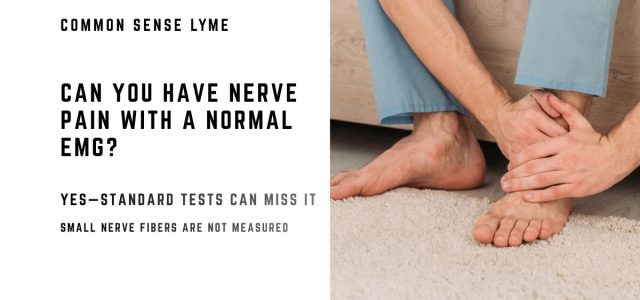
Burning Pain With Normal EMG: Understanding the Disconnect
Severe burning pain can occur with normal nerve tests
Standard EMG studies primarily evaluate large nerve fibers
Small-fiber and autonomic involvement may require further evaluation
Few experiences are more frustrating for patients than severe burning pain paired with “normal” nerve tests.
Burning pain with normal EMG can occur in Lyme disease and is discussed alongside other multisystem symptoms in our Lyme disease symptoms guide, where patterns across nerve, muscle, and immune systems are explained in context.
Burning pain with normal EMG is a well-recognized clinical pattern, yet many patients are told that normal studies mean their symptoms are not neurologic—or worse, not legitimate.
This mismatch between severe pain and normal nerve tests is especially common in post-infectious and inflammatory neurologic conditions, including Lyme disease. The disconnect lies not in the symptoms, but in what these tests are designed to measure.
These symptoms are part of the broader pattern of chronic Lyme disease pain, which can include neuropathic, musculoskeletal, and migrating pain patterns.
In simple terms, burning pain can occur even when standard nerve tests are normal because the nerves responsible for pain are not the same ones those tests assess.
What EMG and Nerve Conduction Studies Measure
EMG and nerve conduction studies evaluate large myelinated motor and sensory nerve fibers. These fibers control muscle strength, reflexes, and vibration or position sense. When they are damaged, EMG/NCS testing often shows clear abnormalities.
Burning, stinging, electric, or raw pain, however, is typically transmitted by small sensory nerve fibers. These fibers regulate pain perception, temperature sensation, and aspects of autonomic function such as sweating and blood flow.
Standard EMG and nerve conduction studies do not reliably assess these fibers. As a result, a patient can experience intense neuropathic pain while large-fiber studies remain completely normal.
Because EMG and nerve conduction studies are widely available and objective, they are often treated as definitive. When results are normal, clinicians may stop looking—even though the most relevant nerve fibers were never tested.
Why Burning Pain Feels Severe Even When Tests Are Normal
Burning pain is often assumed to reflect nerve destruction. In many patients, the opposite is true. The nerves are present and intact—but overactive or misfiring.
Inflammation, immune activation, or post-infectious changes can lower the threshold at which pain signals fire. Sensory nerves begin transmitting danger signals in the absence of tissue damage.
Inflammatory signaling molecules—including cytokines and chemokines—play a central role in this process. These molecules can increase the sensitivity of sensory neurons and activate microglia within the central nervous system, amplifying pain signaling and lowering the threshold for discomfort—a process known as central sensitization.
This mechanism helps explain why burning, stinging, or electric pain can persist even when imaging and nerve conduction studies are normal.
In these cases, the problem is not structural nerve damage but altered signaling within the nervous system.
This process overlaps with neuroinflammation in Lyme disease, where immune activation affects how the brain and nerves process sensory input.
This type of burning pain is one example of how Lyme disease pain behaves differently from typical nerve injuries, often occurring even when standard tests appear normal.
Why Symptoms Fluctuate and Migrate
Patients often report that burning pain moves from one area to another, worsens at night, or intensifies with stress, heat, or fatigue. These features further complicate the diagnostic process.
Such variability is characteristic of functional sensory dysregulation rather than structural nerve loss.
Autonomic involvement can amplify blood flow changes, skin temperature shifts, and sensory sensitivity—causing symptoms to wax and wane without leaving a fixed footprint on standard testing.
Some patients may feel temporarily improved before symptoms flare again during illness, stress, overexertion, or poor sleep. This fluctuating pattern is common in Lyme disease and other post-infectious neurologic conditions.
How Lyme Disease Can Cause Burning Pain With Normal EMG
In Lyme disease, burning pain may arise from immune-mediated sensory nerve irritation, neuroinflammation, or autonomic nervous system involvement rather than from large-fiber nerve damage.
This pattern is frequently seen in patients with Lyme disease and other post-infectious conditions, where symptoms are driven by immune and nervous system dysregulation rather than structural nerve injury.
Small sensory fibers—responsible for pain and temperature perception—can become hypersensitive following infection. Because these fibers are not reliably assessed by EMG or nerve conduction studies, patients may be told their tests are normal even as symptoms persist.
For many, this leads to dismissal rather than further investigation.
Why Burning Pain Can Persist Despite Normal Results
Normal EMG/NCS results are often interpreted as reassurance. While they rule out certain conditions, they do not exclude neuropathic pain syndromes.
When burning pain is dismissed because tests are normal, patients may be misdirected toward psychological explanations instead of receiving appropriate neurologic or autonomic evaluation.
Normal test results do not invalidate pain—they define the limits of the tools being used.
When Does Small-Fiber Neuropathy Require a Skin Biopsy?
A skin biopsy may be useful when persistent burning, tingling, electric pain, altered temperature sensation, or autonomic symptoms suggest small-fiber neuropathy, but the examination and EMG or nerve conduction studies do not explain the symptoms.
The biopsy measures intraepidermal nerve fiber density from small samples of skin. Reduced density provides objective support for small-fiber neuropathy and may be helpful when confirming the diagnosis would change the evaluation or management. It does not, by itself, identify the cause. Clinicians may still need to evaluate for diabetes or impaired glucose tolerance, vitamin deficiencies, thyroid disease, autoimmune disorders, medication effects, infections, and other contributors.
A skin biopsy is not required for every patient with burning pain. It may add little when another diagnosis already explains the symptoms or when the result would not change care. Depending on the symptom pattern, autonomic testing or quantitative sensory testing may also be considered.
A normal biopsy does not completely exclude small-fiber neuropathy, particularly when symptoms are early, patchy, or non-length-dependent. Results should be interpreted alongside the history, examination, and other testing. Repeat biopsy is not routinely needed simply to monitor symptoms or treatment response.
Frequently Asked Questions
Can EMG testing miss nerve pain?
Yes. EMG primarily evaluates large nerve fibers. Burning or neuropathic pain is often transmitted by small sensory fibers.
Does a normal EMG mean the pain is psychological?
No. A normal EMG does not rule out neuropathic pain or autonomic dysfunction.
Can Lyme disease cause burning pain with normal EMG results?
Yes. Lyme disease can affect small sensory and autonomic nerve fibers, producing burning pain despite normal testing.
Does small-fiber neuropathy always require a skin biopsy?
No. A skin biopsy may provide objective support when symptoms suggest small-fiber neuropathy but EMG and nerve conduction studies are normal. It is most useful when confirming the diagnosis would change the evaluation or management. A normal biopsy does not completely exclude small-fiber neuropathy.
Clinical Takeaway
Burning pain with normal EMG is not a contradiction—it reflects the limits of large-fiber nerve studies and highlights the role of small sensory and autonomic nerve dysfunction. Recognizing this pattern helps prevent dismissal and supports more accurate, individualized care.
Normal EMG results do not exclude neuropathic pain, particularly when symptoms involve small sensory fibers that are not captured by standard nerve conduction studies.
Related Articles
These articles explore small-fiber symptoms, neuropathy, persistent pain, and related neurologic patterns.
Small Fiber Neuropathy and Lyme Disease
Lyme Disease Neuropathy
Burning and Tingling in Lyme Disease
Persistent Lyme Disease Overview
References
- Erdogan O, Hu XQ, Chiu IM. Sensory Neurons on Guard: Roles in Pathogen Defense and Host Immunity. Curr Opin Immunol. 2025.
- Lauria G, Hsieh ST, Johansson O, et al. European Federation of Neurological Societies/Peripheral Nerve Society guideline on the use of skin biopsy in the diagnosis of small fiber neuropathy. Eur J Neurol. 2010;17(7):903–912.
Dr. Daniel Cameron, MD, MPH
Lyme disease clinician with over 30 years of experience and past president of ILADS.
Symptoms • Testing • Coinfections • Recovery • Pediatric • Prevention


Do you provide telehealth visits? What is the cost? Do you take BCBS insurance?
You should direct your questions with my office