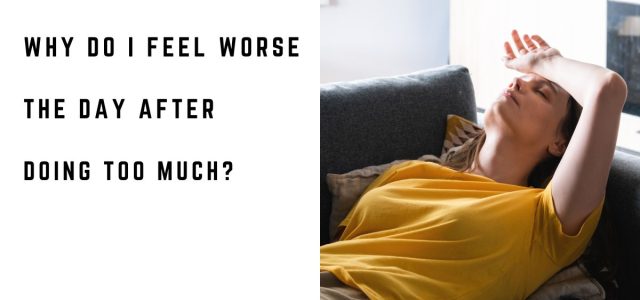
Why Do I Feel Worse the Day After Doing Too Much?
Symptoms may not worsen until hours after activity
Physical and mental exertion can both contribute
A delayed crash may sometimes signal more than ordinary fatigue
You get through a busy day. Maybe you walk farther than usual, run errands, exercise, work for several hours, attend a social event, or spend a long time concentrating. You may even feel reasonably well while you are doing it.
Then the next morning arrives—and you feel much worse.
Fatigue may be heavier. Your thinking may feel slower. Pain, headache, dizziness, weakness, or sensitivity to light and noise may become more noticeable. Some people describe the experience simply as a “crash.”
Feeling worse the day after doing too much can happen for several reasons. Sometimes it reflects ordinary recovery from an unusually demanding day. In other cases, delayed symptom worsening may be associated with migraine, sleep disruption, autonomic dysfunction, an underlying illness, or a pattern known as post-exertional malaise (PEM) or post-exertional symptom exacerbation (PESE).
Why Can Symptoms Be Delayed Until the Next Day?
We often expect our bodies to tell us immediately when we have exceeded our limits. That does not always happen.
During activity, attention, motivation, stress responses, and the demands of the task itself may make symptoms less noticeable. The full impact of the activity may become apparent only later, particularly after the person stops or tries to recover.
Muscles may become sore after unfamiliar exertion. A long or demanding day may interfere with sleep. Prolonged standing may aggravate circulatory or autonomic symptoms. Mental concentration may contribute to cognitive fatigue. Migraine symptoms may emerge after accumulated sensory or physiologic stress.
This means the activity that contributed to today’s symptoms may have happened yesterday.
Doing “Too Much” Does Not Always Mean Exercise
One of the most important points is that exertion is not limited to a workout.
A demanding day can include physical, cognitive, sensory, emotional, and social activity. Grocery shopping, driving, working at a computer, concentrating through meetings, having a long conversation, standing for extended periods, traveling, or spending time in a noisy environment can all require energy.
For someone who is healthy and well rested, these demands may be easy to tolerate. During illness or recovery, however, the same activities may require substantially more effort.
Patients experiencing brain fog and cognitive dysfunction, for example, may find that prolonged concentration requires considerably more mental effort than it once did.
Ordinary Tiredness and a Next-Day Crash Are Not Always the Same
It is normal to feel tired after an unusually active day. A long hike, strenuous workout, poor night’s sleep, or physically demanding project can leave almost anyone sore or fatigued the following morning.
Ordinary recovery usually makes sense in proportion to the activity. The person gradually feels better with sleep, food, hydration, and rest.
A more concerning pattern is when relatively modest activity produces a disproportionate worsening of multiple symptoms.
Instead of simply having tired muscles, a person may develop a combination of profound fatigue, brain fog, headache, dizziness, pain, sleep disturbance, sensory sensitivity, weakness, or a flu-like feeling. The symptoms may also last much longer than expected.
What Is Post-Exertional Malaise?
Post-exertional malaise, or PEM, describes a worsening of symptoms following physical or mental exertion that would previously have been tolerated. The term post-exertional symptom exacerbation, or PESE, is also used.
The delayed timing is particularly important. The Centers for Disease Control and Prevention notes that symptoms in people with ME/CFS typically worsen 12 to 48 hours after activity and may last for days or even weeks.
NICE similarly describes PEM as symptom worsening that may be delayed by hours or days, can be disproportionate to the activity, and may require a prolonged recovery.
PEM is a characteristic feature of myalgic encephalomyelitis/chronic fatigue syndrome (ME/CFS) and has also been described in some people with post-COVID conditions. However, feeling tired the day after activity does not by itself establish a diagnosis of ME/CFS or any other specific illness.
What Can a Post-Exertional Crash Feel Like?
The worsening may involve more than fatigue. Depending on the person and the underlying condition, symptoms can include:
- Profound exhaustion
- Brain fog or slowed thinking
- Difficulty concentrating
- Headache or migraine symptoms
- Muscle or joint pain
- Dizziness or lightheadedness
- Weakness or shakiness
- Unrefreshing or disrupted sleep
- Increased sensitivity to light or noise
- Flu-like feelings or generalized malaise
Some people notice symptoms later the same day. Others do not recognize the full worsening until the following morning.
Could Autonomic Dysfunction Contribute?
Sometimes the problem is not simply how far someone walked or how much exercise they performed. The amount of time spent upright can matter.
Standing and walking require continuous cardiovascular and autonomic adjustments to maintain circulation. In people with orthostatic intolerance or other forms of autonomic dysfunction, a day involving prolonged standing, heat, errands, or walking may impose a greater physiologic burden.
Symptoms can include dizziness, weakness, palpitations, nausea, brain fog, headache, and fatigue. Some patients feel worse while upright and improve after sitting or lying down. For a closer look at this pattern, see why some patients feel worse when standing.
Not everyone with these symptoms has postural orthostatic tachycardia syndrome (POTS). Dehydration, anemia, medication effects, heart rhythm disorders, orthostatic hypotension, and other medical problems may produce overlapping symptoms.
Why Mental Activity Can Matter Too
People sometimes underestimate cognitive exertion because they have not been physically active.
Reading, writing, problem-solving, working at a computer, participating in meetings, driving, studying, and sustained conversation all require attention and information processing. For someone experiencing cognitive dysfunction or recovering from illness, these tasks may be considerably more demanding than they appear.
A person may therefore spend much of the day sitting and still experience significant symptom worsening afterward.
This is one reason an activity diary can be more useful when it records mental, social, sensory, and upright activity—not just exercise.
Can Migraine Cause Delayed Worsening?
Yes. Migraine is another reason a demanding day may be followed by headache, cognitive slowing, fatigue, nausea, dizziness, or increased sensitivity to light and sound.
Sleep disruption, stress, prolonged screen exposure, bright environments, skipped meals, dehydration, and physical exertion can overlap during a busy day. The resulting symptoms may not always appear at the moment the trigger occurs.
For some patients, what feels like a generalized “crash” may therefore include a migraine or vestibular migraine component.
What About Lyme Disease and Other Infections?
Patients recovering from infections may report reduced tolerance for activity, although the mechanisms and clinical significance vary considerably among illnesses and individuals.
Some patients with Lyme disease describe fatigue, cognitive difficulties, dizziness, pain, sleep disturbance, or exercise intolerance that fluctuate with activity. Neurologic and autonomic symptoms may also make ordinary physical or cognitive demands harder to tolerate.
However, worsening after activity is not specific to Lyme disease and should not automatically be attributed to persistent infection. Other explanations—including anemia, thyroid disease, sleep disorders, medication effects, migraine, autonomic dysfunction, cardiopulmonary disease, ME/CFS, and other post-infectious conditions—may need consideration.
At the same time, there is no single test that can establish that every persistent symptom following Lyme disease represents either ongoing infection or complete microbiologic clearance. When symptoms persist or substantially change, the clinical picture may need to be reassessed rather than assuming one explanation accounts for everything.
Should You Push Through a Next-Day Crash?
That depends on why the symptoms are occurring.
Progressive exercise is appropriate in many forms of ordinary deconditioning and rehabilitation. But repeatedly pushing through significant post-exertional symptom worsening may be counterproductive for people who experience PEM.
The CDC describes activity management, often called pacing, as a strategy for people with ME/CFS to balance activity and rest while identifying their individual limits. This differs from simply avoiding all activity.
The goal is to recognize the pattern. If a certain amount or type of activity repeatedly leads to disproportionate worsening the next day, that information can help guide a more individualized approach.
Tracking Yesterday May Explain Today
When symptoms fluctuate, it can be useful to look backward rather than only asking what happened that morning.
A simple diary can record physical activity, prolonged standing, cognitive work, social activity, screen exposure, sleep, hydration, meals, stress, and symptoms over the following 24 to 48 hours.
Patterns may become easier to recognize over time. Someone may discover, for example, that a short walk is well tolerated but combining the walk with shopping, driving, standing in line, and an evening social event consistently produces a difficult next day.
This does not prove a particular diagnosis, but it can provide useful information for a clinician evaluating the problem.
When Should Next-Day Worsening Be Evaluated?
Occasional fatigue after an unusually demanding day is common. Evaluation becomes more important when the pattern is recurrent, disproportionate, prolonged, worsening, or interfering with normal activities.
It may also be appropriate to look for another explanation when activity tolerance has changed substantially from a person’s previous baseline.
New chest pain, severe shortness of breath, fainting, new focal weakness, severe confusion, or other acute neurologic symptoms warrant prompt medical evaluation rather than being assumed to represent an ordinary post-activity crash.
Frequently Asked Questions
Why do I feel worse the day after doing too much?
Symptoms can worsen the following day because the effects of physical, cognitive, sensory, or upright activity may not be immediately apparent. Poor sleep, migraine, autonomic dysfunction, ordinary recovery, or post-exertional malaise may contribute.
Can post-exertional malaise start the next day?
Yes. PEM is often delayed. In ME/CFS, symptoms commonly worsen 12 to 48 hours after activity, although the timing can vary.
Can mental activity cause a next-day crash?
Yes. Cognitive exertion such as concentrating, reading, working at a computer, driving, studying, or prolonged conversation can contribute to symptom worsening in susceptible individuals.
Does feeling worse after activity mean I have ME/CFS?
No. ME/CFS is one condition associated with post-exertional malaise, but many other problems can cause fatigue or symptom worsening after activity. Diagnosis requires a broader clinical evaluation.
Should I exercise if activity makes me feel worse the next day?
The answer depends on the underlying reason for the worsening. Exercise may help ordinary deconditioning, while people experiencing PEM may need a more individualized activity-management approach that avoids repeatedly triggering substantial symptom exacerbations.
Clinical Takeaway
Feeling worse the day after doing too much does not have one explanation. Sometimes it reflects normal recovery from an unusually demanding day. When modest activity repeatedly produces delayed and disproportionate worsening of fatigue, cognition, pain, dizziness, sleep, or other symptoms, the pattern deserves closer attention.
The activity responsible may also be less obvious than expected. Mental concentration, prolonged standing, errands, social activity, sensory stimulation, and physical exercise can all contribute to the total demands of a day.
When today’s symptoms repeatedly seem out of proportion to today’s activity, it may be worth asking what happened yesterday.
Related Articles
These articles explore related patterns involving neurologic symptoms, dizziness, and autonomic dysfunction.
Neurologic Lyme Disease Symptoms: Brain Fog, Dizziness, and More
Lyme Disease Dizziness and the Foggy Feeling
POTS in Lyme Disease: Why You Feel Worse Standing
This article is intended for educational purposes and does not replace individualized medical evaluation or treatment.
References
- Centers for Disease Control and Prevention. Manage ME/CFS. CDC. 2024.
- Centers for Disease Control and Prevention. Strategies to prevent worsening of symptoms. CDC. 2024.
- National Institute for Health and Care Excellence. Myalgic encephalomyelitis (or encephalopathy)/chronic fatigue syndrome: diagnosis and management. NICE Guideline NG206. 2021.
Dr. Daniel Cameron, MD, MPH
Lyme disease clinician with over 30 years of experience and past president of ILADS.
Symptoms • Testing • Coinfections • Recovery • Pediatric • Prevention
Related Posts