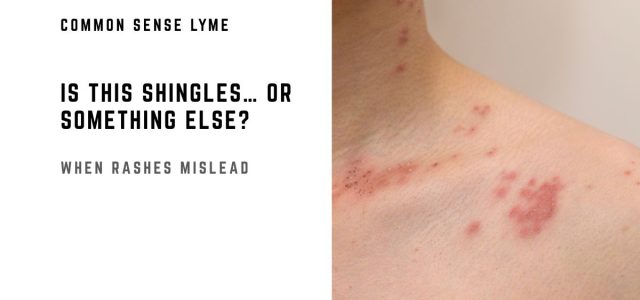
Lyme Disease Mistaken for Shingles: A Case Report
Quick Answer: Lyme disease can be mistaken for shingles when patients present with rash and nerve pain. If symptoms do not improve with antiviral treatment, Lyme disease should be considered — especially in endemic areas.
Lyme disease can sometimes be mistaken for shingles when patients present with rash and severe nerve pain. Hansen and colleagues describe a case illustrating this pattern of Lyme disease misdiagnosis, where a 62-year-old man with abdominal pain and rash was initially treated for shingles but later diagnosed with Lyme disease.
Both Lyme disease and shingles can produce rash and neuropathic pain, which may complicate diagnosis when symptoms occur outside classic patterns.
This overlap is one reason delayed Lyme disease diagnosis remains common, particularly when patients present with atypical neurologic or gastrointestinal symptoms.
Initial Presentation
The patient was admitted to the emergency department complaining of epigastric pain that had been ongoing for four to five weeks. The pain was described as constant with episodic worsening, beginning with a rash in the right upper quadrant.
Physicians considered several diagnoses. The patient had a history of migraines, anxiety, colon polyps, and gastroesophageal reflux disease. Imaging also revealed small gallbladder stones, though these were not considered acute.
Misdiagnosis and Failed Treatment
The man was diagnosed with shingles and prescribed acyclovir and pregabalin. Despite treatment, he remained ill.
His pain increased and he developed additional symptoms including nausea, lethargy, decreased appetite, constipation, decreased urinary stream, and a 5–7 kg weight loss.
Imaging and laboratory tests were negative and the patient was discharged. However, one week later he was readmitted because his general practitioner did not find it reasonable that anxiety alone could explain his symptoms.
When symptoms continue despite appropriate treatment for shingles, physicians may need to reconsider the diagnosis — particularly in patients living in Lyme-endemic regions.
Correct Diagnosis: Lyme Disease
The man lived in an area endemic for Lyme disease. Although he did not recall a recent tick bite, he reported previous tick exposure. Physicians ordered Lyme disease serologic testing.
Because his Borrelia burgdorferi IgG titers were markedly elevated and he had a history of tick bites and rash, a lumbar puncture was performed. The results were positive.
The 62-year-old man was diagnosed with Lyme disease. His symptoms, except for fatigue, resolved after a three-week course of intravenous ceftriaxone.
His weight normalized and abdominal pain largely resolved. Fatigue continued to improve gradually over time.
Some patients with Lyme disease never recall a tick bite, which can further complicate recognition and delay diagnosis. Learn more in Can You Get Lyme Disease Without a Tick Bite?
Autonomic and Neurologic Symptoms
The authors note that atypical clinical presentations of Lyme disease can occur, including gastrointestinal manifestations related to autonomic dysfunction, as was seen in this case.
Neurologic involvement can also contribute to atypical presentations, including neuropathic pain, sensory changes, dizziness, and cognitive symptoms.
Neurologic Lyme disease may affect both the central and peripheral nervous systems, producing symptoms that mimic shingles, neuropathy, anxiety disorders, or gastrointestinal illness.
Why Lyme Disease Can Be Mistaken for Shingles
Lyme disease can affect multiple body systems including the nervous system and autonomic pathways. When symptoms include rash and nerve pain, the condition may resemble shingles or other neurologic disorders.
Because Lyme disease presentations can evolve gradually, recognition may be delayed if early symptoms mimic more common conditions.
Patients may initially experience fatigue, migrating pain, tingling sensations, or cognitive symptoms before Lyme disease is recognized. These broader patterns are reviewed in the Lyme Disease Symptoms Guide.
Frequently Asked Questions
Can Lyme disease be mistaken for shingles?
Yes. Both conditions can cause rash and nerve pain, which can lead to diagnostic confusion when Lyme disease presents with atypical symptoms.
How can doctors tell the difference between Lyme disease and shingles?
Shingles typically causes a dermatomal rash and usually improves with antiviral treatment. Lyme disease may involve tick exposure, neurologic symptoms, and positive serologic testing.
What should you do if shingles treatment isn’t working?
If symptoms persist or worsen despite antiviral treatment, physicians may consider Lyme disease testing — particularly in endemic regions or when there is possible tick exposure.
Clinical Takeaway
Lyme disease can mimic shingles when patients develop rash and neuropathic pain. Persistent symptoms, negative imaging, autonomic dysfunction, or failure to improve with antiviral therapy should prompt consideration of Lyme disease — particularly in endemic areas.
When a diagnosis of shingles is not improving as expected, Lyme disease deserves consideration — especially in patients with possible tick exposure or multisystem symptoms.
Related Articles
- Lyme Disease Misdiagnosis: The Great Imitator
- Autonomic Dysfunction in Lyme Disease
- Can You Get Lyme Disease Without a Tick Bite?
- Delayed Lyme Disease Diagnosis
References
- Hansen BA, Finjord T, Bruserud O. Autonomous dysfunction in Lyme neuroborreliosis. A case report. Clin Case Rep. 2018;6(5):901-903.
Dr. Daniel Cameron, MD, MPH
Lyme disease clinician with over 30 years of experience and past president of ILADS.
Symptoms • Testing • Coinfections • Recovery • Pediatric • Prevention



Yes me too but did not resolve with ceftriaxone IV….using pure stevia leaf extract and homeopathic nosode tincture. ..getting well
Hi Cathrine.
Glad to see you had success with a more holistic treatment plan. Would you be willing to share a little more info about your lyme disease story. I’ve been sick for many years and rely solely on natural treatments. I am currently pulsing two sets of remedies every two weeks, both sets containing one remedy that attacks the parasites and a second remedy that breaks through the biofilm. I do whatever I can to detox including sweating, epsom salt baths and glutathione. I’m thinking of mixing things up a bit to rid my body of this horrific disease once and for all. Thanks for any info you care to share.
Joyce
I have had ongoing problems with my eye for 13 years. I was also diagnosed with shingles, and took 1mg of Acyclovir for years, but never got better. After many years of being misdiagnosed, undiagnosed, or accused of being delusional, I flew to VA, and was diagnosed with Chronic Lyme disease , a RMSF coinfection, and Morgellons disease. I am 47 years old, married with two children. The last 13 years of my life have (literally) been hell on earth! Because I live in GA, it is costly, and therefore causes a great financial hardship for me to fly to VA to be treated! I cannot find a Lyme literate dr in my area, and the “clinics” I have discovered use a holistic approach to this dreadful disease, AND DO NOT accept insurance. My eye, skin, and scalp are the most affected, and how it began, but I’ve developed SO many other symptoms during these years, it’s disheartening and depressing! I now have lost over 20% of my vision, joint/muscle aches, raynauds, cluster headaches, numbness and weakness in my extremities, sensitivity to all elements, brain fog, depression,’ malaise, extreme fatigue, neuralgia, and a list of othe symptoms as well. I am at the end of my rope. I am still having “flare ups”, I am still getting painful nodules on my scalp, hair loss, reoccurring fever (100 or higher), unexplained sores all over my body, hyperthyroidism, reoccurring ear aches with fluid in my ears, trouble swallowing , digestive issues, and many more symptoms. I have always exercised, I am not overweight, I quit smoking over 15 years ago, I seldom drink alcohol, and once considered myself an active, healthy, happy person. I am terrified this is going to kill me, and my family will be left without a mother and wife. I do not know where to turn, what to do, and sometimes question if I even want to continue to live with this dreadful disease,?that has basically stolen my (once happy & healthy) life. Bring a devoted Christian with a strong and everlasting faith, It’s difficult to admit this. I know my symptoms are worsening, and I feel like no one in the medical field could care less what happens to me! Mostly because almost every health care professional I’ve seen accuses me of being delusional , on drugs, inflicting myself with these symptoms or have misdiagnosed and treated me for another condition. Is there any information, insight, and/or advice you can give me to help me find a dr willing to treat my symptoms and/or at least help reduce my numerous flare ups? Thanking you in advance!
Infected in GA
Your comments reflect how difficult to get access to care. Keep working on getting better.
Oh my. I’d like to speak with you. I’m having troubling nerve pain and itch several weeks later after being diagnosed and treated for shingles. Stress brought mine on . You poor thing. Geez. Doctors think we ate crazy. Ugh.
I was diagnosed with Lymes in 2013. Initially my Dr. thought it was contact dermatitis and or costrocondritis. My symptoms were skin pain no joint pain. My skin hurt from the waist up, lost weight and fatigue before I asked my Dr to check me for Lymes.
I recently went to see a neurologist and was diaganoised with postherpetic neuralgia. Had shingles in November and reoccurred without rash in January. just the burning sensation on my skin lasting along time. I’m a 68 yr old female.I feel my immune system has been tampered from the lymes so I am refusing the vaccine. What do you think?
There are many factors that contribute to shingles. I am not aware whether a history of Lyme disease can increase the risk of shingles. You will have to work with your doctor on whether to take the shingles.
I was diagnosed with Lyme in 2012. By 2015 I was much improved. Then, I had hip problems followed by back pain. A steroid injection helped with the hip. A few months later, I received an epidural for my low back. Days after,I had a shingles outbreak at the injection site. It was not diagnosed as shingles until 2 1/2 yrs later. I had multiple treatments, surgeries, etc… They all failed. I haven’t been able to sit or stand in place for 3 yrs now. In Dec 2018, I had a huge breakout which spread across my upper butt and jumped the line. I’ve been treating shingles with antivirals, supplements, diet, etc… It has popped out 9 times since Dec. This happens while on maintenance dose and sometimes full doses of antivirals. I often wonder if the chronic lyme has made the shingles chronic now.
I have patients who suffer from Lyme disease and another illness at the same time.
I have been treating Lyme, Bartonella, and Babesia for two years, naturopathically and with Docycycline, Azythromycin, and Flagyl, and with Chinese herbals.
Have suspected that I have had Rabbit Fever but I’m not sure if that’s been handled. I have had Herpes II for nearly 40 years, but what I thought was a herpes break out in a new location, now appears to be Shingles.
Question, is the standard MD treatment for shingles harmful to me or the herbal protocol used for treating the other infections along with heavy metals detox?
Stress is also sky high: job loss and job hunting, moving in with my partner in a new state, the holiday season upon us with a complex trauma history involving, Santa-suited perpetrators.
(What could get worse, has with this shingles.)
My blog addressed the misdiagnosis of shingles. Your doctor will have to determine the best treatment.
I had Lyme disease 14 years ago and treated it immediately. Never seem to have any issues after that. Now I have reoccurring shingles and was wondering if it could be from the Lyme disease. No one can really figure it out but the shingles are quiet painful. I have had shingles at least six times. Anyone else have this issue?
Yes! I have had shingles 10 times now. I also had Lyme disease and was treated previously(about 10 years ago), but shingles began about 2 years ago. Similarly, no traditional doc(PC, Immunologist, etc.) has figured it out yet. I’m going back to my LLMD.
I have read the Covid vaccines may reactivate the herpes viruses.
I am not vaccinated to add so I don’t think that’s a factor however the virus itself might be
some people have exposure tot the varicella-zoster virus without knowing it.
Wow really. Very interesting. I got shingles 16 months after second vaccine dose. Not to mention. I had added stress but very interesting. Do you know the reasoning behind this ?
My husband has a friend that got the C shot and broke out with a really bad case of shingles. It is said the shot brings out viruses and bacterial infections that lay dormant.
Could be. If you read a fair amount about covid the genome sequencing evidently has been studied as part of determining it’s mutation from bats to human hosts and it has been highly suspicious to have been designed with a section of HIV as part of it. Some docs are saying if recurring issues you should be tested for HIV
Yes me too! I was diagnosed and treated for Lymes disease two years ago and now I get the shingles every other few months around my menstral cycle ! I’ve had it probably 12 times in the past two years
Yes. My lymes has only been inactive for 17 months though. I get reoccurring shingles. I had shingles 6 times in 2022. I’ve had it once in 2023 already. My doctor said it’s because my body is still recovering from lymes. He said it won’t happen as much as time goes by and my body recovers. The fact it’s been 14 years for you is concerning. I keep antivirals on hand. The doctor wants me to take a small dose as a preventative because I get shingles in my eye but I can’t stay on them because I start reacting to the medicine.
Diagnosed with shingles. A few days later a red area – not a rash just red. Above shingles appeared. As the red area increased in size a blueish purpleish ring developed inside the outer edge of circle. First set of lyme labs came back, inconclusive. Second set of labs came back several weeks after shingles and red went away – none shown. I did find a tick on my back. Not embedded in skin just crawling. No bite marks on back, arms, neck, legs, chest. What is your thought?
It can be a challenge to determine the cause of some rashes. I prefer to include an antiviral medication if shingles is a consideration. As many as 3 out of 4 patients with Lyme disease do not recall a tick bite. I followup my patient to look for a tick borne illness of to rule out other illnesses.
About a month ago, I swept a biting bug off my lower calf area. A few days later, a red mark that looked like a burn mark appeared, followed a week later by a diffused ring with a red dot at the center. I did a test for lymes but it was negative. Over the next couple of weeks I had joint aches and a month later had uncomfortable burning under the skin on the right side, mid abdomen. It did feel similar to a mild shingles outbreak I had about 15 years ago. My doctor has left it up to me to decide if I want to do a three week course of doxycycline. At issue is a history of severe side effects of this antibiotic due diagnosed IBS.
I’m not sure which way to go.
It can be difficult to be sure a rash is Lyme disease. The tests for Lyme disease can be negative particularly early in the illness. I take an illness after a rash serious in my patients. It sounds as if you have a doctor who is willing to treat to be on the safe side even if there are risks of stomach upset.
Yep nursing homes in NSW Australia are all jabbed up for covid and shingles,and wouldn’t U know everyone’s got covid and shingles
Problem is I’m 38 haven’t had a jab in 15 years and I have just got a raging case of shingles
As have other purebloods in my area
Also lots of jabbed people getting Lyme disease too
It’s a buffet of sickness these days