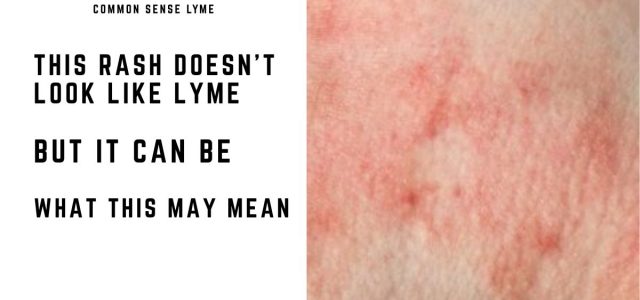
Atypical Lyme Disease Rash: When It’s Mistaken for Shingles or Cellulitis
An atypical Lyme disease rash doesn’t always look like a bull’s-eye. It may resemble shingles, cellulitis, or even a serious skin infection—leading to delayed diagnosis and treatment.
Quick answer: Lyme disease rashes can appear in many forms. When a rash doesn’t respond to standard treatment or continues to evolve, Lyme disease should be considered—even if testing is negative.
Many patients with atypical Lyme disease rash do not recall a tick bite or develop a classic bull’s-eye lesion.
For a broader overview of symptom patterns, see Lyme disease symptoms guide.
Case Example: Lyme Rash Misdiagnosed as Shingles and Cellulitis
Suzuki and colleagues describe a 43-year-old woman from Wisconsin who developed pink papules behind her knee after gardening.
Over several days, the rash evolved into painless vesicles with surrounding faint erythema. She also developed fever, chills, neck pain, and malaise.
Multiple Misdiagnoses: When Lyme Disease Is Missed
Shingles (Herpes Zoster)
Doctors initially suspected shingles and treated her with valacyclovir, but her symptoms worsened.
Some Lyme disease rashes are mistaken for shingles because both conditions can produce painful or blistering skin lesions.
Cellulitis
She was then treated with antibiotics including ceftriaxone, cephalexin, and trimethoprim-sulfamethoxazole—without improvement.
Progressive Skin Infection Concern
Her worsening symptoms eventually led to evaluation for a potentially serious skin infection. At that time, she had a fever of 101.3°F and lymphadenopathy.
This pattern reflects a broader issue explored in Lyme disease misdiagnosis: why it happens.
Correct Diagnosis: Early Lyme Disease
Ultimately, she was diagnosed clinically with early Lyme disease presenting as bullous erythema migrans.
Despite negative lab testing, the diagnosis was based on:
- Geographic risk (Wisconsin)
- Outdoor exposure (gardening)
- Progressive rash
- Lack of response to prior treatments
She was treated with doxycycline for 10 days, and the rash resolved.
Why an Atypical Lyme Disease Rash Is Often Misdiagnosed
An atypical Lyme disease rash does not always resemble the classic bull’s-eye.
It may appear as:
- Blisters or vesicles
- Purple or dark discoloration
- Diffuse redness
- Painful or painless lesions
Because of this variability, Lyme disease can mimic:
- Spider bites
- Shingles
- Cellulitis
For visual examples, see what a Lyme disease rash can look like.
Negative Lyme Tests in Early Infection
Laboratory testing for Lyme disease is often negative in early stages.
Antibodies take weeks to develop, meaning:
- A patient can have an active infection
- A rash may be present
- Tests can still be negative
This limitation is explained in why early Lyme disease tests can be negative.
Frequently Asked Questions
What does an atypical Lyme disease rash look like?
An atypical Lyme disease rash may appear as blisters, vesicles, diffuse redness, purple discoloration, or painful skin lesions rather than a classic bull’s-eye rash.
Can Lyme disease rash look atypical?
Yes. An atypical Lyme disease rash may include vesicles, blisters, or discoloration rather than a bull’s-eye pattern.
Why is atypical Lyme disease rash often misdiagnosed?
Because it can mimic other conditions such as shingles, cellulitis, or spider bites.
What conditions can be mistaken for shingles?
Several conditions can mimic shingles, including atypical Lyme disease rash, cellulitis, spider bites, and other inflammatory skin conditions.
Can Lyme disease tests be negative with a rash?
Yes. Early Lyme disease frequently produces negative antibody tests.
Related Reading
Clinical Perspective and Takeaway
I become concerned when patients are diagnosed with shingles or cellulitis before Lyme disease is considered—especially in endemic areas.
When a rash does not respond to standard treatment—or continues to evolve—Lyme disease should remain on the differential diagnosis, even if laboratory testing is initially negative.
For next steps in recovery, see recovery from Lyme disease.
References
-
- Suzuki H, Carlson JR, Matsumoto E. 43-Year-Old Female With Fever and Bullous Skin Lesion. Clin Infect Dis. 2020;71(10):2763-2764.
- Khanna S, Goebel LJ. Atypical Lyme Disease Rash: A Case Report. Cureus. 2024;16(2):e54779.
- Franco-Avecilla D, Yeung C, Baranchuk A. Lyme carditis presenting with an atypical rash. CMAJ. 2020;192(21):E584.
Dr. Daniel Cameron, MD, MPH
Lyme disease clinician with over 30 years of experience and past president of ILADS.
Symptoms • Testing • Coinfections • Recovery • Pediatric • Prevention

I was recently bitten by Lone Star tickle and 3 days later am covered with hives!