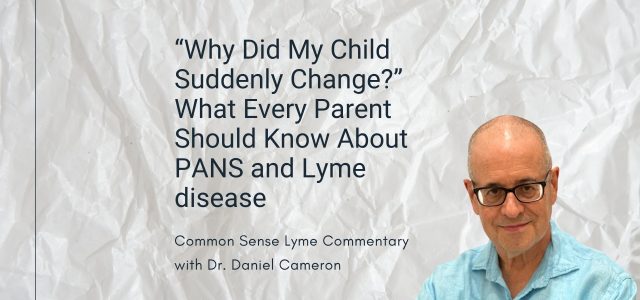
Why Did My Child Suddenly Change? PANS, PANDAS, and Lyme Disease in Children
CHILD CHANGED OVERNIGHT?
IT MAY NOT BE “JUST BEHAVIOR”
Can sudden behavioral changes in children be caused by infection?
Quick Answer: PANS, PANDAS, and infections such as Lyme disease can trigger sudden neuropsychiatric symptoms in children, including anxiety, OCD, mood changes, and cognitive difficulties.
Clinical Insight: When symptoms begin abruptly—especially after illness or possible exposure—an infection-triggered immune response should be considered, even if initial evaluations are inconclusive.
PANS, PANDAS, and Lyme disease can trigger sudden neuropsychiatric symptoms in children. Understanding these conditions can help families seek the right evaluation and treatment.
One of the most distressing things a parent can witness is a sudden, unexplained change in their child.
Sudden behavioral or cognitive changes in children can sometimes be linked to conditions such as PANS, PANDAS, or infections including Lyme disease.
A once joyful, focused child may become anxious, obsessive, withdrawn, or even aggressive. They may stop eating, have trouble sleeping, or begin experiencing panic attacks or irrational fears. Some children develop tics, sensory overload, or even hallucinations.
You’re told it’s a phase. Maybe stress. Maybe behavioral. But sometimes, it’s not that simple.
Sometimes it’s PANS or PANDAS.
What Are PANS and PANDAS?
PANS stands for Pediatric Acute-onset Neuropsychiatric Syndrome.
PANDAS refers to Pediatric Autoimmune Neuropsychiatric Disorders Associated with Streptococcal infections.
Both are clinical diagnoses used when children experience a sudden and severe onset of neuropsychiatric symptoms — including OCD, anxiety, mood swings, tics, cognitive issues, and disrupted sleep.
In PANDAS, the trigger is strep. In PANS, triggers can include a range of infections — including Lyme disease and Babesia.
The National Institute of Mental Health describes how infection-triggered immune responses may contribute to abrupt neuropsychiatric symptoms in children.
What Triggers PANS?
Beyond strep, triggers can include:
- Lyme disease (Borrelia burgdorferi)
- Babesia
- Viruses such as influenza, Epstein-Barr virus, or COVID-19
- Other bacterial infections
- Metabolic or allergic stressors
Often, multiple factors interact—an infection, immune stress, or environmental trigger.
What Symptoms Should Raise Concern?
- Sudden-onset OCD or anxiety
- Rage episodes or mood swings
- Tics
- Sensory sensitivities
- Brain fog or cognitive problems
- Food restriction
- Sleep disruption
- Hallucinations or paranoia
- Frequent urination or regression
Many families describe the change as immediate: “My child was fine… and then something flipped.”
Some children develop symptoms similar to brain fog seen in Lyme disease.
The Role of Lyme Disease and Babesia
In tick-endemic areas, Lyme disease and Babesia should be considered.
These infections may contribute to immune activation and inflammation affecting the nervous system.
Babesia may worsen fatigue, sleep disturbance, and cognitive symptoms.
In children with exposure risk, clinicians may consider evaluation for pediatric Lyme disease and coinfections.
These patterns may overlap with broader challenges seen in delayed Lyme diagnosis, where symptoms evolve and are not immediately recognized.
Some children also develop problems involving the autonomic nervous system.
Why These Children Are Sometimes Misdiagnosed
Symptoms may resemble anxiety, ADHD, or behavioral disorders.
Children are often referred for psychiatric care without a full medical evaluation.
Lyme disease and infections may be missed, especially without a known tick bite or rash.
This can lead families to feel that no clear explanation exists—even when symptoms persist.
In some cases, parents are told there is nothing more that can be done, despite ongoing changes in their child.
How I Evaluate Children With Possible Infection-Triggered PANS
- Detailed symptom timeline
- Exposure history
- Assessment for autonomic dysfunction
- Evaluation for Lyme and Babesia
- Collaboration with therapists and schools
- Family education
I have described a case of a child with PANDAS and Lyme disease whose symptoms improved after treatment.
Recovery Is Possible
Many children recover and return to baseline with proper treatment and support.
Progress may not be linear, but improvement is possible.
A Word to Parents
If your child changed overnight—and no one can explain why—trust your instincts.
PANS, PANDAS, Lyme disease, and Babesia are real and can affect both behavior and cognition.
The symptoms may look psychological, but the root cause may be medical.
You know your child. You are not alone.
Related Reading
- Brain Fog in Lyme Disease
- Autonomic Dysfunction and Lyme Disease
- Babesia and Lyme Coinfections
- Case Report: PANDAS and Lyme Disease in a Child
Dr. Daniel Cameron, MD, MPH
Lyme disease clinician with over 30 years of experience and past president of ILADS.
Symptoms • Testing • Coinfections • Recovery • Pediatric • Prevention