Larval Ticks and Lyme Disease: Are They a Hidden Risk?
Larval ticks and Lyme disease risk may be underestimated. A study published in Parasites & Vectors suggests that larval tick bites—often unnoticed—may contribute to transmission of Borrelia infections.
Researchers found that larvae of Ixodes ricinus can transmit Borrelia afzelii and Borrelia miyamotoi to rodents. :contentReference[oaicite:0]{index=0}
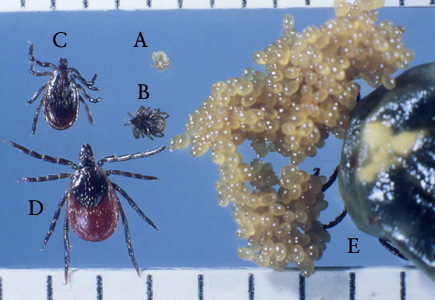
Larva (A), nymph (B), adult male (C), adult female (D), and engorged female (E) of Ixodes scapularis. (CDC)
Why Larval Tick Bites May Be Overlooked
Larval ticks are extremely small and their bites often go unnoticed. In the Netherlands, individuals experience an estimated 30,000 larval bites annually out of 1.1 million total tick bites.
Because larvae are typically not considered infectious, these exposures may be underestimated in clinical practice.
Implications for Lyme Disease Prevention
“Larval transmission of Borrelia miyamotoi has implications for checking for ticks and continuing tick precautions even after the risk of Lyme disease has abated,” says Peter Krause, MD. [2]
The authors conclude that these findings challenge the long-held belief that larval ticks do not transmit Lyme disease.
If confirmed in humans, larval tick transmission could change how clinicians assess tick exposure and how patients approach prevention.
Read more in this related post: Larval ticks may be a threat after all
References:
1. van Duijvendijk G et al. Parasites & Vectors, 2016.
2. Krause PJ et al. Clin Microbiol Infect, 2015.
Dr. Daniel Cameron, MD, MPH
Lyme disease clinician with over 30 years of experience and past president of ILADS.
Symptoms • Testing • Coinfections • Recovery • Pediatric • Prevention



I’m looking for evidance of transmission from other vectors.
And also body fluids.
Your help is appreciated!
There are reports that other vectors harbor pathogens seen in ticks. These researchers have not been able to prove that these pathogens are transmitted via a bite of another vector. I am not familiar with the literature. Again, it is difficult to prove infection even if tests of other fluids are positive e.g PCR research.