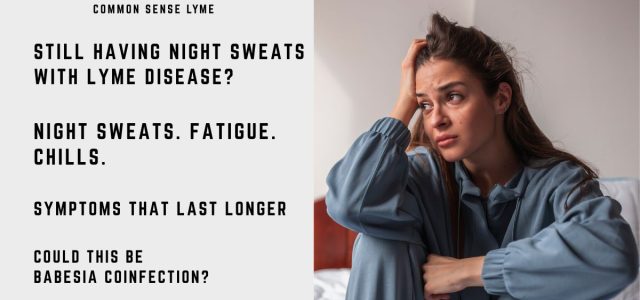
Lyme Disease Night Sweats: Could It Be Babesia?
Night sweats can occur with Lyme disease and Babesia.
Coinfection often leads to more severe illness.
Persistent sweats should prompt evaluation for Babesia.
Lyme disease night sweats can occur with Lyme disease itself, but they may also suggest Babesia coinfection, particularly when accompanied by fever, chills, fatigue, anemia, or a delayed response to treatment. Because several tick-borne illnesses can produce similar symptoms, clinicians should consider the possibility of coinfection when recovery is slower or more severe than expected.
The landmark study by Krause and colleagues, published in the Journal of the American Medical Association, examined patients with concurrent Lyme disease and Babesia infection. Although the investigators did not distinguish between daytime and nighttime sweating, they reported that patients commonly experienced fatigue (81%), headaches (77%), fever (58%), chills (42%), muscle aches (38%), anorexia (31%), joint pain (27%), emotional lability (23%), and neck stiffness (23%).
Can Lyme disease cause night sweats?
Yes. Night sweats can occur in Lyme disease, but they are not specific to Lyme disease alone. Sweating may also occur with Babesia, Anaplasmosis, viral illnesses, autoimmune disorders, menopause, medication reactions, endocrine disorders, and other medical conditions.
In Krause’s study, approximately 22% of patients with Lyme disease alone reported sweats. Sweats were more common among patients with Babesia infection and those coinfected with both Lyme disease and Babesia.
Can Lyme disease cause excessive sweating or hot flashes?
Some patients describe profuse sweating, hot flashes, or episodes of excessive sweating rather than classic night sweats. These symptoms are not unique to Lyme disease but may occur with Lyme disease, Babesia, autonomic dysfunction, fever, menopause, medication side effects, or other medical conditions. Persistent or unexplained sweating deserves medical evaluation.
Why Babesia should be considered
Babesia is a malaria-like parasite transmitted by Ixodes ticks. It can cause fever, chills, sweats, fatigue, headache, muscle aches, anemia, shortness of breath, and prolonged illness. Babesia should be considered whenever Lyme disease symptoms appear unusually severe, persistent, or atypical.
Krause and colleagues found that patients coinfected with Lyme disease and Babesia were significantly sicker and remained ill longer than patients with Lyme disease alone.
- “Thirteen (50%) of 26 co-infected patients were symptomatic for 3 months or longer compared with 7 (4%) of the 184 patients with Lyme disease alone from whom follow-up data were available (P<.001).”
- “Patients co-infected with Lyme disease experienced more symptoms and a more persistent episode of illness than did those experiencing babesial infection alone.”
- “Circulating spirochetal DNA was detected more than 3 times as often in co-infected patients as in those with Lyme disease alone (P=.06).”
They were also more likely to develop clinical illness than patients infected by either organism alone. As Krause noted, “The presence of both agents tends to synergize a variety of other symptoms as well, especially headache, chills, and sweats.”
“Although not all patients experience severe illness, co-infection generally results in more intense acute illness and a more prolonged convalescence than accompany either infection alone.”
The investigators also observed that Babesia treatment was frequently delayed because the diagnosis was often not initially recognized.
Babesia often affects immunocompetent patients
Babesia is frequently associated with immunocompromised patients, but Krause’s study demonstrated that many affected individuals were otherwise healthy.
“Although three of the Babesia-infected subjects had a history of pre-existing malignancy, no other evidence of immunosuppression was noted in any of the other subjects in the study.”
Babesia cases continue to increase throughout the Northeastern United States, increasing the likelihood that clinicians will encounter patients with coinfection.
Diuk-Wasser and colleagues estimated that as many as 40% of patients with Lyme disease may have concurrent Babesia infection in some endemic regions.
“Physicians caring for patients with moderate to severe Lyme disease should consider obtaining diagnostic tests for babesiosis and possibly other tick-borne pathogens… especially in patients experiencing atypical Lyme disease or delayed response to therapy.”
Testing for Babesia can be challenging
Clinicians should avoid relying solely on blood smear examination because parasites are frequently absent or difficult to detect.
Krause noted that “parasites frequently cannot be seen in blood films.”
PCR testing, antibody testing, blood smear examination, and newer molecular techniques each have strengths and limitations. Repeat testing may occasionally be necessary when clinical suspicion remains high despite initially negative results.
When evaluating suspected Babesia, physicians should interpret laboratory results together with the patient’s symptoms, exposure history, and clinical course.
Treatment differs from Lyme disease
Recognizing Babesia is important because treatment differs from treatment for Lyme disease.
For most patients with mild to moderate babesiosis, the preferred treatment is atovaquone plus azithromycin.
Patients with severe disease—including those with significant hemolysis, organ dysfunction, or high-grade parasitemia—may require hospitalization, intravenous therapy, exchange transfusion in selected cases, or treatment with clindamycin plus quinine.
“For the treatment of babesiosis, a regimen of atovaquone and azithromycin is as effective as a regimen of clindamycin and quinine and is associated with fewer adverse reactions.”
Newer agents such as tafenoquine have also been investigated for babesiosis in selected situations. However, its role remains limited, and it is not considered standard first-line therapy. Tafenoquine requires G6PD testing before use because of the risk of hemolytic anemia in patients with G6PD deficiency.
A patient treated only for Lyme disease may continue to experience night sweats, fever, chills, fatigue, or relapsing symptoms if Babesia is also present and has not been adequately treated.
Sweats are helpful but not diagnostic
Although night sweats can be an important clue, they are not diagnostic of Babesia. In the Krause study, 46% of patients with Babesia reported sweats, meaning that more than half either did not report sweats or the symptom was not prominent.
Likewise, sweats are not unique to Babesia. Krause and Ramsey found that approximately 22% of patients with Lyme disease and 37.5% of patients with Anaplasmosis also reported sweats.
When evaluating patients with suspected Babesia, physicians should consider the entire clinical picture—including fever, chills, fatigue, anemia, shortness of breath, laboratory findings, tick exposure, and response to treatment—rather than relying on a single symptom.
Other causes of night sweats
Night sweats have many possible causes. According to Mold and colleagues, nighttime sweating has been associated with menopause, malignancies, autoimmune diseases, endocrine disorders, medication side effects, and numerous infections.
Patients with persistent or unexplained night sweats should undergo a careful medical evaluation, particularly if they also have weight loss, persistent fever, swollen lymph nodes, chest symptoms, anemia, or prolonged fatigue.
Frequently Asked Questions
Can Lyme disease cause night sweats?
Yes. Night sweats can occur in Lyme disease, but they are not specific to Lyme disease. They may also occur with Babesia, Anaplasmosis, viral infections, menopause, autoimmune diseases, medication reactions, and other medical conditions.
Are night sweats a sign of Babesia?
Night sweats may raise suspicion for Babesia, particularly when accompanied by fever, chills, fatigue, anemia, headache, or delayed recovery after treatment for Lyme disease. However, many patients with Babesia do not report night sweats.
Can Babesia cause night sweats without fever?
Yes. Although fever is common, some patients report sweats, fatigue, or other nonspecific symptoms without persistent fever. Babesia should be considered in the appropriate clinical setting even when fever is absent.
Can Lyme disease and Babesia occur together?
Yes. Both infections are transmitted by Ixodes ticks. Coinfected patients may experience more severe symptoms and a longer recovery than patients with Lyme disease alone.
Why might Lyme disease treatment not stop night sweats?
If Babesia or another tick-borne coinfection is present, treatment directed only at Lyme disease may not resolve persistent sweats. Babesia requires antiparasitic therapy rather than Lyme disease antibiotics alone.
Clinical Perspective
Night sweats are one of several symptoms that may suggest Babesia coinfection in patients with Lyme disease, particularly when accompanied by fever, chills, fatigue, anemia, or an unexpectedly prolonged recovery.
Because Babesia requires treatment different from Lyme disease, recognizing coinfection can have important therapeutic implications. While night sweats alone are not diagnostic, they should prompt clinicians to broaden the differential diagnosis rather than assuming Lyme disease is the sole explanation.
Clinical Takeaway
Lyme disease night sweats may occur with Lyme disease itself, but they should also raise suspicion for Babesia, especially in endemic areas or when illness is unusually severe or prolonged.
Krause and colleagues demonstrated that patients coinfected with Lyme disease and Babesia experienced more severe illness and longer recovery than patients with Lyme disease alone. Early recognition of Babesia may allow timely diagnosis and appropriate antiparasitic treatment.
Persistent night sweats should prompt clinicians to consider Babesia, particularly when Lyme disease symptoms are unusually severe, prolonged, or fail to improve as expected.
Related Articles
Continue learning about Lyme disease and Babesia:
- Babesia Symptoms, Testing, and Treatment
- Tick-Borne Coinfections
- Lyme Disease Symptoms Guide
- Recovery From Lyme Disease
- Persistent Lyme Disease Overview
References
- Homer MJ, Aguilar-Delfin I, Telford SR 3rd, Krause PJ, Persing DH. Babesiosis. Clin Microbiol Rev. 2000;13(3):451-469.
- Krause PJ, Telford SR 3rd, Spielman A, et al. Concurrent Lyme disease and babesiosis. Evidence for increased severity and duration of illness. JAMA. 1996;275(21):1657-1660.
- Krause PJ, McKay K, Thompson CA, et al. Disease-specific diagnosis of coinfecting tickborne zoonoses: babesiosis, human granulocytic ehrlichiosis, and Lyme disease. Clin Infect Dis. 2002;34(9):1184-1191.
- Mold JW, Holtzclaw BJ, McCarthy L. Night sweats: a systematic review of the literature. J Am Board Fam Med. 2012;25(6):878-893.
- Ramsey AH, Belongia EA, Chyou PH, Davis JP. Appropriateness of Lyme disease serologic testing. Ann Fam Med. 2004;2(4):341-344.
- Krause PJ, Lepore T, Sikand VK, et al. Atovaquone and azithromycin for the treatment of babesiosis. N Engl J Med. 2000;343(20):1454-1458.
- Diuk-Wasser MA, Vannier E, Krause PJ. Coinfection by Ixodes tick-borne pathogens: ecological, epidemiological, and clinical consequences. Trends Parasitol. 2016;32(1):30-42.
Dr. Daniel Cameron, MD, MPH
Lyme disease clinician with over 30 years of experience and past president of ILADS.
Symptoms • Testing • Coinfections • Recovery • Pediatric • Prevention
My husband was diagnosed with Lyme disease about 3 years ago…….although a bulls eye was never noticed on him, we feel he had it for considerable time before being diagnosed. He had one month of antibiotics and did well for about 4 months……He has had occasional night sweats and high debilitating fevers. Now he is dealing with body sweats throughout the day. His physician did a repeat testing for Lyme and it was negative. I am at my wits end as to how to help him….soo many doctors insist he is cured and he is not! I notice mood swings….memory loss…concentration issues….At 71 he still works a full 60 hours per week, but I do not know how he does it…..he was tested for coinfections and the test also was negative…..where do we turn?
Doctors are divided over whether to use clinical judgement when testing negative. You may need to consider treatment for Babesia given the sweats. You should also rule out other illnesses.
Same thing happened to me. My Lyme doctor told me I was cured, but I was having crazy heat flashes in the middle of the day, exhaustion, stiff neck, etc. I contacted dr. Zhang in nyc and went on their herbal protocol and it changed my life for the better. They told me immediately that I had Babesiosis and they could tell because a key symptom is it does not allow you to regulate your body temperature! You can do one in person consult with him or his assistant Phyllis and he/she will put him on an herbal
Protocol that costs about 300-400 a month and he will be cured within a year. Only hard part is the diet they put you on, but it’s worth having your health back. If you don’t want to go to nyc then you can also get the book “healing Lyme” by Stephen Buhner and it tells you some of the herbs that Zhang would recommend and he can order them online and self medicate. That will work too, but the diet actually speeds up the process and zhang has pharma grade herbs so I would go that route. Last piece of advice is make sure his iron count is good if he goes on the herbs..the herbs need the iron to kill the Babesiosis, I was anemic so it took a lot of extra time until I found that out..Babesiosis loves to eat the iron in the body too, so you need to take liquid supplements while killing it! That’s it..good luck and god bless.
Try to find a llmd doctor that will treat your husband for his symptoms, not blood test results-you could still have lyme desease, babasia ,bartonella with negative blood test results
It would be wonderful if you had a practice in maryland
Where do you live in Maryland?
I went to the University of Minnesota and got 2500 dollars in blood tests that all came back negative. I am at my wits end with this. Pain, Insomnia, sweats, chronic fatigue etc…I messaged my doctor about the results and asked if I should get an appointment as I had returning headaches. He told me he sent me to the specialists because he is unable to help me and to find another doctor. What???I’ve seen everyone already, at great cost to my family for the last 16 months. Tested CDC positive for Lyme. I write this as I didn’t sleep at all tonight, not uncommon anymore, pain and sweats were bad so I gave up. Is there anyone in MN that gets this?? Starting to give up but I can’t. I have to keep going for my kids. Feel so sick. Financially, emotionally and physically can’t keep this up anymore!
I grew up in Minnesota. I realize how hard it include a doctor with experience treating tick borne diseases. I have people who fly to New York reflecting the difficulty finding a doctor. You should work with local support groups or leaders to find a doctor. You may also contact the Lyme Disease Association, ILADS, or Global Lyme Alliance websites for names.
Hi Cathy, perhaps this is far too late as you commented a year+ ago…. my husband has been having the same issues and we have spent tens of thousands of dollars trying to figure out what is wrong with him. He finally went (per recommendation….. after 6+ years of issues) to Restorative Health Solutions in Edina and saw Dr . Warren. He performed a whole panel of very extensive testing for infections and co-infections. We FINALLY got an answer…. Babesia. We are waiting on the co-infection result, but suspected Lyme as well and we have an appointment this Friday…. which can’t come soon enough. In the last week the symptoms have worsened with extreme flushing/sweats during the day accompanied by chills and severe headache.
We recommended a friend to Dr. Warren as well and she has a phone consult on Friday. This has been the most frustrating, anxiety ridden journey we could have ever embarked on. It’s suspected he’s had it since he was bit in 2011. The last 3.5 years have been hell, and progressively worsening— to the point of questioning if a career and residence change is needed.
I do hope you see this and can seek some additional testing at this clinic. The Dr was very committed to finding the cause, but started with the “base” testing…. it was $1450. If additional tests were needed he would do them, but believes in only doing what is necessary to keep costs down for patients.
I often find Babesia to be the missing link in my patients who are finding it difficult to get better with treatment for other tick-borne illnesses. Commonly used antibiotics like doxycycline and amoxicillin are not effective for Babesia.
Am wondering if Cathy found the help she so much needed??
Am wondering if Cathy found the help she so much needed??
Homeopathy may help. Search for Lyme and Homeopathy and go from there.
No, it won’t. That’s a fantasy that keeps people from pursuing serious but challenging treatment.
Lymedisease.org has a Physician Finder link. You can just type your location to find an LLMD nearest to you. They also have free CME courses for physicians and nurses (AND patients!) to better educate medical professionals on current research and treatments. A lot has changed since I was first diagnosed in 2013! I am currently taking advantage of the free CME courses for my license renewal.
I was just diagnosed with Lyme but know nothing about it. Saw the red dot but honestly , if that’s the beginning why have I been getting worse since last year. Can they tell you definitively what stage it is cause I have them all
Do yourself a favor and find a REAL doctor, even remotely. I’ve struggled with it for nearly a decade…
Having almost 100 symptoms(of Lymes disease)for 3 years, the newest symptom of a few months is sweating under the soles of my feet, sweating following drinking a hot drink(also chills and touch) Imagine still no diagnosis and absolutely NOBODY taking me seriously, I mean what has to happen before somebody will DIE
I have babesia, Rocky mountain spotted and lymes for 2 years, the antibiotics are not working, I don’t have any idea what to do. The antibiotics have killed my immune system to where I can’t go out without catching something. I’m at wits end.
I am sorry to hear you are having a problems. I have patients who have benefited from a second Lyme disease opinion doctors vary in their approaches.