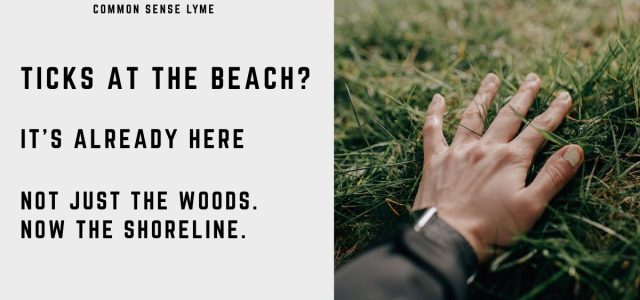
Can You Get Lyme Disease at the Beach? Ticks Are Moving to Coastal Areas
Can you get Lyme disease at the beach? Yes. Ticks are increasingly being found in coastal environments—including beaches, dunes, and shoreline trails.
Pleasure Beach in Bridgeport, Connecticut, was closed for the summer of 2025—not because of weather, but because of ticks.
Multiple species were identified, including the Asian longhorned tick, an emerging invasive species.
Ticks at the beach are now part of the Lyme disease conversation.
Ticks at the Beach: What We’re Seeing
Ticks can survive in beach environments, especially where there is:
- Dune grass
- Vegetation
- Leaf litter
- Moist coastal conditions
In my practice, I remind patients that you do not need to be deep in the woods to be exposed.
Migrating birds, including gulls and shorebirds, may transport ticks to coastal areas.
A 2020 study found ticks on 74% of beach trails in coastal parks.
This is no longer a hypothetical risk—it is an expanding public health concern.
Tick Risk Is High Across the Northeast
Tick activity remains high across the Northeast, with favorable conditions for both nymph and adult ticks.
Common species include:
- Blacklegged ticks (Lyme, Babesia, Anaplasma, Powassan)
- Lone Star ticks (Ehrlichiosis, alpha-gal, STARI)
- American dog ticks (Rocky Mountain spotted fever)
- Asian longhorned ticks (emerging pathogens under study)
These ticks are no longer confined to wooded areas—they are increasingly found in suburban yards, parks, and coastal ecosystems.
The Asian Longhorned Tick: A Growing Concern
First identified in the United States in 2017, the Asian longhorned tick has spread rapidly.
It reproduces without mating through parthenogenesis, allowing populations to expand quickly.
It has been associated with:
- Ehrlichiosis
- Anaplasmosis
- Theileria (primarily in animals)
Its full impact on human disease is still being investigated.
I consider this tick when patients present with unexplained fever, fatigue, or abnormal laboratory findings in affected regions.
Children and Pets Are at Higher Risk
Beach environments may increase exposure risk for certain groups:
- Children often wear less clothing, play close to the ground, and may skip tick checks
- Dogs can carry ticks into the home after walks along dunes or coastal trails
Tick precautions remain important—even after a beach day.
Prevention Now Includes the Beach
Protective measures now apply to coastal environments as well.
Before You Go
- Use EPA-approved repellents such as DEET, picaridin, or oil of lemon eucalyptus
- Treat shoes and outdoor gear with permethrin
- Wear protective clothing when possible
- Stay on cleared paths and avoid dense vegetation
After You Return
- Shower within 2 hours
- Perform a full-body tick check, including hairline, waistband, and behind the ears
- Dry clothes on high heat for at least 10 minutes
- Check pets carefully
If You Find a Tick
- Remove it with fine-tipped tweezers
- Clean the area thoroughly
- Watch for symptoms such as rash, fever, joint pain, or chills
- Seek medical care if symptoms develop
Clinical Takeaway
Lyme disease risk is expanding beyond traditional wooded environments.
Ticks are now present in beaches, dunes, and coastal ecosystems.
- Do not assume the beach is risk-free
- Use prevention strategies consistently
- Educate families about changing exposure patterns
Lyme prevention now includes the beach.
Frequently Asked Questions
Can you get Lyme disease at the beach?
Yes. Ticks are increasingly found in coastal areas including dunes, shoreline vegetation, and beach trails.
Are ticks common near beaches?
Ticks can survive in moist coastal environments with vegetation and leaf litter.
What ticks are found near beaches?
Blacklegged ticks, Lone Star ticks, dog ticks, and Asian longhorned ticks have all been identified in coastal regions.
Should you do tick checks after a beach trip?
Yes. Tick checks remain important after any outdoor exposure, including beach visits.
Related Articles
- Human bite leads to discovery of Asian longhorned ticks in New York
- How to Remove a Tick
- Can You Get Lyme Disease Without a Rash?
- Lyme Disease Prevention
References
- A 2020 Journal of Medical Entomology study found ticks on 74% of beach trails in coastal parks. Prevention.
- Examining prevalence and diversity of tick-borne pathogens in questing Ixodes pacificus ticks in California. Appl Environ Microbiol.
- Where ticks live. Centers for Disease Control and Prevention.
Dr. Daniel Cameron, MD, MPH
Lyme disease clinician with over 30 years of experience and past president of ILADS.
Symptoms • Testing • Coinfections • Recovery • Pediatric • Prevention



I have had Lyme and most Coinfections. I was bit in 1979at 19 yrs. in the Coctin Mountains, at a Resident camp. as a counselor. I was taken to a small Hospital in Hagerstown, MD. I had a 105 degree fever they could not break for a week. In the mean time my foot was sore they found something had bit me in a vein. After 2 weeks sent home to Baltimore. Life got slowly worse. Told was crazy and that was it. A friend said look into Lyme, 1990 Got a apt. wit Dr. Burrascano. I would have been long, but are still on antibiotics I am wheelchair bound. Still has not changed a lot.
I have patients facing the same challenges since opening practice in 1987. I am glad you were able to include Dr. Burrascano in your evaluation.