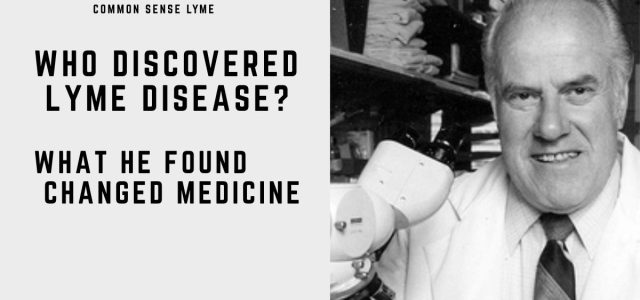
Willy Burgdorfer and the Discovery of Lyme Disease
By Alan MacDonald, M.D.
Guest Blog
Dr. Willy Burgdorfer’s discovery of the bacterium responsible for Lyme disease transformed modern medicine—and his legacy continues to shape how we understand this complex illness today.
Willy Burgdorfer’s Lyme disease discovery identified the bacterium Borrelia burgdorferi, establishing Lyme disease as a bacterial infection.
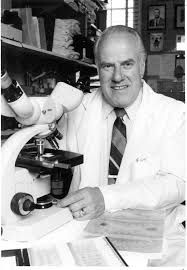
Dr. Willy Burgdorfer, discoverer of Borrelia burgdorferi.
A Life and Legacy That Endures
Dr. Willy Burgdorfer, who passed away in 2014, was a scientist of remarkable insight and humility. Those who knew him remember not only his groundbreaking work, but also his quiet dedication to science and patients.
Many colleagues described him as humble despite the worldwide impact of his discovery.
His discovery continues to influence the lives of millions of individuals affected by Lyme disease worldwide.
The Discovery That Changed Lyme Disease
Working at the Rocky Mountain Laboratories, Dr. Burgdorfer identified spirochetes within the midgut of Ixodes ticks—organisms that would later be confirmed as the cause of Lyme disease in humans.
Ticks collected from Shelter Island, New York, played an important role in the investigation that led to this discovery.
The bacterium was named Borrelia burgdorferi in his honor.
Several alternative names were reportedly considered before the microbiology community selected Borrelia burgdorferi.
This discovery marked a turning point:
- Lyme disease was no longer considered a viral illness
- The infectious cause was identified
- Treatment strategies could now target a bacterial pathogen
A Shift in Medical Understanding
Before this discovery, treatment approaches were limited and often ineffective.
Recognizing Lyme disease as a bacterial infection led to the development of antibiotic-based therapies and a new framework for diagnosis and treatment.
This fundamentally changed how clinicians approached Lyme disease.
This shift allowed clinicians to connect symptoms, exposure, and infection in a way that had not previously been possible.
A Lasting Impact on Medicine
Dr. Burgdorfer’s work has been compared to other landmark discoveries in microbiology, where identifying a microbial cause reshaped medical understanding.
His findings were validated by researchers worldwide and laid the foundation for decades of ongoing investigation into tick-borne diseases.
More than 30 years later, the full implications of his discovery are still being explored.
By identifying the bacterial cause of Lyme disease, Dr. Burgdorfer helped solve one of the major medical puzzles surrounding chronic tick-borne illness.
Why His Work Still Matters
Lyme disease remains a complex and evolving illness.
Dr. Burgdorfer’s discovery not only identified its cause—it opened the door to ongoing inquiry into its diagnosis, treatment, and long-term effects.
His work reminds us that scientific progress often begins with careful observation and the willingness to challenge existing assumptions.
The Legacy of Dr. Burgdorfer
Understanding the origins of Lyme disease is essential to understanding its present challenges.
Dr. Burgdorfer’s legacy continues to guide clinicians and researchers as they work to improve care for patients with tick-borne illness.
His contributions remain a cornerstone of modern Lyme disease research and treatment.
Frequently Asked Questions
Who discovered Lyme disease?
Willy Burgdorfer identified the spirochete Borrelia burgdorferi in 1982 while working at the Rocky Mountain Laboratories.
What is Borrelia burgdorferi named after?
The bacterium was named in honor of Willy Burgdorfer following his discovery of its role in causing Lyme disease.
Why does Willy Burgdorfer’s discovery still matter?
His identification of the bacterial cause of Lyme disease established the foundation for antibiotic treatment and decades of ongoing research into tick-borne illness.
Related Articles
- Lyme Disease: Overview and Key Facts
- Lyme Disease Symptoms Guide
- Lyme Disease Coinfections
- Lyme Disease Prevention Strategies
References
- Burgdorfer W, Barbour AG, Hayes SF, Benach JL, Grunwaldt E, Davis JP.
Lyme disease-a tick-borne spirochetosis?
Science. 1982;216(4552):1317-1319. - Centers for Disease Control and Prevention (CDC).
Lyme Disease.
Dr. Daniel Cameron, MD, MPH
Lyme disease clinician with over 30 years of experience and past president of ILADS.
Symptoms • Testing • Coinfections • Recovery • Pediatric • Prevention