Does Lyme Disease Go Away After Treatment? What Patients Should Expect
Does Lyme disease go away after treatment? In many cases, yes—but not always. While some patients recover fully, others continue to experience fatigue, pain, or cognitive symptoms that require further evaluation.
This question reflects one of the most important—and often misunderstood—patterns in Lyme disease:
Recovery is common, but not universal.
Some individuals return to full health, while others experience symptoms that fluctuate or persist over time.
Understanding why recovery varies is essential for guiding care and avoiding premature dismissal of ongoing symptoms. Learn more about Lyme disease recovery.
When Lyme Disease Is Treated Early
In early-stage Lyme disease, treatment with antibiotics such as doxycycline or amoxicillin is often effective.
When therapy begins soon after infection, many patients recover without long-term complications.
However, not all patients develop a rash or recall a tick bite. Even among those who receive early treatment, recovery is not universal.
So does Lyme disease go away with early treatment? Often—but not always.
What Is Post-Treatment Lyme Disease Syndrome (PTLDS)?
When symptoms persist, clinicians often use the term Post-Treatment Lyme Disease Syndrome (PTLDS).
This describes symptoms lasting six months or longer after completing standard antibiotic therapy.
Common symptoms include:
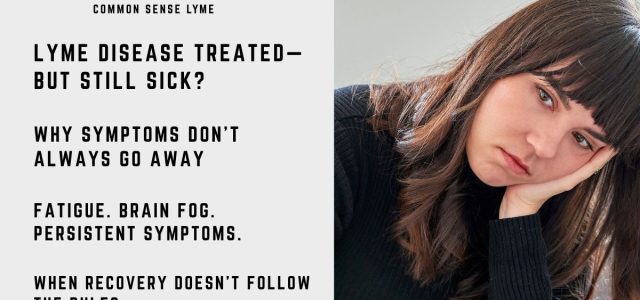
- Fatigue
- Joint or muscle pain
- Cognitive difficulties (brain fog)
- Sleep disruption
- Dizziness or lightheadedness
Some experts attribute PTLDS to post-infectious inflammation, though patient experiences vary.
In some cases, improvement occurs only after co-infections such as Babesia or Bartonella are identified and treated.
Could Symptoms Reflect Ongoing Infection?
Some research suggests Borrelia burgdorferi may persist in tissue after antibiotic exposure.
In humans, bacterial DNA or antigens have been detected after treatment, though the clinical meaning remains debated.
Diagnostic testing adds complexity.
Standard tests measure antibodies—not active infection—so negative results do not necessarily confirm resolution.
This helps explain why Lyme tests can be negative even when symptoms persist.
What If Symptoms Don’t Go Away?
When symptoms persist or return, patients may experience:
- Late Lyme manifestations (arthritis or neurologic involvement)
- Chronic, fluctuating symptom patterns
- Undiagnosed co-infections
- Functional decline and misdiagnosis
Too often, patients are reassured without explanation.
Yet further evaluation may uncover treatable contributors.
Why Recovery May Stall
- Delayed diagnosis
- Limited initial treatment
- Unrecognized co-infections such as Babesia or Bartonella
- Immune or autonomic dysfunction including autonomic dysfunction
- Diagnostic limitations
These factors often overlap, making recovery more complex than a single treatment course.
Is Recovery Still Possible?
Yes. Many patients improve over time with individualized care.
Whether symptoms reflect PTLDS, persistent infection, co-infections, or immune dysfunction, recovery remains possible.
So does Lyme disease go away after prolonged illness? For many patients, yes—with the right evaluation and approach.
What to Do If You’re Still Sick
- Track symptoms over time
- Ask about co-infections
- Seek experienced clinicians
- Avoid dismissal without explanation
- Pursue further evaluation when needed
Clinical Takeaway
Lyme disease often improves with treatment—but recovery is not always immediate or complete.
Persistent symptoms deserve careful evaluation—not dismissal.
Understanding the full clinical picture is key to guiding recovery.
Frequently Asked Questions
Does Lyme disease go away after treatment?
Often yes—but not always. Some patients develop persistent symptoms.
Why do symptoms persist?
Possible causes include delayed diagnosis, co-infections, immune dysfunction, or testing limitations.
What is PTLDS?
A term describing symptoms lasting six months or longer after treatment.
Can Lyme disease come back?
Symptoms may recur or persist depending on underlying factors.
Is recovery possible?
Yes. Many patients improve with appropriate care.
Dr. Daniel Cameron, MD, MPH
Lyme disease clinician with over 30 years of experience and past president of ILADS.
Symptoms • Testing • Coinfections • Recovery • Pediatric • Prevention