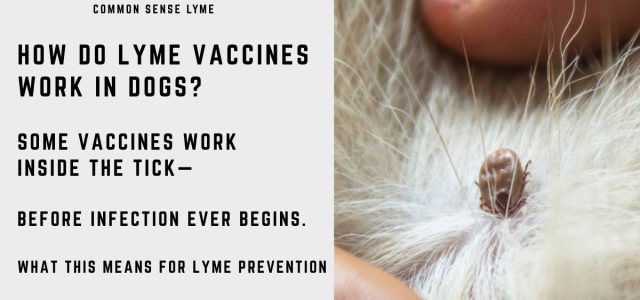
How Lyme Disease Vaccines Work in Dogs: Blocking Infection Before
It Starts
Lyme disease vaccines in dogs are designed to block transmission of
Borrelia burgdorferi before infection can take hold. Lyme disease is the
most common tick-borne disease affecting both humans and dogs. According
to the Companion Animal Parasite Council, 319,000 canines tested positive
in 2018—up from 160,000 in 2012, with true numbers likely higher.
How Lyme Disease Vaccines in Dogs Are Designed
The Lyme spirochete expresses different surface proteins depending on where
it is in its life cycle. In ticks, the bacteria produce Outer Surface
Protein A (OspA). After transmission to mammals, the organism shifts to
producing OspC.
This transition is central to how Lyme disease vaccines are designed.
OspA-Based Vaccines
Recombitek Lyme, produced by Boehringer Ingelheim, contains only OspA
proteins. Anti-OspA antibodies work by targeting spirochetes in the tick
midgut, blocking transmission before the bacteria enter the dog.
This means the vaccine acts at the level of the tick—not after infection
has already begun. The human vaccine LYMErix, introduced in 1998 and
withdrawn in 2001, was also based on OspA.
OspA and OspC Combination Vaccines
Some newer vaccines, such as VANGUARD crLyme, include both OspA and OspC
components. These vaccines aim to provide two layers of protection—targeting
bacteria in the tick and bacteria in the mammal after transmission.
A vaccine targeting both stages has the potential to use two synergistic
mechanisms of protection. There is currently no human vaccine using this
combined strategy.
Frequently Asked Questions
How do Lyme disease vaccines work in dogs?
Most vaccines use OspA proteins to target the bacteria inside the tick
before transmission. Some also include OspC to target bacteria after they
enter the dog.
Is there a Lyme disease vaccine for humans?
The OspA-based human vaccine LYMErix was withdrawn in 2001. No OspA
and OspC combination vaccine is currently available for humans.
Do Lyme disease vaccines fully protect dogs?
Vaccines reduce risk but are not a complete solution. Tick prevention
and regular checks remain essential alongside vaccination.
Clinical Takeaway
Lyme disease vaccines in dogs work by targeting the spirochete at different
stages of transmission—some inside the tick, some after the bacteria enter
the mammal. Because the organism shifts surface proteins during transmission,
no single target provides complete protection.
Vaccination reduces risk but does not replace tick prevention—exposure
remains the primary driver of infection.
Related Articles
- Lyme Disease
Prevention: Reducing Your Risk - Questions
Linger on the Efficacy of the Lyme Disease Vaccine - Could
Monoclonal Antibodies Prevent Lyme Disease Better Than a Vaccine? - What Blood Type
Do Ticks Prefer?
References
- Izac JR, Marconi RT. Diversity of the Lyme Disease Spirochetes
and its Influence on Immune Responses to Infection and Vaccination.
Vet Clin North Am Small Anim Pract. 2019.
Dr. Daniel Cameron, MD, MPH
Lyme disease clinician with over 30 years of experience and past president of ILADS.
Symptoms • Testing • Coinfections • Recovery • Pediatric • Prevention


I’m hearing about Hyperbaric Oxygen therapy for Lyme. Any thoughts?
Thank you!
I have followed Hyperbaric Oxygen therapy. I do not know the therapy well enough to evaluate its use.