Can You Have Lyme Disease Without Seeing a Tick Bite?
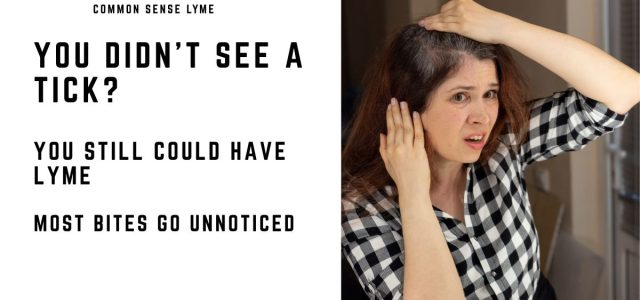
Can you have Lyme disease without seeing a tick bite? Yes—and most patients never see the tick that infected them.
Ticks that transmit Lyme disease are often extremely small, painless, and easy to miss. By the time symptoms appear, the tick is usually long gone.
Not seeing a tick does not rule out Lyme disease. Diagnosis is based on symptoms, exposure, and clinical judgment—not just a visible bite.
For a broader overview, see Lyme disease symptoms guide.
Why Most Tick Bites Go Unnoticed
A patient once said, “I check myself carefully—I would have seen a tick.” This is a common belief, but it is often incorrect.
The ticks that spread Lyme disease are frequently nymphs—smaller than a poppy seed and nearly invisible on the skin.
They do not hurt when they bite and can hide in areas that are difficult to see, including:
- Scalp
- Behind the knees
- Waistbands and skin folds
- Behind the ears
Even adult ticks can be missed. They may resemble small moles, freckles, or scabs and blend into the skin.
Nymph and Adult Ticks: Small but High Risk
Both nymph and adult ticks can transmit Lyme disease.
Nymphs cause most infections because they are active in late spring and summer and are difficult to detect.
Adult ticks remain active in the fall and early winter and can still transmit infection—especially when attached in hidden areas.
Research suggests that many patients diagnosed with Lyme disease never recall a tick bite.
In a study of 1,770 children evaluated for Lyme disease, only about 30% recalled a preceding tick bite.
Why Tick Bites Don’t Hurt
Ticks release anesthetic compounds when they attach, numbing the skin so the bite goes unnoticed.
They also release substances that prevent blood clotting, allowing them to remain attached without detection.
This is why patients often do not realize they have been bitten until symptoms appear days or weeks later.
Early Lyme Symptoms Without a Known Tick Bite
Even without a known tick bite, early Lyme disease may include:
- Fatigue or flu-like illness
- Headache or stiff neck
- Rash (not always a bull’s-eye)
- Joint or muscle pain
- Brain fog or mood changes
If these symptoms follow outdoor exposure, Lyme disease should be considered.
Learn more about why Lyme tests can be negative early.
Why This Leads to Missed Diagnosis
Many clinicians still rely on a recalled tick bite when considering Lyme disease.
When no tick is seen, symptoms may be attributed to stress, viral illness, or other conditions.
This contributes to Lyme disease misdiagnosis and delayed treatment.
Frequently Asked Questions
Can I have Lyme disease if I never saw a tick?
Yes. Most patients do not recall the tick that infected them.
Why don’t tick bites hurt?
Ticks release anesthetic compounds that numb the bite area.
Are nymph ticks more dangerous?
Nymphs cause most infections because they are small and difficult to detect.
How long does a tick need to be attached?
Risk increases with time, but transmission timing can vary.
Clinical Takeaway
The absence of a recalled tick bite should not rule out Lyme disease—especially when symptoms follow outdoor exposure.
Most Lyme disease patients never see the tick that infected them. Recognition depends on symptoms, exposure history, and clinical judgment rather than a visible tick alone.
Related Articles
Prevention of Lyme Disease: What Actually Works?
Why Lyme Disease Diagnosis Is Often Delayed
Why Lyme Symptoms Come and Go
Can Lyme Disease Spread in Under 24 Hours?
References
- Nigrovic LE, Thompson AD, Fine AM, et al. Clinical predictors of Lyme disease among children undergoing evaluation for Lyme disease. Acad Emerg Med. 2019;26(6):626–637.
- Eisen RJ, Eisen L. The Blacklegged Tick, Ixodes scapularis: An Increasing Public Health Concern. Trends Parasitol. 2018;34(4):295–309.
- Falco RC, Fish D. Prevalence of Ixodes dammini Infestation on Humans in a Lyme Disease Endemic Area of New York State. Am J Epidemiol. 1988;128(5):1146–1152.
Dr. Daniel Cameron, MD, MPH
Lyme disease clinician with over 30 years of experience and past president of ILADS.
Symptoms • Testing • Coinfections • Recovery • Pediatric • Prevention