
Persistent Symptoms After Lyme Disease Treatment
Some Lyme disease patients remain ill after treatment.
Fatigue, pain, and brain fog may persist.
Early recognition may improve outcomes.
Early identification of Lyme disease patients who remain symptomatic after treatment remains a major clinical challenge. While many individuals recover following standard antibiotic therapy, a subset continue to experience fatigue, pain, brain fog, and impaired daily functioning.
In the Archives of Clinical Neuropsychology, Bechtold and colleagues from Johns Hopkins University examined symptom patterns in patients following treatment for early Lyme disease. 4
The investigators reported that a substantial number of patients continued to experience persistent symptoms six months after completing a three-week course of antibiotics for an erythema migrans rash.
Out of 107 patients:
- 6 patients (6%) developed Post-Treatment Lyme Disease Syndrome (PTLDS)
- Patients reported ongoing fatigue, pain, and functional impairment
- Some individuals experienced significant cognitive symptoms and brain fog
An erythema migrans rash often seen in early Lyme disease.
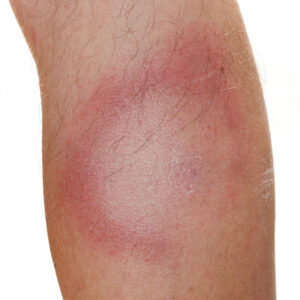
The authors emphasized that patients with persistent symptoms such as pain, fatigue, depression, brain fog, and cognitive concerns—identified through standardized symptom instruments—may benefit from targeted behavioral and medical interventions.
Bechtold noted that patients with ongoing cognitive complaints after Lyme disease treatment may warrant referral for neuropsychological evaluation.
What Is Post-Treatment Lyme Disease Syndrome (PTLDS)?
PTLDS refers to persistent symptoms that continue after standard Lyme disease treatment. Symptoms may include:
- Fatigue
- Pain
- Sleep disturbance
- Brain fog and cognitive slowing
- Functional decline
The mechanisms underlying PTLDS remain controversial and incompletely understood. Some researchers have explored immune dysregulation and inflammatory pathways, while others have examined the possibility of persistent bacterial antigens or ongoing immune activation.
Additional discussion can be found in:
Could Some Patients Benefit From Re-Treatment?
The question of re-treatment remains debated.
“Studies using rodent and primate models have suggested that the persistence of bacteria and/or spirochetal antigens after antibiotic therapy may drive disease,” according to Aucott from Johns Hopkins University School of Medicine. 5
“The use of short-term antibiotic retreatment in the early, post-treatment phase of Lyme disease has yet to be formally tested, although it may be widely applied in clinical practice.”
In the Johns Hopkins cohort:
- 8 patients underwent early re-treatment
- 5 patients had new objective neurologic findings such as neuropathy
- 3 patients had persistent or recurrent erythema migrans rashes
Notably, only 2 of the 6 patients who later developed PTLDS were re-treated.
Why Early Recognition Matters
Patients with persistent Lyme disease symptoms are often identified only after substantial functional decline has occurred.
Early recognition of:
- fatigue,
- brain fog,
- persistent pain,
- or new neurologic findings
may help guide closer monitoring, neurocognitive evaluation, and individualized management strategies.
Can Lyme Disease Symptoms Continue After Antibiotics?
Yes. Some patients continue to experience symptoms despite standard antibiotic therapy. The reasons remain an area of active investigation and clinical debate.
Persistent symptoms do not necessarily mean active infection is present in every case. However, symptom persistence after Lyme disease treatment has been documented in multiple clinical studies. 1-5
Clinical Takeaway
The Johns Hopkins findings support the importance of identifying Lyme disease patients at risk for persistent symptoms early in the course of illness. A subset of patients may benefit from closer follow-up, neuropsychological assessment, and individualized treatment strategies when symptoms fail to resolve.
References
- Logigian EL, Kaplan RF, Steere AC. Chronic neurologic manifestations of Lyme disease. N Engl J Med. 1990;323(21):1438-1444.
- Klempner MS, Hu LT, Evans J, et al. Two controlled trials of antibiotic treatment in patients with persistent symptoms and a history of Lyme disease. N Engl J Med. 2001;345(2):85-92.
- Fallon BA, Keilp JG, Corbera KM, et al. A randomized, placebo-controlled trial of repeated IV antibiotic therapy for Lyme encephalopathy. Neurology. 2008;70(13):992-1003.
- Bechtold KT, Rebman AW, Crowder LA, Johnson-Greene D, Aucott JN. Standardized symptom measurement of individuals with early Lyme disease over time. Arch Clin Neuropsychol. 2017;32(2):129-141.
- Aucott JN, Soloski MJ, Rebman AW, et al. CCL19 as a chemokine risk factor for post-treatment Lyme disease syndrome: a prospective clinical cohort study. Clin Vaccine Immunol. 2016.
Dr. Daniel Cameron, MD, MPH
Lyme disease clinician with over 30 years of experience and past president of ILADS.
Symptoms • Testing • Coinfections • Recovery • Pediatric • Prevention



Why is it not recognized by most Dr’s? I googled for a Dr here in WV and out of 20 listested, all but 3 were psychiatrists? I was need Dr taken seriously at ER or Dr’s and never given antibiotics. Now I am bed ridden. Would give anything to be tested correctly. I have found black specks coming put of my skin using coconut oil, or peroxide, also small sperm shaped things in mouth after eating cherry popcycle, put samples in alcohol to preserve, coughed up fluke looking things, thrown up worms after ingesting turpentine and found worms in mucous from bowls. I have hard scabs all over head that are clear and red spots, when pick them off, if I am able to pry up, there’s black specks and hard salt like things. I have crusted scabs on my face and body I can’t get rid of. The rx I was given for cream costs 9000. This is insane and ruining my life…..
It can be difficult to find a diagnosis. There are a growing number of conditions that are yet to be explained even in the tick borne illnesses. Morgellon’s includes a rash but the etiology remains unknown. There are people with Morgellon’s who also have Lyme disease.
Until people live it they will not truly help you. They’re too concerned with discrediting Morgellons, to actually listen and see what is obviously happening right in front of them. They can take biopsies and see for them selves that you are living in a nightmare. Rather than researching for answer and options that have been successful for others with Morgellons, and talking with MD’s who’ve treated patients successfully, they just shrug you away with “we don’t know what’s causing this” or “it’s a psychosis and you’re doing this to yourself,” it’s difficult especially if you’re a woman, to be heard, believed, supported and helped with basic health problems. Keep searching, you’ll find someone who will actually put in effort to search for answers and help heal your symptoms and give you back a quality of life. I am sorry you’re faced with such skepticism.