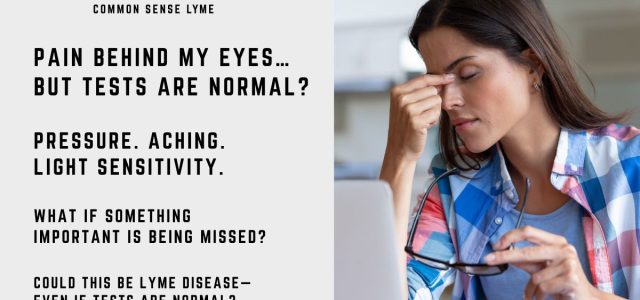
Lyme Disease Eye Symptoms: Pain Behind the Eyes
She thought it was another sinus infection — until antibiotics for Lyme disease made her eye pain disappear.
Pain behind the eyes is one of the more commonly described but often misunderstood complaints among patients with Lyme disease. Patients may describe a deep, aching pressure behind or around the eyes. It may worsen with fatigue, bright lights, headaches, or certain head movements. Yet in clinic after clinic, it may be dismissed as sinus pressure, eye strain, or migraine.
For some patients, an inaccurate diagnosis may explain why the pain does not improve with standard sinus, allergy, or migraine treatments.
What Patients Describe
Many Lyme disease patients with pain behind their eyes report discomfort that does not fit the usual patterns. They may feel pressure rather than sharp pain. The pain can be accompanied by headaches, blurred vision, sensitivity to light, floaters, double vision, or pain with eye movement.
One patient said, “It felt like someone was pressing from inside my skull, right behind my eyes.”
Another described it as “a deep ache that moved from one eye to the other and got worse when I was exhausted.”
These symptoms do not prove Lyme disease. But in a patient with a tick bite, an expanding rash, facial palsy, neurologic symptoms, joint pain, fatigue, or illness after outdoor exposure, eye pain should not be ignored.
Can Lyme Disease Affect the Eyes?
Yes. Lyme disease can be associated with a range of ocular and neuro-ophthalmic findings. These include conjunctivitis, keratitis, uveitis, retinal inflammation, optic nerve involvement, cranial nerve palsies, double vision, and light sensitivity.
A 2026 systematic review and meta-analysis of ocular findings in Lyme disease included 21 studies and 859 patients. The authors reported that ocular findings such as conjunctivitis, anterior uveitis, strabismus, and diplopia may occur in Lyme disease and should raise suspicion for infection in the appropriate clinical setting.
Earlier reviews also describe ocular Lyme disease as uncommon but clinically important. Lesser reported that ocular manifestations may include conjunctivitis, keratitis, vitritis, uveitis, neuroretinitis, optic nerve findings, disc edema, and cranial nerve involvement.
Why Pain Behind the Eyes May Occur
Pain behind the eyes in Lyme disease may arise from several overlapping mechanisms:
- Inflammation around ocular tissues, including uveitis, keratitis, episcleritis, or retinal inflammation.
- Neuro-ophthalmic involvement, including cranial nerve irritation or optic nerve inflammation.
- Headache syndromes associated with neurologic Lyme disease.
- Light sensitivity and visual strain, which can worsen pain and pressure sensations.
- Facial nerve involvement, which may alter blinking, tear production, or eye surface comfort.
In one clinical series of ocular Lyme borreliosis, patients developed uveitis, retinal vasculitis, neuro-ophthalmologic disorders, severe photophobia, and severe periodic ocular or facial pain. These findings are important because they show that eye pain may occur as part of a broader ocular or neurologic Lyme presentation.
Why It Is Often Misdiagnosed
Pain behind the eyes is easily attributed to more common conditions. Patients may be told they have:
- Sinus infection
- Migraine
- Eye strain
- Dry eye
- Allergies
- Tension headache
- Temporomandibular joint dysfunction
These diagnoses may be correct in many cases. But they can also delay recognition of Lyme disease when eye pain occurs with systemic symptoms, neurologic complaints, or a history of tick exposure.
Red Flags That Need Prompt Evaluation
Patients with eye pain should seek prompt medical or ophthalmologic evaluation if they develop:
- Vision loss or sudden blurred vision
- Double vision
- New eye redness with pain
- Severe light sensitivity
- Pain with eye movement
- Facial weakness or Bell’s palsy
- Severe headache, stiff neck, or neurologic symptoms
- Floaters, flashes, or visual field changes
These symptoms may reflect inflammation, optic nerve involvement, retinal disease, cranial nerve involvement, or another urgent eye condition.
How Doctors Evaluate Eye Symptoms in Lyme Disease
Evaluation depends on the patient’s symptoms and exam findings. A careful workup may include:
- A detailed history of tick exposure, rash, fever, facial palsy, neurologic symptoms, and prior Lyme disease
- Eye examination by an ophthalmologist
- Visual acuity and visual field testing
- Slit-lamp examination
- Retinal examination
- Optical coherence tomography when optic nerve or retinal involvement is suspected
- Lyme disease testing when clinically appropriate
- Evaluation for other causes, including autoimmune, viral, inflammatory, vascular, and infectious conditions
No single eye symptom confirms Lyme disease. The diagnosis depends on the full clinical picture, including exposure risk, associated symptoms, examination findings, and test results.
Treatment Considerations
Treatment depends on the type and severity of ocular involvement. Some patients with Lyme disease are treated with oral antibiotics, while others with more serious ocular or neurologic findings may require intravenous therapy. Lesser noted that management of ocular manifestations may require intravenous treatment in some cases.
Patients with suspected uveitis, retinal vasculitis, optic neuritis, neuroretinitis, or cranial nerve involvement should be evaluated promptly. Treatment decisions should be individualized and coordinated with an ophthalmologist or neuro-ophthalmologist when appropriate.
Clinical Perspective
Pain behind the eyes is not the most recognized symptom of Lyme disease, but it can be clinically meaningful. In some patients, it may reflect ocular inflammation, neuro-ophthalmic involvement, headache syndromes, or cranial nerve irritation.
The key is not to assume every case of eye pressure is sinus disease or migraine, especially when the patient also has fatigue, headaches, light sensitivity, neurologic symptoms, facial palsy, migrating pain, or a history of tick exposure.
Clinical Takeaway
Lyme disease can affect the eyes and nervous system. Pain behind the eyes, especially when accompanied by light sensitivity, visual changes, double vision, facial weakness, headaches, or systemic symptoms, deserves careful evaluation.
For patients in endemic areas, ocular symptoms should be considered in the broader clinical context of Lyme disease rather than dismissed as isolated eye strain or sinus pressure.
Related Articles
For more information on Lyme disease symptoms and neurologic complications, see:
- Ocular Lyme Disease
- Neurologic Lyme Disease
- Lyme Disease Symptoms Guide
- Brain Fog and Lyme Disease
- Lyme Disease Fatigue
References
- Barbosa LIT, Lima RV, Moreira JLM, Hira S, Arruda MP, Zinher MT, Thomaz S, Del Valle GS. Ocular findings in patients with Lyme disease: a systematic review and meta-analysis. Graefes Arch Clin Exp Ophthalmol. 2026;264(4):1101-1110. doi:10.1007/s00417-025-07110-2
- Lesser RL. Ocular manifestations of Lyme disease. Am J Med. 1995;98(4A):60S-62S. doi:10.1016/S0002-9343(99)80045-X
- Mikkilä HO, Seppälä IJ, Viljanen MK, Peltomaa MP, Karma A. The expanding clinical spectrum of ocular Lyme borreliosis. Ophthalmology. 2000;107(3):581-587. doi:10.1016/S0161-6420(99)00128-1
- Havuz E, Havuz SG. Lyme disease atypically presenting with a singular symptom: unilateral chorioretinitis. Eur J Ophthalmol. 2021;31(2):NP151-NP156. doi:10.1177/1120672120962055
Dr. Daniel Cameron, MD, MPH
Lyme disease clinician with over 30 years of experience and past president of ILADS.
Symptoms • Testing • Coinfections • Recovery • Pediatric • Prevention

I have had 4 Lyme infections. My first infection was 40 years long before diagnosis. I have had recurrent sinus infections, fungal sinus infections and random eye pain for all my life. I am 70. The pain gets so bad I can barely see. I can no longer take anti inflammatory so I must rely on fioricet for the migraines when the pressure becomes unbearable. Ice can help a bit. I have chronic swelling in my nasal passages and eyes too… I’ve been dismissed so many times by MD’s that I’ve switched to naturopaths and functional medicine for support. MD’s are under educated when it comes to vector born disease. And 10 days of doxy only causes lapse for me. I need a minimum of 30 days and I couple treatment with Buhner’s protocol for months to get the job done. Thank you for talking about this issue!!!!
Yes! My eye pain was a deep pressure behind my eyes. With the eye pressure I had deep fatigue and a plethora of neurological symptoms. After I was diagnosed and treated for Lyme disease, the symptoms started to disappear. I’m not completely in remission, but I’m a high functioning Lyme survivor.
There are so many eye manifestations. I write a few in a blog https://danielcameronmd.com/lyme-disease-can-affect-your-eyes-leading-to-various-complications/