Atypical Lyme Rash in Children: When the Rash Changes Over Time
Lyme rashes do not always look typical
Rashes in children may evolve over days
Early symptoms are often missed
An atypical Lyme rash in children can make early diagnosis challenging—especially when the rash does not resemble the classic bull’s-eye pattern.
Children with Lyme disease often develop rashes that look different from the classic bull’s-eye image shown in textbooks. An atypical Lyme rash may be uniformly red, oval, expanding, blue-red, or appear as several separate lesions. Because these rashes can evolve over several days, early recognition may be difficult.
Case reports highlight how Lyme disease may present in unexpected ways. In a report by Banadyha and colleagues, an 11-year-old girl developed multiple evolving rashes before a classic erythema migrans lesion appeared.
Early Symptoms Did Not Suggest Lyme Disease
The child was admitted with fever, headaches, abdominal pain, and a progressing rash.
Her illness began with a small rash on her left foot that resolved with topical treatment.
Shortly after, a second rash appeared on her right foot and also disappeared after antihistamine therapy.
These early rashes were transient and initially did not raise suspicion for Lyme disease.
Studies suggest atypical erythema migrans lesions may be more common than many clinicians expect, contributing to delayed recognition and missed opportunities for early treatment. Researchers studying PCR-confirmed Lyme disease found that many patients with proven infection had nonclassic rashes, highlighting how reliance on textbook images may delay diagnosis.
What Does an Atypical Lyme Rash Look Like in Children?
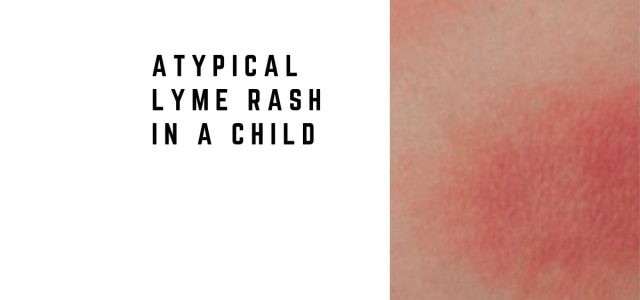
An atypical Lyme rash in children may not have central clearing or a classic bull’s-eye pattern. Instead, it may appear as a solid red patch, an oval expanding rash, a blue-red lesion, or a rash that resembles an insect bite, cellulitis, allergic reaction, or other skin condition.
Although many people expect a bull’s-eye rash, children often develop expanding rashes that never develop central clearing.
Toddlers may develop the same atypical Lyme rashes seen in older children, although the rash may be harder to recognize because young children cannot describe how it is changing.
Learn more about how erythema migrans may not have a bull’s-eye appearance.
Pictures of Atypical Lyme Rash in Children
Photographs of Lyme disease often show a classic bull’s-eye rash, but many children develop uniformly red, expanding, oval, blue-red, or multiple lesions instead. Comparing several examples may help parents understand how variable erythema migrans can appear.
A single picture may not show the full story. Rash progression over time—whether the rash enlarges, spreads, or appears in multiple locations—may be more important than how it looks on the first day.
Rash Progression Over Several Days
By the fourth day of illness, a maculopapular rash appeared on the trunk and limbs.
Over the following days:
- The rashes enlarged
- Fever and lethargy developed
- Headaches and abdominal pain worsened
Initial diagnoses included other conditions such as toxic erythema.
Evolving and migratory rashes may complicate recognition of Lyme disease, particularly when the appearance changes over time.
An atypical Lyme rash often changes over several days, becoming larger, developing additional lesions, or evolving into a more recognizable erythema migrans rash.
Research has shown that atypical erythema migrans may appear uniformly red, red-blue, or resemble insect bites, cellulitis, or other dermatologic conditions rather than classic target lesions. In one PCR-confirmed cohort, most patients had nonclassic rather than classic erythema migrans lesions.
Diagnosis Delayed by Atypical Features
The child’s parents did not recall a tick bite.
Lyme disease was not initially suspected because symptoms began during a colder season.
Absence of a known tick bite, atypical rashes, and seasonality can lower clinical suspicion and contribute to delayed Lyme disease diagnosis.
Studies of PCR-confirmed Lyme disease have emphasized that clinicians should not rely solely on the classic bull’s-eye appearance when evaluating a possible erythema migrans rash. Although erythema migrans has traditionally been described as an expanding lesion, more recent studies have shown that its appearance is more variable than once believed. In my clinical experience, some patients do not notice or recall expansion before evaluation, and diagnosis often depends on the overall clinical presentation rather than a documented history of enlargement.
When the Classic Rash Appears Late
Only on the seventh day of illness did a typical erythema migrans lesion appear on the chest.
At that point, Lyme disease became more apparent.
Serologic testing confirmed early disseminated Lyme disease.
The child recovered after doxycycline treatment, illustrating the value of recognizing evolving erythema migrans before complications develop.
When Should Parents Call Their Doctor?
Parents should consider contacting their doctor when a child develops an expanding rash after a tick bite or possible tick exposure, especially if the rash is accompanied by fever, headache, fatigue, abdominal pain, joint pain, or other new symptoms.
Medical evaluation may also be important when a rash changes over time, appears in multiple areas, or does not fit the classic bull’s-eye image. Additional pediatric presentations are discussed in early signs of Lyme disease in children.
Why This Case Matters
The authors noted that the rash was extensive, multiple, and migratory—features that differ from classic teaching.
Recognition may depend on following symptom progression rather than relying on a single early finding.
Frequently Asked Questions
Can Lyme rash in children look different from a bull’s-eye rash?
Yes. Some children develop atypical, evolving, or multiple rashes that do not initially resemble classic erythema migrans.
Can a Lyme rash appear without a bull’s-eye?
Yes. Lyme disease rashes may appear as solid red, oval, expanding, blue-red, or multiple lesions without the classic bull’s-eye appearance.
What is the difference between a tick bite and a Lyme rash?
A simple tick bite reaction is often small and may improve within a short period of time. A Lyme rash is more concerning when it expands, changes over several days, appears in multiple areas, or is accompanied by fever, headache, fatigue, or other symptoms.
Can Lyme disease rash change over time?
Yes. Rashes may enlarge, migrate, or evolve over several days before becoming more recognizable.
Do children always remember a tick bite?
No. Many children and parents do not recall a tick bite before symptoms develop.
Are multiple rashes a sign of disseminated Lyme disease?
Multiple lesions may raise concern for disseminated infection, although clinical context remains important.
Clinical Takeaway
Atypical Lyme rash in children may delay diagnosis because early symptoms often do not match the expected pattern.
Children with evolving, migratory, expanding, or multiple rashes plus systemic symptoms may warrant consideration of Lyme disease even without a known tick bite.
Related Articles
These related articles explore pediatric presentations, diagnostic challenges, rash variability, and symptom recognition in Lyme disease.
Lyme disease symptoms guide
Giant erythema in a child with Lyme disease
Pediatric Lyme disease
Lyme disease misdiagnosis
Lyme disease rash
References
- Banadyha K, et al. Giant erythema in a child with Lyme disease.
- Schutzer SE, Berger BW, Krueger JG, et al. Atypical erythema migrans in patients with PCR-positive Lyme disease. Emerg Infect Dis. 2013;19(5):815-817.
- Franco-Avecilla D, Yeung C, Baranchuk A. Lyme carditis presenting with an atypical rash. CMAJ. 2020;192(21):E584.
- Review discussing variability in erythema migrans presentation and diagnostic challenges.
Dr. Daniel Cameron, MD, MPH
Lyme disease clinician with over 30 years of experience and past president of ILADS.
Symptoms • Testing • Coinfections • Recovery • Pediatric • Prevention