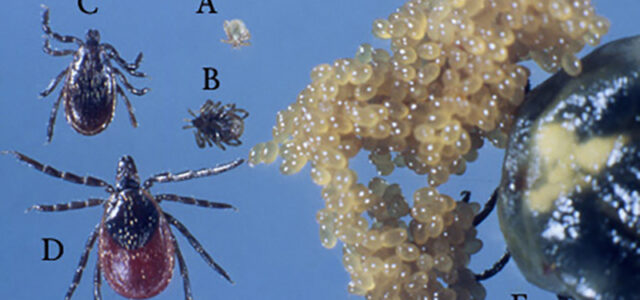
Can Tick Larvae Bite Humans? Do They Carry Lyme Disease?
Tick larvae can bite humans but are easily overlooked.
Most newly hatched larvae are not thought to carry Lyme disease bacteria.
Recent studies have refined what we know about larval tick transmission.
Can tick larvae bite humans? Yes. Tick larvae, sometimes called “seed ticks,” can bite humans. Because they are much smaller than nymphs or adult ticks, they often go unnoticed. Researchers continue to study whether larval ticks can transmit disease and under what circumstances.
A 2016 study published in Parasites & Vectors challenged the long-held assumption that naturally infected larval Ixodes ricinus ticks play little or no role in transmitting Lyme borreliosis. Researchers demonstrated that naturally infected larvae transmitted Borrelia afzelii and Borrelia miyamotoi to laboratory rodents. The authors estimated that individuals living in the Netherlands receive approximately 30,000 larval tick bites each year out of an estimated 1.1 million total tick bites.
The investigators concluded that these findings challenged the traditional view that larval bites could not transmit Lyme borreliosis. However, the study involved European Ixodes ricinus ticks and primarily demonstrated transmission under experimental conditions. Additional studies continue to support that efficient vertical transmission of Borrelia burgdorferi is uncommon, particularly in North American blacklegged ticks, so the overall risk from newly hatched larvae remains low.
Can larval ticks carry Lyme disease?
The answer depends on the organism being considered and the tick species.
Most Lyme disease bacteria (Borrelia burgdorferi sensu lato) are believed to be acquired when larval ticks feed on infected reservoir hosts such as rodents. Once infected during their first blood meal, larvae molt into nymphs, which account for most human Lyme disease infections. This lifecycle helps explain why nymphs, rather than larvae, remain the stage responsible for most cases of Lyme disease in people.
Several studies have found that efficient transmission of Lyme disease bacteria from an infected female tick directly to her eggs (transovarial transmission) is uncommon or absent in North American ticks. Because of this, newly hatched larvae are generally considered unlikely to carry Borrelia burgdorferi.
In contrast, Borrelia miyamotoi, a relapsing fever spirochete, is more readily transmitted from infected female ticks to their offspring. This distinction may explain why larval transmission appears more biologically plausible for B. miyamotoi than for the bacteria that typically cause Lyme disease.
“Larval transmission of Borrelia miyamotoi has implications for checking for ticks and continuing tick precautions even after the risk of Lyme disease has abated,” said Peter Krause, MD, of Yale University School of Public Health.
Do seed ticks (larval ticks) bite humans?
Yes. Tick larvae, often called seed ticks, readily feed on small mammals and birds, but they may also bite humans. Because they are extremely small—often about the size of a grain of sand—they are easy to miss during routine tick checks.
Although individual larval bites are usually overlooked, people may occasionally encounter large numbers of larvae at one time, resulting in clusters of bites commonly referred to as “seed tick” bites. Larval tick bites often cause small, itchy red bumps that may resemble other insect bites. Because larvae are so tiny, many people notice the skin reaction before they ever see the attached ticks. Most bites are simply irritating, but their tiny size makes careful skin examinations after outdoor activities especially important.
Do ticks lay eggs on humans?
No. Ticks do not lay eggs on people. Female ticks feed until fully engorged, then drop off their host before laying thousands of eggs in leaf litter or other protected areas of the environment. After hatching, the six-legged larvae seek their first blood meal from small animals or, less commonly, humans.
This is an important distinction because internet searches for “tick eggs on humans” frequently describe skin conditions, insect eggs, or other findings that are not actually tick eggs.
What does this study mean for patients?
The 2016 study expanded our understanding of larval tick biology by demonstrating that naturally infected European Ixodes ricinus larvae can transmit Borrelia afzelii and Borrelia miyamotoi under experimental conditions. These findings challenged the longstanding assumption that larval ticks play no role in transmitting Lyme-related bacteria.
At the same time, decades of research continue to support that efficient transovarial transmission of Borrelia burgdorferi—the principal cause of Lyme disease in North America—is uncommon. Most larvae acquire Lyme disease bacteria only after feeding on infected reservoir animals before molting into infected nymphs.
These findings also highlight an important difference between Lyme disease bacteria and Borrelia miyamotoi. Unlike B. burgdorferi, B. miyamotoi is efficiently passed from infected female ticks to their offspring, making larval transmission biologically more plausible.
For patients, the practical message remains straightforward. Perform careful tick checks after spending time outdoors, even when ticks are extremely small. While infected nymphs remain the greatest source of human Lyme disease, larval ticks can bite humans and should not be ignored during tick prevention efforts.
Frequently Asked Questions
Can tick larvae bite humans?
Yes. Tick larvae can bite humans, although they are extremely small and often go unnoticed. Because of their size, careful tick checks remain important after spending time outdoors.
Can larval ticks transmit Lyme disease?
Evidence suggests this is uncommon for the principal Lyme disease bacteria, especially in North America. However, a European study demonstrated transmission of Borrelia afzelii by naturally infected Ixodes ricinus larvae under experimental conditions.
Are seed ticks dangerous?
Seed ticks are larval ticks. Although they are tiny and usually cause only minor irritation, they can attach in large numbers. Research suggests they may occasionally transmit certain pathogens, particularly Borrelia miyamotoi, but infected nymphs remain the primary source of human Lyme disease.
Do ticks lay eggs on humans?
No. Female ticks drop off their host before laying eggs in the environment. Tick eggs are not laid on or under human skin.
Clinical Takeaway
Larval ticks can bite humans and are easily overlooked because of their small size. While newly hatched North American larvae are generally considered unlikely to carry the principal Lyme disease bacterium, studies have demonstrated that European Ixodes ricinus larvae can transmit Borrelia afzelii under experimental conditions. In contrast, Borrelia miyamotoi appears capable of efficient vertical transmission from infected female ticks to their offspring.
Although infected nymphs remain the primary source of human Lyme disease, people should continue practicing tick avoidance and performing careful tick checks because even tiny larval ticks can attach and feed.
Related Articles
Larval Ticks and Borrelia miyamotoi
How to Remove a Tick Safely
Lyme Disease Symptoms Guide
Tick Bite Prevention
References
- van Duijvendijk G, Coipan C, Wagemakers A, et al. Larvae of Ixodes ricinus transmit Borrelia afzelii and B. miyamotoi to vertebrate hosts. Parasites & Vectors. 2016;9:97.
- Richter D, Debski A, Hubalek Z, Matuschka FR. Absence of Lyme disease spirochetes in larval Ixodes ricinus ticks. Vector Borne Zoonotic Dis. 2012;12(1):21-27.
- Schoeler GB, Lane RS. Efficiency of transovarial transmission of the Lyme disease spirochete, Borrelia burgdorferi, in the western blacklegged tick, Ixodes pacificus. J Med Entomol. 1993;30(1):80-86.
- Krause PJ, Fish D, Narasimhan S, Barbour AG. Borrelia miyamotoi infection in nature and in humans. Clin Microbiol Infect. 2015;21(7):631-639.
- Couret J, Dyer MC, Mather TN, et al. Acquisition of Borrelia burgdorferi infection by larval Ixodes scapularis associated with engorgement measures. J Med Entomol. 2017;54(4):1055-1060.
- Scholl A, Li B, Dennis J, De S. A comprehensive method on black-legged tick larvae and nymph feeding on mice to study Lyme disease transmission and acquisition. Front Microbiol. 2025;16:1527821.
Dr. Daniel Cameron, MD, MPH
Lyme disease clinician with over 30 years of experience and past president of ILADS.
Symptoms • Testing • Coinfections • Recovery • Pediatric • Prevention



I’m looking for evidance of transmission from other vectors.
And also body fluids.
Your help is appreciated!
There are reports that other vectors harbor pathogens seen in ticks. These researchers have not been able to prove that these pathogens are transmitted via a bite of another vector. I am not familiar with the literature. Again, it is difficult to prove infection even if tests of other fluids are positive e.g PCR research.