Atypical Erythema Migrans: What an Atypical Lyme Rash Looks Like
NOT A BULL’S-EYE?
LYME RASHES
DON’T ALWAYS LOOK TYPICAL
An atypical erythema migrans rash may not look like the classic bull’s-eye—and many patients never develop one at all, leading to missed or delayed diagnosis.
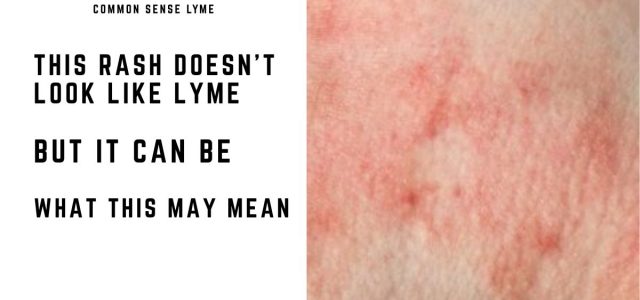
Atypical erythema migrans refers to a Lyme disease rash that appears without the classic ring or central clearing.
These rashes are often flat, expanding, and uniform in color rather than ring-shaped.
The erythema migrans rash is the most common skin sign of Lyme disease, but it often appears in atypical forms.
For a broader overview, see Lyme disease symptoms guide.
See also Lyme rash misdiagnosis examples.
What Does an Atypical Lyme Rash Look Like?
- Flat red or pink patches without a ring pattern
- Uniform or solid-colored patches
- Large, expanding rash without central clearing
- Multiple rashes appearing in different locations
- Rashes that change, fade, or move across the body
- Rashes that resemble viral or allergic skin reactions
Atypical Lyme rashes can be mistaken for viral or allergic skin conditions, which may delay diagnosis.
For more examples, see Lyme rash variations.
Case: A Child With Atypical Erythema Migrans
This case illustrates how an atypical Lyme rash can change location, appearance, and size over time.
In the article “Giant Erythema in a Child with Lyme Disease,” Banadyha and colleagues describe an 11-year-old girl with an unusual and evolving rash pattern.1
The girl was admitted to the hospital with a high fever, headaches, abdominal pain, and a progressing rash.
Her symptoms began several days after a small rash appeared on her left foot, which cleared with topical treatment.
The following day, a rash appeared on her right foot near the ankle, which also resolved after antihistamine treatment.
By the fourth day, maculopapular rashes emerged on the trunk and limbs.
Over the next few days, the rashes grew larger, and she developed fever, lethargy, headaches, and abdominal pain.
Why This Rash Was Difficult to Diagnose
Clinicians initially considered other conditions, including toxic erythema, due to the rash’s atypical appearance.
New rashes continued to appear, prompting reconsideration of the diagnosis.
The patient’s parents did not recall a tick bite, and Lyme disease was not initially suspected because the illness began during a colder season.
Only on the seventh day did a more typical erythema migrans rash appear on the chest.
The authors noted that the diagnostic complexity was due to the rash being large, homogeneous, and migratory.
Why Atypical Lyme Rashes Are Missed
- Rashes may not look like a bull’s-eye
- Symptoms may mimic viral or allergic conditions
- No known tick bite
- Symptoms can appear outside peak tick season
This variability can delay diagnosis, especially when clinicians expect a classic bull’s-eye rash.
For more on diagnostic challenges, see why Lyme tests can be negative.
FAQ: Atypical Lyme Disease Rash
What is an erythema migrans rash?
Erythema migrans is the most common rash of Lyme disease, but it often appears as a solid or irregular patch rather than a bull’s-eye.
Can a Lyme disease rash be mistaken for other conditions?
Yes. Lyme rashes can resemble viral rashes, allergic reactions, or other skin conditions.
Does erythema migrans always have a bull’s-eye appearance?
No. Many Lyme rashes are uniform or irregular without central clearing.
Can Lyme disease cause multiple rashes?
Yes. Early disseminated Lyme disease can lead to multiple erythema migrans lesions.
Can an erythema migrans rash look like a viral rash?
Yes. Atypical erythema migrans can resemble viral rashes, which is one reason Lyme disease may be missed early.
Clinical Takeaway
Lyme disease should not be ruled out based on rash appearance alone—even when the rash does not resemble a bull’s-eye.
In many cases, the pattern and progression of the rash over time provide more diagnostic clues than its appearance at a single point.
Early recognition and treatment can prevent progression to more serious disease.
Related Articles:
Lyme disease skin rash puzzles doctors, leads to misdiagnosis
Erythema migrans rash doesn’t always have bull’s-eye appearance
Single dose of doxycycline for treatment of tick bite only prevents Lyme disease rash
References:
- Banadyha N, Rogalskyy I, Komorovsky R. Giant Erythema in a Child with Lyme Disease. Infect Drug Resist. 2024.
Dr. Daniel Cameron, MD, MPH
Lyme disease clinician with over 30 years of experience and past president of ILADS.
Symptoms • Testing • Coinfections • Recovery • Pediatric • Prevention