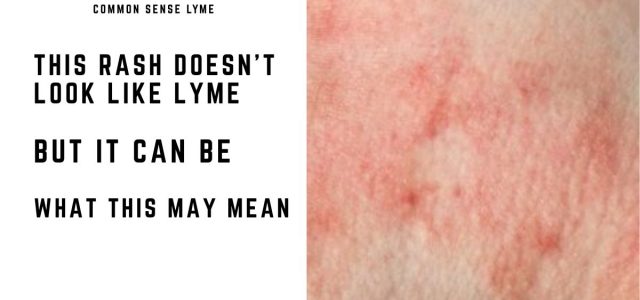
Lyme Disease Rash Isn’t Always a Bull’s-Eye: A Child’s Case
Lyme disease rash can look atypical
Erythema migrans is not always a bull’s-eye
Children may develop multiple or migrating rashes
Most people associate a Lyme disease rash with the classic bull’s-eye appearance. In reality, a Lyme disease rash can take many different forms. Some patients develop uniformly red, multiple, vesicular, blue-purple, or otherwise atypical rashes that do not resemble the classic target pattern.
Although the bull’s-eye pattern is widely recognized, studies have shown that many erythema migrans lesions are uniformly red rather than target-shaped.
In their article, Giant Erythema in a Child with Lyme Disease, Banadyha and colleagues describe a young girl with Lyme disease who exhibited a unique presentation of an erythema migrans skin rash.
Can Lyme disease cause an unusual skin rash?
Yes. The erythema migrans rash may appear as a large red patch, multiple lesions, a homogeneous rash, or a rash that expands or migrates over time. This variability can make Lyme disease harder to recognize, especially in children.
Aucott and colleagues found that patients correctly identified classic bull’s-eye erythema migrans far more often than nonclassic Lyme disease rashes. The findings help explain why atypical Lyme disease rashes are frequently overlooked by both patients and clinicians.
A child’s Lyme disease rash was difficult to recognize
The 11-year-old girl was admitted to the hospital with a high fever, headaches, abdominal pain, and a progressing rash. Her symptoms began several days after a small rash appeared on her left foot. However, this cleared with topical treatment.
“The following day, a skin rash appeared on the girl’s right foot, near the ankle, which also vanished after antihistamine treatment,” the authors state.
On the 4th day, maculopapular rashes emerged on the trunk and limbs.
Over the next few days, the rashes grew larger, and the young girl developed fever, lethargy, headaches, and abdominal pain.
Clinicians initially considered other medical conditions, including toxic erythema. “However, new rashes kept appearing, prompting reconsideration,” the authors point out.
The patient’s parents did not recall a tick bite on their child, and Lyme disease was not initially suspected because the child’s illness began during a colder season.
“Only on the 7th day of the illness did typical Lyme disease rashes of erythema migrans appear on the anterolateral surface of the chest.”
“The diagnostic complexity was increased by the rash’s atypical presentation – large, homogeneous papular rashes,” the authors state.
After serologic testing for Lyme disease was positive, the patient was diagnosed with early disseminated Lyme disease and treated successfully with doxycycline.
“This clinical case is noteworthy due to the unique challenge of identifying a rash that was extensive, multiple, and migratory.”
Why this Lyme disease rash was misdiagnosed
This child’s illness illustrates why Lyme disease can be difficult to recognize. The rash was extensive, migratory, and appeared during a colder season without a remembered tick bite. Clinicians initially considered other diagnoses before characteristic erythema migrans lesions appeared several days later.
The case also shows why the absence of a known tick bite does not rule out Lyme disease. Many patients with Lyme disease never recall a tick bite because nymphal ticks are extremely small and their bites are often painless.
Multiple erythema migrans lesions generally reflect early dissemination of the infection rather than multiple tick bites. Because of this variability, Lyme disease should remain in the differential diagnosis even when the rash looks unusual.
Authors’ takeaways
- “This report underscores the importance of recognizing atypical presentations of Lyme borreliosis in children and the need for careful differential diagnosis.”
- Her illness began with a small rash that disappeared with treatment. Over a few days, she developed a high fever, headaches, abdominal pain, and extensive rashes on her body.
Frequently Asked Questions
Does every Lyme disease rash look like a bull’s-eye?
No. Erythema migrans can appear as a classic bull’s-eye rash, but it may also look like a uniformly red patch, multiple rashes, a large expanding lesion, or another atypical skin finding.
Can Lyme disease cause more than one rash?
Yes. Multiple erythema migrans lesions can occur in early disseminated Lyme disease. Multiple or migrating rashes may make the diagnosis more difficult if clinicians expect only one classic bull’s-eye lesion.
Can a Lyme disease rash disappear and come back?
A Lyme disease rash may fade, change, expand, or be followed by new lesions. In this case, early rashes appeared and disappeared before more typical erythema migrans lesions were recognized.
Can children develop atypical Lyme disease rashes?
Yes. Children can develop atypical Lyme disease rashes, including extensive, multiple, homogeneous, or migratory lesions. Atypical rashes can delay diagnosis when there is no remembered tick bite.
How long does erythema migrans last?
Erythema migrans may expand over days and can persist for days to weeks if untreated. The appearance may change over time, and some patients develop additional lesions as the infection disseminates.
Clinical Takeaway
A Lyme disease rash is not always a bull’s-eye. Uniformly red, expanding, multiple, or migratory erythema migrans lesions are well-described and can delay diagnosis when clinicians expect the classic target appearance.
When a child develops expanding or recurring rashes with fever, headache, abdominal pain, or systemic symptoms, Lyme disease should remain in the differential diagnosis even without a remembered tick bite or classic bull’s-eye rash.
Related Articles
These related articles explore Lyme disease rashes, atypical erythema migrans, tick bite decisions, and delayed diagnosis.
Lyme disease skin rash puzzles doctors, leads to misdiagnosis
Erythema migrans rash doesn’t always have bull’s-eye appearance
Single dose of doxycycline for treatment of tick bite only prevents Lyme disease rash
Pediatric Lyme disease
Lyme disease symptoms guide
References
- Banadyha N, Rogalskyy I, Komorovsky R. Giant Erythema in a Child with Lyme Disease. Infect Drug Resist. 2024;17:4343-4348. doi:10.2147/IDR.S489845.
- Aucott JN, Crowder LA, Yedlin V, Kortte KB. Bull’s-Eye and Nontarget Skin Lesions of Lyme Disease: An Internet Survey of Identification of Erythema Migrans. Dermatol Res Pract. 2012;2012:451727. doi:10.1155/2012/451727.
- Steere AC. Lyme Arthritis: A 50-Year Journey. J Infect Dis. 2024;230(Suppl 1):S1-S10. doi:10.1093/infdis/jiae126.
Dr. Daniel Cameron, MD, MPH
Lyme disease clinician with over 30 years of experience and past president of ILADS.
Symptoms • Testing • Coinfections • Recovery • Pediatric • Prevention