Why Lyme Prevention Fails: What a New Review Reveals
Prevention advice sounds simple
Real-world prevention is more complicated
This may explain why people still get sick
Why Lyme prevention fails is more complicated than simply forgetting bug spray or missing a tick check. A large systematic review of 127 studies found that Lyme disease prevention strategies vary widely in effectiveness, feasibility, cost, environmental impact, and public acceptance.
In other words, preventing Lyme disease is not always as straightforward as public health messaging suggests.
Learn more about early warning signs in this guide to Lyme disease symptoms.
Why Lyme Prevention Fails May Be the Wrong Question
Many people assume prevention fails because individuals make mistakes. But the evidence suggests the challenge is larger than individual behavior.
Prevention strategies often depend on multiple factors working together:
- Tick density in the environment
- Wildlife host populations
- Landscape features
- Human behavior
- Public acceptance of prevention methods
- Cost and accessibility
The review found that many prevention studies showed mixed results rather than clear success or failure.
Why Personal Protection Alone Often Falls Short
Many prevention campaigns focus heavily on individual behavior:
- Tick checks
- Protective clothing
- Repellents
- Avoiding high-risk areas
- Showering after outdoor exposure
These strategies remain important. But relying only on individual behavior may leave important gaps.
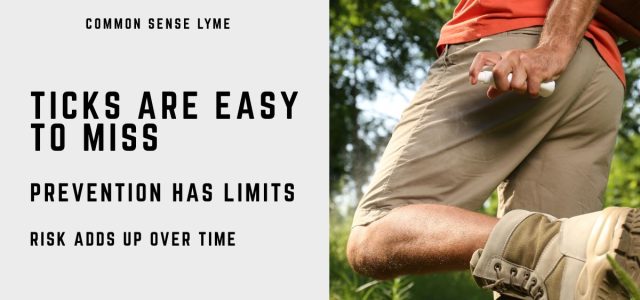
People forget. Children play outdoors. Tick exposure occurs unexpectedly. Symptoms may not appear immediately.
When prevention depends entirely on perfect behavior, failures become more likely.
The Evidence for Integrated Lyme Prevention Strategies
One of the clearest messages from the review was that integrated approaches may work better than relying on one strategy alone.
Researchers repeatedly supported combining approaches such as:
- Environmental control measures
- Wildlife-targeted interventions
- Landscape modification
- Personal protection behaviors
- Community education programs
The challenge may not be that people ignore prevention—it may be that prevention itself is more difficult than we admit.
Environmental Factors Make Prevention Harder
Ticks thrive in environments that are difficult to control completely.
Forested areas, leaf litter, wildlife reservoirs, fragmented landscapes, and expanding tick habitats all increase exposure risk.
Climate change, suburban expansion, and changing wildlife patterns may further complicate prevention efforts.
Read more about reducing exposure in our Lyme prevention hub.
Why Prevention Failure Leads to Delayed Diagnosis
When prevention fails, diagnosis becomes even more important.
Patients who believe they were “careful” may not consider Lyme disease when symptoms appear. Clinicians may overlook exposure histories when patients do not recall a tick bite.
These delays matter.
Delayed diagnosis has been associated with more complicated illness patterns and prolonged recovery in some patients.
Learn more about the impact of delayed recognition in Delayed Lyme Disease Diagnosis.
What This Means for Patients
The review does not suggest abandoning prevention.
Instead, it suggests that prevention should be viewed as layered protection rather than a single action.
Multiple approaches used together may provide more protection than any individual strategy alone.
Understanding that prevention is imperfect may also help patients and clinicians recognize symptoms earlier when illness occurs.
Clinical Takeaway
Why Lyme prevention fails may have less to do with patient behavior and more to do with the complexity of Lyme disease ecology.
Prevention remains important—but layered prevention, early recognition, and prompt evaluation may be equally important.
When prevention strategies are viewed as part of a larger system rather than a single solution, the limitations become easier to understand.
Related Articles
Learn more about prevention, symptoms, and delayed diagnosis:
- Prevention of Lyme Disease
- Delayed Lyme Disease Diagnosis
- Lyme Disease Symptoms Guide
- Persistent Lyme Disease
- How Do You Get Lyme Disease?
References
- Ost K, Norman M, Dumas A, et al. A systematic review of the effectiveness and utility of Lyme disease prevention measures in Canada, the United States, and Europe. BMC Infect Dis. 2025;25:889.
- Beaujean DJMA, Crutzen R, Kengen MMF, et al. Determinants of tick bites and Lyme borreliosis prevention: a systematic review. Ticks Tick Borne Dis. 2013;4(1-2):101-107.
Dr. Daniel Cameron, MD, MPH
Lyme disease clinician with over 30 years of experience and past president of ILADS.
Symptoms • Testing • Coinfections • Recovery • Pediatric • Prevention