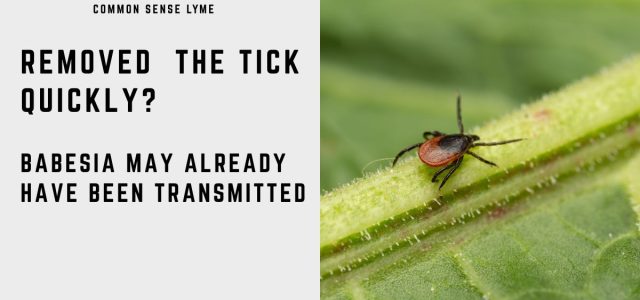
How Fast Can a Tick Transmit Babesia? Why There Is No Safe Window
How fast can a tick transmit Babesia? In some cases, transmission may occur almost immediately after the tick begins feeding.
Many people assume they have 24–48 hours to safely remove a tick before infection develops.
That assumption may not apply to Babesia.
The issue has become increasingly important as Babesia cases continue to rise across the Northeastern United States.
Babesia Cases Are Increasing
According to a CDC Morbidity and Mortality Weekly Report (MMWR), Babesia cases increased significantly between 2011 and 2019 in several Northeastern states.
States reporting the largest increases included:
- Connecticut
- Maine
- Massachusetts
- New Hampshire
- New Jersey
- New York
- Rhode Island
- Vermont
The true number of cases may be underestimated because babesiosis is not reportable in every state.
How Fast Can Babesia Be Transmitted?
Lyme disease is often described as requiring 24–48 hours of tick attachment before transmission occurs.
However, some studies suggest Lyme disease transmission may occur in less than 16 hours under certain conditions—particularly if the tick’s salivary glands are infected.
Babesia appears to behave differently.
Because Babesia parasites can reside in the tick’s salivary glands, transmission may occur as soon as feeding begins.
“There is no grace period between tick attachment and transmission,” wrote Scott.
This distinction may explain why some patients report becoming ill rapidly after a tick bite.
Other Tick-Borne Infections May Spread Quickly
Babesia is not the only infection transmitted rapidly.
- Anaplasma phagocytophilum may be transmitted in less than 24 hours
- Powassan virus may be transmitted in as little as 15 minutes
Some infections may occur before the tick is even noticed.
Why This Matters for Treatment
This distinction has important treatment implications.
Doxycycline is commonly prescribed after a tick bite to reduce the risk of Lyme disease.
However, doxycycline does not treat Babesia.
Babesia typically requires antiparasitic treatment such as:
This is one reason why Babesia testing may be important—especially when symptoms develop rapidly after a tick bite.
What Symptoms Should You Watch For?
Babesia symptoms may include:
- Fever and chills
- Severe fatigue
- Night sweats
- Air hunger
If symptoms appear quickly after a tick bite, Babesia should be considered.
Clinical Takeaway
Babesia may be transmitted rapidly—sometimes immediately—after a tick bite.
Unlike Lyme disease, there may be no reliable safe window before transmission occurs.
Recognizing this difference may lead to earlier diagnosis and more appropriate treatment.
Frequently Asked Questions
How fast can a tick transmit Babesia?
Babesia may be transmitted very quickly after tick attachment because the parasite may already reside in the tick’s salivary glands.
Does the 24–48 hour rule apply to Babesia?
No. The commonly cited 24–48 hour window applies mainly to Lyme disease and may not apply to Babesia.
Can Babesia be transmitted immediately?
Some researchers believe transmission may occur as soon as feeding begins.
Does doxycycline treat Babesia?
No. Babesia usually requires antiparasitic therapy such as atovaquone plus azithromycin.
What symptoms suggest Babesia?
Common symptoms include fever, chills, fatigue, night sweats, and air hunger.
Related Articles
- After a tick bite, how long for disease transmission?
- Birds vs. rodents in transmitting tick-borne pathogens
- Babesia infections and tick-borne agents transmitted through the blood supply
- Babesia testing
References
- Swanson M, Pickrel A, Williamson J, Montgomery S. Trends in Reported Babesiosis Cases — United States, 2011–2019. MMWR Morb Mortal Wkly Rep. 2023;72(11):273-277.
- Scott JD, Clark KL, Foley JE, Bierman BC, Durden LA. Far-Reaching Dispersal of Borrelia burgdorferi Sensu Lato-Infected Blacklegged Ticks by Migratory Songbirds in Canada. Healthcare (Basel). 2018;6(3):89.
- Cook MJ. Lyme borreliosis: a review of data on transmission time after tick attachment. Int J Gen Med. 2015;8:1-8.
- Ebel GD, Kramer LD. Duration of tick attachment required for transmission of Powassan virus by deer ticks. Am J Trop Med Hyg. 2004;71(3):268-271.
Dr. Daniel Cameron, MD, MPH
Lyme disease clinician with over 30 years of experience and past president of ILADS.
Symptoms • Testing • Coinfections • Recovery • Pediatric • Prevention
I was on Malarone for nearly two years, along with atovaquone and zithromax. Malarone is not the same as Mepron, it contains atovaquone plus proguanil. I can attest that babesiosis is bad stuff.
Hi Michael,
I’ve been looking for a person who has taken Atovaquone & zith for a while. I have babs. I’ve been on atovaquone & zith for 7 months. I thought I only had to do a 6 month course, but when I stopped my symptoms came back. I am guessing from your post that I was wrong, or Marty Ross was wrong, about the length of treatment. How did you know when to stop treatment & how are you feeling now?
Michele;
Sorry I did not get back to you sooner on the antibiotic treatment of babesiosis. After being on atova and zithromax and atova and proguanil (called Malarone) after one full year I felt fine and my tests were all negative. However, I was kept on the gamish mentioned for another full year. Why this was so I am not sure, the doctors were totally non-committal on this issue of telling me, the patient, what the rationale was for the extra year of treatment in the face of having all negative tests including the smears. I’m about 9 months beyond cessation of antibiotics and I feel super duper. Could I have stopped after one full year on the “stuff”? Dunno. It’s water over the dam and I wish I could get some answers from the docs but no way, Jose’.
I’m at ml******@***oo.com if you need to contact me for any issue related to your drug regime, etc.
Hi, Sorry you’ve both suffered from Babesia. Michele, I have been treating for almost a year with a specialist. I am taking zith and atovaquone for 11 months. I started with Malarone since it was stronger (with 2 drugs as Michael points out). Unfortunately, I had an allergic reaction, so moved to the atovaquone. Seems there is no set timeline for treatment. Will depend on your symptoms. Michele, I keep notes in my calendar. I also do monthly bloodwork to make sure nothing goes out of whack. I did cut back a bit with zithro to twice a week but continue to increase atovaquone. The zithro needs to stay on board in order for it to be effective. I have greatly improved. I also added NAC (natural supplement) 4 times a day. …I understand your doctor wanting to stop the meds. My primary wanted me to wean off. But my specialist says if you stop prematurely and you relapse, drugs may not be as effective second time around. I am choosing to continue. Hope that helps.
…I left out a very important piece from my treatment. 2 hours after taking zithro I flood with probiotics and Sach B ( to replenish good bacteria and prevent yeast infection). Also, I know long term treatment isn’t typical, but we suspect I contracted Babesia 30 years ago when I tested positive for Lyme. I got the typical antibiotic treatment for Lyme at the time and wasn’t tested further. Fast forward, I got bit again and after primary gave me regular Lyme treatment, I was still sick. I chose to seek out a tick born infection specialist and thank God I did. I tested positive for lyme and 2 strains of Babesia. I’m curious: Are we only keeping the parasitic load down or really eradicating this?
Thanks Rosanne,
I was bit in 2001 – starting getting really sick in 2009. I’ve been treating borrelia, bartonella for past 4 years. Now I’m treating, what I believe it the last infection, babesiosis. And I believe we are treating the parasitic load and it never goes away. I saw an abstract from NIH website where it reported this. I am guessing we can reduce it and then maintenance dose? I see the LLMD next week and I’m going to ask her. I might consult with Dr. Cameron too. But I want to talk to other people who have been treating longer than I before I do.
I was treated with much more than Azith & Atovaquone, I actually saw a better response to Atovaquone, but it usually stops working after two months, then I need to take a break and start again.
I was on Rifampin on the off months, as well as doxy.
Do not know what the end game is, I cannot afford this treatment, when I die I die.
Suffering from brain fog, tremors, tingling & burning all over, heel pain, neck pain, eye floaters, weird liver area pain, since 2019/2020.
Most blood tests are normal, so are the MRI’s besides a positive B.Duncani and some spondelysis, but nothing to explain this sudden onset.
Was told it’s Fibro, so I should stop searching for relief and just accept the fate, I dont know, I wish there was more proof to prove either one or the other, they are both scientific mysteries.
I have all of your symptoms as well and have been diagnosed with fibromyalgia, peripheral neuropathy, cervicogenic neuralgia, occipital neuralgia, trigeminal neuralgia, chronic migraines, major fatigue and pain all over. I do have old injuries that caused pain in neck and back with some migraines. Since my Lyme Disease diagnosis 8 years ago, I hurt so much more all over, brain fog is terrible. I live in NC without Lyme literate doctors. I had to be my own advocate even though I had classic ‘Bullseye Rash and finally diagnosed with Babesiosis 9 month later. I wish I could find a way to get some quality of life back. I’ve always been a ‘Go getter’ person but my get up and go has got up and gone!!!
I live in North Carolina and was diagnosed with Lyme Disease 8 years ago and now suffer from chronic Lyme. I took several course of antibiotics over the first 9 months but was still not getting better. Labwork was being drawn frequently. Finally after 9 quelling months of suffering, no energy and felt as though i was dying, labwork came back positive for Babesiosis. Treated with Mepron and felt so much better but my Ig kept getting lower and lower. I’ve been on immunoglobulin infusion for 4 years now. It helps but I’m still exhausted, weaker than I should be and get major brain fog. My 1st Infectious Disease doctor retired and my 2nd Infectious Disease doctor doesn’t believe Lyme is this far south. He has me diagnosed with CVID(COMMON VARIABLE IMMUNE DEFICIENCY). Does anyone have any advice for me on what I might be able to do to regain some life back? Thank you in advanced! Liz Lindner in Winterville NC.
In one of the questions I saw someone asking about testing, it may have been on another post. Regardless, you did not have answers but pointed them to the scientist that wrote the article.
Since I have found that apparently Igenex and TLabs from MD do the fish test which is apparently the best way to detect the parasite. Dr. Linden? (My memory isn’t great) Has done an interview that can be found on youtube. His daughter has it, and he has been devoted for approx 2.5 yrs now.
He said the tlabs is specific to the new varient but neither is perfect and Physicians should treat on symptoms as many LLMDs agree.
I just wanted to share the information hoping again to help your patients.
He also states that the treatment he uses starts with the general malaria drugs increasing as needed and warranted. Gradually stepping up dosage along with adding different types of malaria drugs as well as antibiotics.
I’m now adding this information to my pcp in hopes she will order the test and do further investigation into the different types of TBD as they all only use antibody testing which this does not show up on.
Hello, since 2004 when I was diagnosed with Lymes, I am now 74 and wondering if any aging problems can be attributed to that, thus the main question is – does lymes ever truly disappear from your body, bloodstream? Can it still come back to haunt you with mental, cognitive issues? Can it make certain problems worse than they are – such as liver and kidney disease? My life turned upside down at 54 and I have never regained back the way I was. I am so sorry for everyone who experiences this disease, especially when the doctors are not knowledgeable enough to even conceive of the possibility – my first doctor just chalked it up to women’s stuff. Then I sought out an alternative doctor and he diagnosed it for me and very grateful.
I wish everyone well and yes it can definitely be a hard pill to swallow. Thank you for sharing your stories.