Lyme Disease Rash: What Does It Really Look Like?
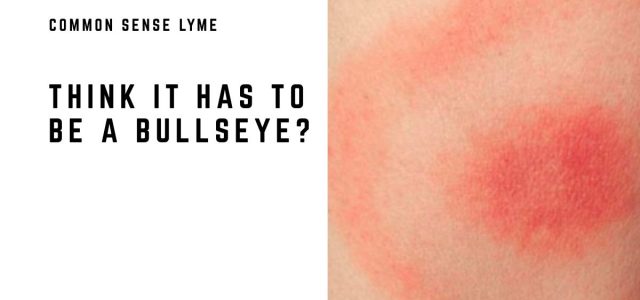
Not all Lyme rashes look like a bull’s-eye.
Many appear as solid red patches instead.
Some patients never develop a rash at all.
Many people assume that a bull’s-eye or erythema migrans (EM) rash is a common manifestation of Lyme disease—and that the lack of a rash confirms a person does not have the disease.
This is far from the truth.
EM rash identification remains a challenge because Lyme disease rashes often take on a variety of appearances, according to a study by Burlina and colleagues.
“Only 20% of patients with an EM rash in the United States present with lesions that have the central clearing of a classic target lesion (‘ring-within-a-ring’ or ‘bull’s-eye’).”
Instead, “the majority of EM lesions appear uniformly red or bluish-red in color and lack central clearing.”
Why the Bull’s-Eye Rash Is Misleading
The classic bull’s-eye rash—a red ring with central clearing—appears in medical textbooks and public health materials as the defining feature of Lyme disease.
But in clinical practice, only about 20% of patients present with this pattern.
This creates a dangerous misconception: patients and clinicians may assume that without a bull’s-eye rash, Lyme disease can be ruled out.
The reality is that most Lyme rashes look nothing like the textbook image.
The majority of erythema migrans lesions appear as solid red or bluish-red patches without central clearing. They may be round, oval, or irregular in shape.
Lyme Rash Misdiagnosed as Cellulitis
Lyme disease rashes are often mistaken for other skin conditions.
For instance, patients with Lyme disease may be misdiagnosed as having cellulitis.
Cellulitis typically presents with warmth, swelling, and tenderness—features that can overlap with erythema migrans.
However, EM rashes are usually less painful and less warm to the touch than bacterial cellulitis.
The treatment for cellulitis is not necessarily effective for Lyme disease.
When Lyme disease is missed, the infection may later spread to joints, nerves, or the heart.
Lyme Rash Misdiagnosed as Shingles
Between 4% and 8% of Lyme disease rashes present with central blistering.
These cases can be misdiagnosed as shingles, a viral infection commonly treated with antiviral medications.
Shingles treatment is not effective in treating Lyme disease.
READ MORE: It wasn’t shingles. It was Lyme disease.
By the time neurologic or systemic symptoms develop, the connection to the original rash is often lost.
Multiple Lyme Rashes Can Occur
About 20% of patients have multiple erythema migrans rashes at the time of diagnosis because the Lyme spirochete has disseminated to other areas of the body.
This presentation can be confused with erythema multiforme or other skin disorders.
Multiple lesions may suggest early disseminated Lyme disease rather than a simple localized infection.
Some Lyme Patients Never Develop a Rash
Not every patient with Lyme disease develops an erythema migrans rash.
This means the absence of a rash cannot rule out Lyme disease.
Patients with fatigue, joint pain, brain fog, neurologic symptoms, or flu-like illness may still have Lyme disease even without a visible skin lesion.
Relying too heavily on rash appearance contributes to delayed diagnosis and underrecognition.
Clinical Approach When the Rash Is Uncertain
In practice, I treat with an antibiotic if there is uncertainty, as the consequences of missing a diagnosis of Lyme disease can be serious.
If the rash is questionable, I often choose an antibiotic that would be effective for either Lyme disease or another possible condition.
For example, I might treat a patient with a rash that could represent cellulitis or Lyme disease with cefuroxime rather than Keflex.
I have also treated patients with a combination of an antiviral medication and cefuroxime if the rash could represent either shingles or Lyme disease.
Frequently Asked Questions
What does a Lyme disease rash really look like?
Most Lyme disease rashes are not classic bull’s-eye lesions. Many appear as solid red or bluish-red patches without central clearing.
Does everyone with Lyme disease develop a rash?
No. Some patients never develop an erythema migrans rash, so the absence of a rash does not exclude Lyme disease.
Can Lyme disease be mistaken for cellulitis?
Yes. Lyme rashes may resemble cellulitis, although erythema migrans lesions are usually less painful and less warm to the touch.
Can Lyme disease be mistaken for shingles?
Yes. Some Lyme rashes blister and may resemble shingles, leading to delays in diagnosis if antiviral treatment is ineffective.
Can Lyme disease cause multiple rashes?
Yes. Approximately 20% of patients develop multiple erythema migrans lesions, which may indicate early disseminated infection.
Clinical Takeaway
Most Lyme disease rashes do not resemble the classic bull’s-eye appearance shown in textbooks.
Many appear as solid red lesions, some blister like shingles, and others resemble cellulitis or allergic reactions.
Recognizing the variability of erythema migrans is essential for avoiding delayed diagnosis and missed treatment opportunities.
Related Articles
Lyme Rash Misdiagnosis: Not Always a Bull’s-Eye
Lyme Disease Misdiagnosis: The Great Imitator
Delayed Lyme Disease Diagnosis
Lyme Disease Symptoms Guide
Neurologic Lyme Disease
References:
- Burlina PM, Joshi NJ, Mathew PA, Paul W, Rebman AW, Aucott JN. AI-based detection of erythema migrans and disambiguation against other skin lesions. Comput Biol Med. 2020;125:103977.
Dr. Daniel Cameron, MD, MPH
Lyme disease clinician with over 30 years of experience and past president of ILADS.
Symptoms • Testing • Coinfections • Recovery • Pediatric • Prevention



I am glad you exist. I presented with an EM rash and a black legged tick at my GP, (an NP). She dismissed my concerns and said I had to wait for symptoms. I knew the rash is a symptom, so I tried several other practitioners, and Nurse practitioners, and all said the same thing. The NPs are used as gatekeepers in my Ivy league community in Western NY dominated by a callous hospital system with repeated write ups into the 2010s for keeping separate wing for poor people and gate keeping by labeling poor people as drug addicts to refuse care… It was over three years before I was able to get in front of a full fledged doctor, I presented him with all the info I had and your web URL, and he actually read it! At that point, I had inflammation and heat in my lower spine, and my left knee: he felt it was Lyme arthritis. He started antibiotic treatment, but I went into sepsis a week after the end of a medium course of doxicycline. It took another three years of constant on and off antibiotic cocktails until the symptoms of heat and pain stopped returning shortly after stopping the antibiotic treatment. Needless to say, I was nearly bed bound as my low back had locked up, adhesion in the low back fascia from lack of use, my discs were impinging on my spine according to a neurologist reading my MRI. I did have pre existing injuries to both my knee and low back, which complicated getting treatment as in NYS work related injuries are addressed as “off limits body parts” to deny care due to their choice, even though I was trying to get treatment for Lyme, they would refuse to examine me due to the body part, due to a pre existing work injury, the loophole they use to refuse care these days.
Regardless, it took another three years for the inflammation to resolve in my low back, just in time for my entire medical team to retire after COVID. 2023, over ten years after I first presented with a tick and rash for treatment, an MRI showed a gap between the formerly swollen discs and my cord, no impingement. I however have no intact discs in my lumbar, with the disc at the SI joint, a pre existing injury, now in pieces. I was able to start getting my legs back though, even though in 2023 I could only shuffle….