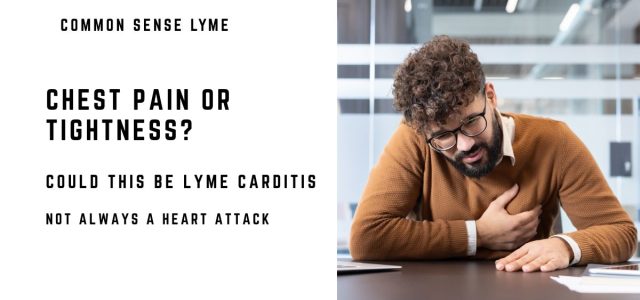
Can Lyme Disease Mimic a Heart Attack? Understanding Lyme Carditis
Chest pain from Lyme disease can closely resemble a heart attack. In some cases, patients present with elevated cardiac biomarkers and EKG changes indistinguishable from acute coronary syndrome—until further evaluation reveals a different cause.
Presentation Mimicking Myocardial Infarction
According to the authors,
Lyme disease mimicked a myocardial infarction (heart attack)
in a 45-year-old woman who presented with sudden chest pain radiating to her neck.
This pattern—location, radiation, and severity—is classic for myocardial infarction and typically reflects cardiac ischemia due to blocked coronary arteries.
Strong Evidence for Heart Attack
The evidence supporting myocardial infarction was compelling. The patient had EKG changes, elevated Troponin and CK-MB, and rising biomarker levels at 6 hours.
- EKG changes: Consistent with cardiac injury or ischemia
- Elevated Troponin: Indicates heart muscle damage
- Elevated CK-MB: Another marker of myocardial injury
- Rising levels: Suggest ongoing cardiac damage
By standard criteria, the diagnosis of heart attack appeared certain.
Cardiac Catheterization Rules Out Blockage
Cardiac catheterization, however, revealed no significant coronary artery disease.
This finding shifted the diagnosis. Despite clear evidence of myocardial injury, there was no arterial blockage.
The heart muscle was affected—but not by ischemia.
Diagnosis Revealed by Facial Palsy
Two days later, the patient developed right-sided facial palsy, leading to the diagnosis of Lyme disease confirmed by ELISA and positive IgM and IgG antibodies.
Facial nerve palsy in the setting of unexplained cardiac findings should raise suspicion for
Lyme carditis.
Treatment and Recovery
The patient improved with intravenous ceftriaxone and oral steroids.
The response supported Lyme myocarditis as the underlying cause rather than coronary artery disease.
Why This Case Is Unusual
This case was notable for Lyme myocarditis presenting without conduction abnormalities but with markedly elevated troponin.
Three features stand out:
- Elevated biomarkers without heart block: Most Lyme carditis cases involve conduction abnormalities rather than myocardial injury markers.
- Normal ventricular function: Despite biomarker elevation, cardiac function remained preserved.
- MI-like presentation: The clinical picture closely resembled acute coronary syndrome.
Diagnostic Challenges
“Lyme myocarditis may be a challenging diagnosis in endemic areas,” the authors note, particularly in patients presenting with typical cardiac symptoms.
When chest pain, EKG changes, and elevated biomarkers are present, clinicians are naturally guided toward a diagnosis of myocardial infarction.
However, Lyme disease may occasionally present in a similar way.
Including Lyme in the Differential
Lyme disease should be considered in patients with myocardial injury and normal coronary arteries—especially in endemic regions.
The key distinction is the absence of obstructive coronary disease despite objective evidence of cardiac involvement.
When to Suspect Lyme Disease
- Residence in or travel to an endemic area
- Younger age with fewer cardiac risk factors
- Normal coronary arteries on catheterization
- Systemic symptoms such as fatigue or headache
- Neurologic findings such as facial palsy
- Recent tick exposure
For a broader overview of symptoms, see the
Lyme disease symptoms guide.
The Diagnostic Trap
This case illustrates how a convincing presentation can narrow the diagnostic focus.
When findings strongly suggest a common diagnosis, alternative explanations may be overlooked.
Maintaining a broader differential is especially important when key findings—such as normal coronary arteries—do not fully align with the expected diagnosis.
Clinical Perspective
Lyme disease can affect the heart in multiple ways, including conduction abnormalities and myocarditis.
While heart block is most common, myocardial inflammation mimicking heart attack has been documented.
Recognizing these patterns is important for timely diagnosis and treatment.
For more on cardiac involvement, see
cardiac complications of Lyme disease.
Clinical Takeaway
Lyme disease can mimic acute coronary syndrome, including chest pain, EKG changes, and elevated cardiac biomarkers.
When coronary arteries are normal, Lyme myocarditis should be considered—particularly in endemic areas or when neurologic findings such as facial palsy are present.
Frequently Asked Questions
Can Lyme disease cause chest pain like a heart attack?
Yes. Lyme myocarditis can cause chest pain, elevated biomarkers, and EKG changes similar to myocardial infarction.
Can Lyme disease elevate troponin levels?
Yes. Myocardial inflammation from Lyme disease can release troponin, similar to heart muscle injury.
How is Lyme myocarditis distinguished from heart attack?
Cardiac catheterization shows normal coronary arteries in Lyme myocarditis, unlike coronary artery blockage seen in heart attack.
Can Lyme disease cause EKG changes?
Yes. Lyme carditis can produce a range of EKG abnormalities.
Is Lyme myocarditis treatable?
Yes. Most cases respond well to antibiotic therapy when recognized early.
Related Reading:
Lyme Carditis: When Heart Symptoms Can’t Wait
Lyme Carditis Diagnosis: 18 Cases Show Broader ECG Findings
Lyme Disease Cardiac Problems: 19 Documented Complications
Lyme Carditis Causes Complete Heart Block in 26-Year-Old Man
What Might Sudden Cardiac Death Due to Lyme Disease Look Like?
References:
- Gilson J, Khalighi K, Elmi F, Krishnamurthy M, Talebian A, Toor RS. Lyme disease presenting with facial palsy and myocarditis mimicking myocardial infarction. J Community Hosp Intern Med Perspect. 2017;7(6):363-365.
Dr. Daniel Cameron, MD, MPH
Lyme disease clinician with over 30 years of experience and past president of ILADS.
Symptoms • Testing • Coinfections • Recovery • Pediatric • Prevention


PTLDS is a medical term implying that all medical treatment has failed, and that one’s only hope is to seek alternatives outside the medical system. Chronic Lyme Disease, on the other hand, is acknowledgment of a disease process that proceeds Borrelia infection and by nature of tick biology, may include multiple co-infections. Whether by ongoing infection, immune response, unknown factors or a combination of these, people are still sick and treatments still need to be explored. Please stop calling it post treatment.
I am not happy with the term either. The 2006 IDSA guideline advised using the PTLDS label for patients still ill with functional limitations after 3 weeks of doxycycline. The term implies that the infection has cleared.
My husband was 59 when he died from Lymes Carditis. All Lymes tests for the month prior were negative. The CDC and Minnesota Department of Public Health confirmed the results after his autopsy.
Just wanted to tell you how sorry I am for the loss of your husband. Everything about this disease is horrible, including the lack of support from doctors and insurance companies, dismissal by the media and consequent ridicule from the public. So grateful to the medical professionals, researchers and patients who work tirelessly to change things for the better. Hoping you have some of those people in your life, and that those relationships provide the love and support you deserve.
Thats makes me so sad and scared My condolences. Im 21 and was actually positive for it. I’m being treated with doxy but im still scared I can die from this. I have anxiety 🙁
How are you doing now? I am currently on Doxycycline It’s been interesting feeling the medication work in various body parts. I had Herxheimer reaction, which went away and am now with chest pain behind the left breast, but all other symptoms are disappearing, as I believe the cheat pain will too. Have you recovered?
This is how my Lyme story started 3+ years ago. I had symptoms of a heart attack, raised troponin levels. All other cardio test came back that as a 50 year old, I had the cardiovascular system of a 35 year old.
I still have some palpitations, but my chest pain and back pain have cleared for the most part. My worst symptom is daily horrendous anxiety, major depression, crying jags. Still very scary for me EVERY DAY. Still in treatment.
Hello, I have had Lyme for over over 10 years it is believed. I did a short course of abx when I found out, now am
On herbal treatment. I had a oil set embolism before beginning the herbal treatment last year. A huge history o unexplained chest pains and tachycardia with a near normal cardiac workup other than some what my doc describes as insignificant ekg changes. They won’t even refer me to cardiology again although my symptoms are much the same and unimproved.
Doctors differ in how they look at Lyme disease. You should seek a Lyme disease second opinion in addition to followup by a cardiologist.
I Was finally diagnosed with lymes disease after going to the er for chills ,fever neck pain in 2016 by my primary care after the erythema rash developed on my knee several days later. I was placed on doxy for 10 days and all was good. Aug 2 2018 I woke with pain in my left shoulder pain , thought I slept wrong I took some aleeve in the morning went to work and still felt the discomfort. I develvedoped chills and thought am I getting lymes again. I had aches and pain in my upper body., pain when taking deep breath also. I went home thinking should I have gone to the er again. I took aleeve again and later had chills took my temp was 100.2 . I had no appetite. I tried to lie down for a while and rest and could not get comfortable at all. The pain in my shoulder and chest when I breathed was getting worse. So at 2 am I drove myself to my local er thinking I was having a heart attack or pulmonary embolism. I was taken quickly ekg no changes my bp was 211/90 hr 90. Labs drawn . All neg except for bnp was 298. Ct for pe was neg but did show Cardiomegaly. Lyme test was neg no rashes.
The er physician discussed I was not in any life threatening state. I stated to him it must be lymes again , my symptoms were very similar to 2016 except I had no chest pain or shoulder pain.i started on doxy that morning and chest pain and shoulder pain decreased . The pain would flare up and I would take ibproben 600mg every 12 hours and that seem to help a lot. I was able to sleep . I have access to my medical records and reviewed them from my visit in 2016 my chest X-ray showed Cardiomegaly also my crp was 3.9. . I made an appointment to see my primary care in 2 weeks . I am courious what labs should be drawn , should I see a cardiologist? I am also thinking of going to the Lyme research in Valhalla. Any suggestions.
You should definitely see a cardiologist. You also should pursue the tick borne infection question. Doctors are divided on their approach to tick borne illnesses. You should weigh the different treatment approaches.
I had a tick bite 8 months ago with a cascading rash. I started having a host of symptoms (swollen lymph nodes, left side facial insensitivity including the tongue, tingling in the arms, legs, and back of the head. I have a low body temp 97.5 and had terrible flu like symptoms. I was tested (Quest labs) using Western blot and was negative. I am an avid runner but started having minor chest pains (left side) that have progressively gotten more constant. They do not worsen with exercise. I received an MRI on brain which was negative. I have had 2 EKGs and have also had a stress test with contrast. All negative. All blood work negative. I am taking lisinopril for blood pressure and am on daay 30 of a 42 day doxy regiment. The symptoms have improved significantly with the exception of the chest pain. Any ideas?
Thanks for sharing your story. It is very common to end up with a wide range of tests in addition to tick borne illness. It sounds as if your doctor treated you based on clinical judgemnt with modest gains. Antibiotics can lead to chest pain. You should make sure you take probiotics. It is it doxycycline, you may need to take it with food. You will need followup to check to see if you are well. Don’t forget coinfections e.g. Babesia. My comments are meant for discussion and should not be a substitute for your doctor. You will need to work with your doctor.
This post caught my eye after a month of disconcerting chest pain directly over my heart and right side arm pressure and pain, especially while taking minocycline. Was diagnosed with Lyme 13 years ago and bartonella just two months ago. Went to ER, heart and lungs are fine, blood work is good, thyroid is fine but Hashimoto’s is flaring.
Dr. Cameron mentioned that antibiotics lead to chest pain–why is that? Is this a sign of a problem or just one more thing to get used to? So greatful for these forums, thank you!
I have seen chest pain related to gastritis or costochondritis due to Lyme disease. I have also seen chest pain relate to heart disease. I always include a cardiologist in the mix.
Hi Robert, I was wondering if your symptoms went away? Everything sounds very similar to what I have and I am a runner too. It started as a minor chest pain (left side) and slowly spread to a pretty bad shoulder and neck pain that gets worse at nights. I feel like my muscles on the upper left side got heavy or swollen and push on my nerves and that’s causing pain. It comes along with fatigue and low body temperature. There are good days and bad days. It’s been for 6 months. Quest lab tests for lyme came negative. I did 3 MRIs and chest CT scan – all negative. Not sure what’s going on and what should be my next step. Doctors tell me it’s not lyme, but nothing really helps and everything does sound awfully similar to what other people say on this page. If all your are symptoms has gone away, I will ask my doctors to prescribe doxy too. Thanks a million for any info.
Chest pain is so scary. I’ve been to 3 cardiologists and one electrophysiologist and they’ve all cleared me for heart problems. I just hate feeling like they’re missing something. I guess I just have to trust their judgement and the evidence the tests and multiple labs presents. Not sure why I have sharp bursts of chest pain other than lyme disease and co-infections. I absolutley never had palpitations, chest pain or shortness of breath before. Got sick last July and these symptoms began. I am glad I got checked out, both for cardiac and pulmonary issues. I just wish the pain would go away for good.
I am glad you do not have cardiac or pulmonary problems. You will likely have to see other doctors including doctors experienced in Lyme disease to try and find a solution.
Pretty scary stuff 🙁
Hope the women is now ok though!
I’ve had Lyme, Rocky Mountain Spotted Fever, Babesia, and Bartonella for 4 years now and I still get intermittent chest pains like a heart attack. Had a full cardiology work up when I was first sick but not yet diagnosed, everything looked wonderful. A couple years in I started getting race heart rates, low bp, and fainting episodes. A few EKGs came back abnormal, but would then resolve once at the hospital. My LLMD and PCP suspect POTs, I do have significant neurological disruption (left side of body feels slightly disconnected compared to the right, my pulse has also been noted as weaker in my left side, numbness, tingling, burning, shooting, occasional tremors with stress) to add on top of that. There’s also the issue of mold exposure, so trying to narrow it all down before jumping to carditis. Terrifying though, to have all the symptoms of a heart attack and physically feel like you’re dying while the people around you have no clue how to stop it or ease it.
You should also consider speaking with your Physician the Alpha-Gal Mammalian Meat Allergy allergy as possibly being a contributor to your chest pain. After treatment for Lyme Disease, it took 8 years for me to determine that most of my inflammation, respiratory issues and chest pain were directly related to the Alpha Gal Allergy and avoidance of key triggers, including meat, dairy, toothpaste and any products containing carrageenan.
It’s interesting how other diseases/illnesses can mimic a heart attack and cause the same symptoms. Some of these aren’t even necessarily dangerous. With mitral valve prolapse, for example, chest pain/angina is common, as are symptoms such as shortness of breath, fatigue, dizziness, etc. Thing is, one never knows, so it’s important to not brush off new/scary symptoms or wait it out.
@SuMay and @DocCameron – Came across this post as I’ve been diagnosed with Lyme via Igenix (Western blot came back neg of course). Biggest issue by far was I couldn’t seem to take a deep breath for months all of a sudden and had major breathing issues (enhanced when lying down). Added now are chest pains that typically are on the left side near and around my heart in various places. At first I thought it was some sort of heart attack (both jabbing sharp pains and then at times dull ache). Some days now the pain reverberates to the right side as well. @Su – Have your problems with chest pain resolved at all? Were you able to discover anything specific as it relates to the antibiotics and getting rid of the chest pain? @Doc – The part about costochondritis caught my eye as my PT specialist from years past kept saying I had exactly that (costo). Are there any known solutions or ideas on treatment for the chest pain while taking antibiotics for people with costo? Thx
I have patients with similar issues despite exhaustive evaluations by cardiologists. I have had some patients who have benefited from treatment for Lyme disease. I have also had patients who have air hunger from Babesia.
I realize I’m posting on an old feed, but didn’t see any comments asking if a loop recorder might help in these cases when palpitations, bradycardia and tachycardia are apparent but dismissed as not being dangerous. It seems they only look for afib?
I’m reading the devices can cause heart and or vessel issues, so is it worth the risk? Or should we be asking for some other type of tests?
I have not heard of the loop recorder have been a problem.
I was diagnosed with ALS in November and I am devastated as you can imagine. I found an engorged deer tick on my back in 2020. I was given 2 doses of doxycycline. I have had about 3 Lyme tests, all negative. Symptoms are very similar to Als. Weakness, slurred speech, twitching. Any comments? What do you think?
I have not been convinced a single 200 mg dose of doxycycline prevents more than a rash. I have also been concerned that a single dose of doxycycline may interfere with the testing. I advise my patients to look at Lyme disease a second time in addition to working with their neurologist even if the tests are negative.
Could you please pay attention in one of your much respected blogs to lyme induced costochondritis?
Thanks. There is not much written in the literature to discuss in a blog. I approach costochondritis in my Lyme patients by ruling out a cardiac cause. I approach costochondritis in my Lyme disease patients as I would for synovitis and bursitis.
This is a helpful information for us. Thanks for sharing it.