
Contact us at 914-666-4665

Dr. Daniel Cameron

Dr. Daniel Cameron is a board-certified physician and epidemiologist specializing in Lyme disease and tick-borne illnesses. He is a past president of ILADS and has contributed to Lyme disease treatment guidelines, with a clinical focus on diagnosis, testing limitations, and complex cases.

Dr. Daniel Cameron
WHY DO MY THYROID SYMPTOMS NOT MAKE SENSE

Can Lyme Disease Affect the Thyroid? What to Know About Thyroiditis

Can Lyme Disease Affect the Thyroid? What to Know About Thyroiditis Can Lyme disease affect the thyroid? In rare cases, infection with Borrelia burgdorferi has been associated with autoimmune thyroiditis—raising important questions about how infection may influence immune function. Lyme disease and thyroid problems may occasionally occur together, particularly when infection triggers inflammation affecting multiple

Can Lyme Disease Affect the Thyroid? What to Know About Thyroiditis Read More »

Doctor examining knee to diagnose Lyme arthritis in children.

Lyme Arthritis vs Septic Arthritis in Children: When MRI Can Prevent Unnecessary Surgery

Lyme Arthritis vs Septic Arthritis in Children: When MRI Can Prevent Unnecessary Surgery Symptoms can overlap closely Children may appear seriously ill Misdiagnosis can lead to surgery MRI may help guide decisions Distinguishing Lyme arthritis vs septic arthritis in children can be difficult. Both conditions may present with similar symptoms, leading to diagnostic uncertainty and,

Lyme Arthritis vs Septic Arthritis in Children: When MRI Can Prevent Unnecessary Surgery Read More »

Man with Lyme disease and meningitis holding his neck in pain.

Lyme Disease Brachial Plexopathy: Arm Weakness and Radicular Pain

Lyme Disease Brachial Plexopathy: Arm Weakness and Radicular Pain ARM WEAKNESS SHOCK-LIKE PAIN? COULD THIS BE LYME DISEASE? Lyme disease brachial plexopathy can present as progressive arm weakness, neck pain, and shock-like pains radiating from the shoulders. A 76-year-old man developed left arm weakness following what he believed was a mosquito bite. He was initially

Lyme Disease Brachial Plexopathy: Arm Weakness and Radicular Pain Read More »

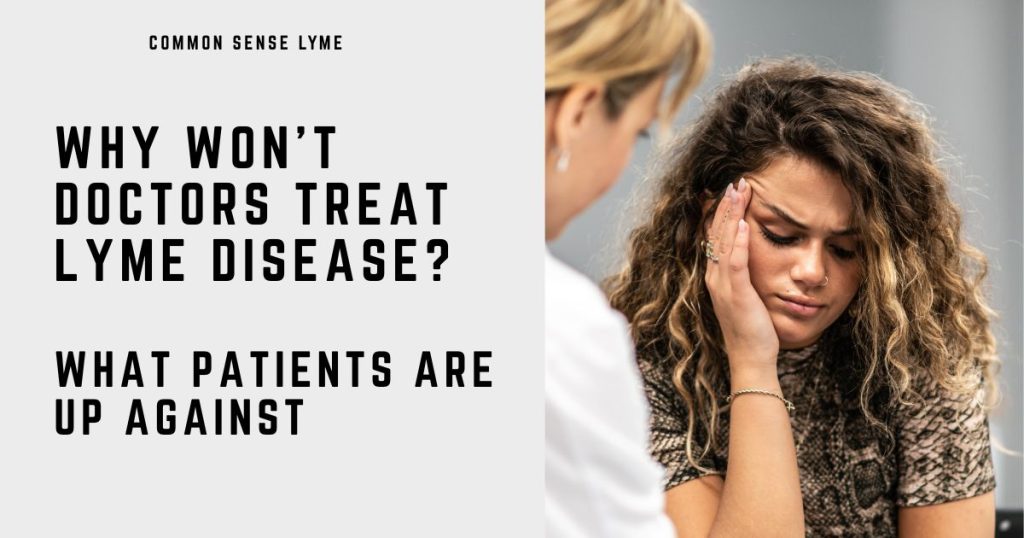
WHY WON’T DOCTORS TREAT LYME DISEASE

Why are doctors reluctant to treat Lyme disease?

Why Are Doctors Reluctant to Treat Lyme Disease? Why are doctors reluctant to treat Lyme disease? Many clinicians face regulatory pressure, professional stigma, insurance barriers, and the clinical complexity of managing persistent Lyme symptoms. Doctors may be reluctant to treat Lyme disease when symptoms persist beyond standard treatment—especially when care requires time-intensive, individualized evaluation. These

Why are doctors reluctant to treat Lyme disease? Read More »

Woman with Lyme disease and COVID-19 being examined in hospital bed.

Are Lyme disease patients at greater risk for developing severe COVID-19?

Are Lyme disease patients at greater risk for developing severe COVID-19? A new study looks at the risk of severe COVID-19 in patients with a history of exposure to Lyme disease. In their study “Correlation between COVID-19 severity and previous exposure of patients to Borrelia spp.,” Szewczyk‑Dąbrowska et al.² examined 3 groups of patients: those

Are Lyme disease patients at greater risk for developing severe COVID-19? Read More »

Babesia Asplenia

Babesia Asplenia: Why Standard Treatment Often Fails

Babesia Asplenia: Why Standard Treatment Often Fails The spleen clears infected blood cells Without it, infection persists longer Standard treatment is often not enough Quick Answer: Babesia asplenia cases are high risk because the spleen is essential for clearing infected red blood cells. Without it, patients often require extended treatment and face higher relapse risk.

Babesia Asplenia: Why Standard Treatment Often Fails Read More »

Clinician talking about co-infections with patient.

Illinois clinicians demonstrate gaps in understanding of tick-borne co-infections

Illinois clinicians demonstrate gaps in understanding of tick-borne co-infections Carson and colleagues surveyed clinicians between August 2020 and February 2022 and reported their findings in the article “Knowledge, attitudes, and practices of Illinois medical professionals related to ticks and tick-borne disease.” ¹ The respondents included RNs (61.3%), physicians (21.4%), and APNs/PAs (17.3%). The authors found

Illinois clinicians demonstrate gaps in understanding of tick-borne co-infections Read More »

Man with powassan virus encephalitis holding his head.

Powassan virus encephalitis contracted during winter months

Powassan Virus Encephalitis: Symptoms and Risks After a Tick Bite Powassan virus can affect the brain. Symptoms include confusion, weakness, and speech problems. Early recognition is critical. Powassan virus encephalitis is a rare but serious tick-borne infection that can cause inflammation of the brain. Powassan virus is a rare tick-borne infection that can rapidly affect

Powassan virus encephalitis contracted during winter months Read More »

Patient on telemedicine visit during COVID pandemic.

3 Benefits of Telemedicine for Lyme Disease Patients

3 Benefits of Telemedicine for Lyme Disease Telemedicine for Lyme disease has expanded rapidly since the COVID-19 pandemic and may help improve early diagnosis and treatment. A study entitled “The Impact of Telemedicine in the Diagnosis of Erythema Migrans during the COVID Pandemic: A Comparison with In-Person Diagnosis in the Pre-COVID Era,” compared clinical data

3 Benefits of Telemedicine for Lyme Disease Patients Read More »