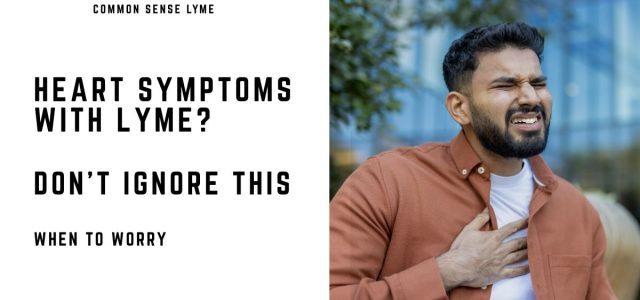
Lyme Carditis: When Heart Symptoms Can’t Wait
Lyme carditis can turn a missed diagnosis into a medical emergency.
Chest pain after a tick bite is not always anxiety. Lightheadedness is not always deconditioning. Palpitations that begin alongside flu-like symptoms should not be dismissed—especially in a Lyme-endemic area.
When Lyme disease affects the heart, the clinical urgency changes quickly. Lyme carditis can disrupt the heart’s electrical system and lead to varying degrees of heart block.
Delayed recognition remains one of the major risks. See delayed Lyme disease diagnosis.
Lyme carditis is often reversible with prompt diagnosis and appropriate treatment.
What Is Lyme Carditis?
Lyme carditis occurs when Borrelia burgdorferi affects heart tissue, most commonly the atrioventricular (AV) node, which helps coordinate the heartbeat.
Inflammation affecting this electrical pathway may lead to varying degrees of heart block.
Cardiac involvement develops in an estimated 1–10% of untreated Lyme disease cases, typically within weeks of infection.
Although uncommon, Lyme carditis remains one of the most serious early complications of Lyme disease because it can progress rapidly if not recognized.
Although AV block is the most recognized presentation, Lyme carditis may also involve myocarditis, pericarditis, ventricular dysfunction, or, rarely, acute heart failure.
Cardiac involvement may appear before Lyme disease is otherwise recognized. This is one reason early Lyme disease tests can be negative even when cardiac risk is already present.
Symptoms: What Should Raise Concern
Symptoms are frequently misinterpreted. Patients may be told they are anxious, overtired, or deconditioned—particularly when they are otherwise healthy.
Symptoms may fluctuate as the degree of heart block changes, making repeated evaluation important.
Common symptoms include:
- Chest pain or pressure
- Lightheadedness or dizziness
- Syncope or near-syncope
- Shortness of breath
- Palpitations or irregular heartbeat
- Profound fatigue
Symptoms requiring urgent evaluation include:
- Fainting or loss of consciousness
- Chest pain with exertion
- Marked bradycardia
- Rapid worsening of symptoms
For broader symptom patterns, see the Lyme disease symptoms guide.
How Quickly Can Lyme Carditis Progress?
Lyme carditis may worsen over a short period of time. Patients can present with mild symptoms and later develop higher-degree heart block.
Because conduction abnormalities may fluctuate, patients often require cardiac monitoring, repeat ECGs, and treatment while evaluation is ongoing.
This is one reason outpatient “wait and see” approaches may be risky when Lyme carditis is strongly suspected.
Diagnosis: Why Clinical Suspicion Matters
Diagnosis depends heavily on recognizing the pattern early.
- ECG testing
- Lyme serology
- Cardiac monitoring
- Additional cardiac evaluation when indicated
Testing may be negative early in infection, making clinical judgment especially important.
Patients with significant conduction abnormalities often require hospital admission for continuous cardiac monitoring while treatment decisions are made.
Patients with new heart block, unexplained palpitations, dizziness, or syncope deserve careful evaluation in Lyme-endemic areas.
Treatment: Why Timing Matters
Treatment depends on severity. Patients with higher-degree AV block often require hospitalization, IV antibiotics, and temporary pacing support.
Many conduction abnormalities improve within days after treatment begins.
This reversibility is one reason clinicians try to avoid unnecessary permanent pacemaker placement whenever appropriate.
For more detailed discussion, see pacemakers for Lyme carditis.
Outcomes: The Difference Early Treatment Makes
With prompt treatment:
- Most patients recover completely.
- Heart block often resolves within days to weeks.
- Permanent pacemakers may be avoided.
With delayed recognition:
- Heart block may worsen rapidly.
- Emergency intervention may become necessary.
- Severe complications, including sudden cardiac death, can occur in rare cases.
Lyme carditis remains one of the clearest examples of how delayed diagnosis can affect outcome.
When to Suspect Lyme Carditis
- New cardiac symptoms after possible tick exposure
- Heart symptoms occurring with suspected Lyme disease
- Heart block without another clear explanation
- Recent flu-like illness followed by new cardiac symptoms
Lyme carditis can occur even without:
- A recalled tick bite
- An erythema migrans rash
- Positive early Lyme testing
These patients require prompt medical evaluation because cardiac conduction abnormalities can progress rapidly.
Related Lyme Carditis Topics
For more detailed discussions of diagnosis and management, see these related Lyme carditis articles:
- Temporary Pacemaker Strategies for Lyme Carditis
- When a Pacemaker May Be Necessary
- Avoiding Permanent Pacemakers in High-Degree AV Block
- When Pacemakers Can Be Removed After Lyme Carditis
- Atypical Presentations of Lyme Carditis
Clinical Perspective
Lyme carditis is one of the few manifestations of Lyme disease where delayed recognition may rapidly become life-threatening.
Symptoms are frequently attributed to anxiety, stress, viral illness, or deconditioning before Lyme disease is considered.
The reassuring aspect is that most patients recover well when Lyme carditis is recognized early and treated promptly with appropriate antibiotics and cardiac monitoring.
Clinical Takeaway
Lyme carditis is a time-sensitive manifestation of Lyme disease that may disrupt the heart’s electrical system but is often reversible with prompt treatment.
When unexplained chest pain, palpitations, dizziness, fainting, or heart block occur after possible tick exposure, clinicians should maintain suspicion even when a rash, recalled tick bite, or early Lyme testing are absent.
Related Articles
Learn more about Lyme disease and cardiac complications:
- Patients Can Die When Lyme Carditis Is Not Treated
- Lyme Carditis Diagnosis: Lessons From 18 Cases
- How Lyme Disease Heart Block Can Progress Rapidly
- How Lyme Disease Can Mimic a Heart Attack
References
- Robinson ML, Kobayashi T, Higgins Y, Calkins H, Melia MT. Lyme carditis. Infect Dis Clin North Am. 2015;29(2):255-268.
- Yeung C, Baranchuk A. Diagnosis and Treatment of Lyme Carditis: JACC Review Topic of the Week. J Am Coll Cardiol. 2019;73(6):717-726.
- Costello JM, Alexander ME, Greco KM, Perez-Atayde AR, Laussen PC. Lyme carditis in children: presentation, predictive factors, and clinical course. Pediatrics. 2009;123(5):e835-e841.
- Forrester JD, Mead P. Third-Degree Heart Block Associated With Lyme Carditis: Review of Published Cases. Clin Infect Dis. 2021.
Dr. Daniel Cameron, MD, MPH
Lyme disease clinician with over 30 years of experience and past president of ILADS.
Symptoms • Testing • Coinfections • Recovery • Pediatric • Prevention