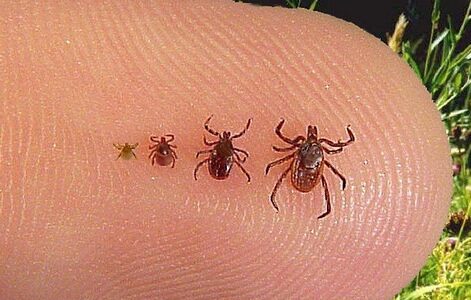
Study Finds Tiny Larval Ticks Can Transmit Borrelia miyamotoi
Larval ticks may pose a greater infection risk than previously recognized—especially for Borrelia miyamotoi.
Unlike Borrelia burgdorferi, the causative agent of Lyme disease, female ticks infected with Borrelia miyamotoi can pass the bacteria to their offspring.
“Therefore, in addition to nymphs and adults, larvae can vector B. miyamotoi to wildlife and human hosts,” write the authors of a study on vertical transmission rates of Borrelia miyamotoi in Ixodes scapularis. [1]
Larval Ticks and Seasonal Risk
The majority of Lyme disease cases occur in mid-summer when nymphal black-legged ticks are most active. However, Borrelia miyamotoi appears to follow a different seasonal pattern.
Recent studies indicate that many cases occur later—from July through September—during the larval questing period.
This distinction may help explain missed or delayed diagnoses.
Study Design
Han and colleagues evaluated vertical transmission to better understand how B. miyamotoi is maintained in nature and to predict disease risk.
Ticks were collected from white-tailed deer at hunter check stations in Maine, New Hampshire, Tennessee, and Wisconsin during November 2015 and 2016.
Key Findings
Out of 1,263 ticks collected, 33 were infected with B. miyamotoi. Most infected ticks were from Wisconsin, with smaller numbers from Maine (n=3), New Hampshire (n=2), and Tennessee (n=1).
- Average infection rate: 2.6% (range 0–7%)
- Transmission from infected female ticks to eggs: 90.9%
- Transmission from eggs to larvae: 84.8%
- Infection risk increases after blood meals in larvae and nymphs
These findings confirm that larval ticks can emerge already infected—without requiring a prior blood meal.
Clinical Implications
While nymphs remain the primary vector for Lyme disease, larvae may represent an important—and possibly underrecognized—risk for Borrelia miyamotoi infection.
The authors conclude that larvae may pose “the greatest risk” for Borrelia miyamotoi disease due to their:
- High abundance
- Tiny size (making them difficult to detect)
- Ability to carry infection at birth
Learn more about Borrelia miyamotoi infection and how it differs from Lyme disease.
Related Articles:
Blood smear not reliable in diagnosing Borrelia miyamotoi disease
Doctors face challenges in diagnosing Borrelia miyamotoi
Larval ticks may be a threat after all
Move over nymphal ticks, larval deer ticks now pose a threat
References:
- Han S, Lubelczyk C, Hickling GJ, Belperron AA, Bockenstedt LK, Tsao JI. Vertical transmission rates of Borrelia miyamotoi in Ixodes scapularis collected from white-tailed deer. Ticks Tick Borne Dis. 2019.
Dr. Daniel Cameron, MD, MPH
Lyme disease clinician with over 30 years of experience and past president of ILADS.
Symptoms • Testing • Coinfections • Recovery • Pediatric • Prevention