Borrelia miyamotoi Transmission: Larval Deer Ticks Can Infect
Larval deer ticks are often overlooked
Borrelia miyamotoi can be passed through tick eggs
Even newly hatched larvae may transmit infection
Borrelia miyamotoi transmission changes how we think about larval deer ticks.
In Lyme disease, larval ticks are typically not infected with Borrelia burgdorferi because the bacteria are not usually passed through tick eggs.
But Borrelia miyamotoi is different.
Researchers have shown that infected adult ticks can pass B. miyamotoi to their offspring through transovarial transmission, meaning larval ticks may already carry infection when they hatch.
What Borrelia miyamotoi Transovarial Transmission Means
According to investigators from the Centers for Disease Control and Prevention, larval ticks can already be infected with Borrelia miyamotoi after they hatch.
This occurs through transovarial transmission, a process in which an infected adult female tick passes the bacteria to offspring through infected eggs.
This is clinically important because larval ticks are often assumed to be harmless compared with nymphal ticks.
That assumption may not hold for B. miyamotoi.
CDC Study on Larval Tick Transmission
Researchers infected experimental mice with Borrelia miyamotoi, the relapsing fever bacterium.
They found that “minimal or partial blood meals by single-feeding transovarially B. miyamotoi-infected larvae also resulted in approximately half of experimental hosts developing infections detectable by examination of blood for presence of B. miyamotoi DNA,” writes Breuner from the CDC’s National Center for Emerging and Zoonotic Infectious Diseases.
This finding challenges the assumption that larval ticks are always low risk.
Can Larval Ticks Transmit Lyme Disease?
Many people ask whether larval ticks can transmit Lyme disease.
Most larval deer ticks are not considered an important source of Lyme disease because Borrelia burgdorferi, the bacterium that causes Lyme disease, is generally not passed from infected female ticks to their eggs.
However, larval ticks can transmit Borrelia miyamotoi, a relapsing fever spirochete that is transmitted through transovarial transmission.
This means infected female ticks can pass the infection directly to their offspring.
As a result, larval ticks may carry Borrelia miyamotoi even though they are unlikely to transmit Lyme disease itself.
Why Larval Deer Ticks Pose a Unique Risk
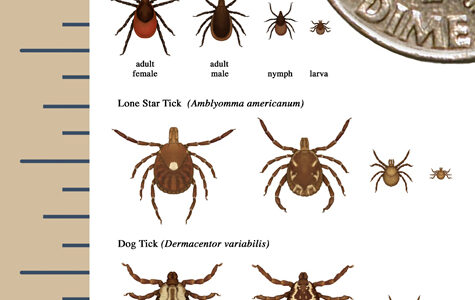
Larval ticks are extremely small and easy to miss.
They are often active in July and August, when many people are outdoors and may be less vigilant about tick protection.
Public health messaging has traditionally emphasized nymphal ticks in spring and early summer.
However, this study suggests that late-summer exposure may also carry risk when larval ticks are infected with B. miyamotoi.
How This Differs From Lyme Disease
In Lyme disease, larval ticks are generally not considered an important source of infection because Borrelia burgdorferi is not typically transmitted through eggs.
By contrast, B. miyamotoi can be passed from infected female ticks to offspring.
This distinction matters for prevention, diagnosis, and patient education.
Patients bitten by larval ticks may still need monitoring for symptoms of tick-borne coinfections and relapsing fever-type illness.
Public Health Implications
The authors suggested that public health officials consider revising tick-bite prevention messaging to include larval ticks and their seasonal activity.
This is especially important in July and August, when larval ticks may be active and people may mistakenly assume the highest-risk season has passed.
Prevention messages should include daily tick checks, protective clothing, repellents, and awareness that very small ticks can still matter clinically.
Clinical Perspective
Most clinicians focus on nymphal deer ticks because they are the primary source of Lyme disease transmission.
However, Borrelia miyamotoi behaves differently from Borrelia burgdorferi. Because infected female ticks can pass the organism directly to their offspring, larval ticks may represent a clinically relevant source of infection.
This distinction may be important when evaluating patients who develop symptoms after late-summer tick exposure.
Frequently Asked Questions
Can larval ticks transmit disease?
Yes. Although larval ticks are less important than nymphs for Lyme disease transmission, studies have shown that larval deer ticks can transmit Borrelia miyamotoi through transovarial transmission.
Do larval ticks carry Lyme disease?
Most larval ticks are not considered an important source of Lyme disease because Borrelia burgdorferi is generally not passed through tick eggs.
Can larval ticks bite humans?
Yes. Larval deer ticks can attach to and feed on humans, although their tiny size often makes them difficult to detect.
When are larval ticks most active?
Larval deer ticks are most active during July and August in many endemic regions.
Are larval ticks dangerous?
Most larval ticks are considered lower risk for Lyme disease than nymphs. However, studies have shown that larval deer ticks can transmit Borrelia miyamotoi, meaning they should not automatically be considered harmless.
Clinical Takeaway
Larval deer ticks can transmit Borrelia miyamotoi when they acquire infection through transovarial transmission.
This expands the clinical importance of larval tick bites and late-summer tick exposure.
Patients and clinicians should not assume that larval ticks are harmless, particularly when symptoms follow a summer tick bite.
Related Articles
- Borrelia miyamotoi
- Do Tick Larvae Bite Humans?
- Study Demonstrates Larval Ticks May Be a Threat
- Prevention of Lyme Disease
References
- Breuner NE, Hojgaard A, Replogle AJ, Boegler KA, Eisen L. Transmission of the relapsing fever spirochete, Borrelia miyamotoi, by single transovarially-infected larval Ixodes scapularis ticks. Ticks Tick Borne Dis. 2018.
Dr. Daniel Cameron, MD, MPH
Lyme disease clinician with over 30 years of experience and past president of ILADS.
Symptoms • Testing • Coinfections • Recovery • Pediatric • Prevention



Lone Stars also transmit some infections transovarially.
So if you have had chiggers could you have lyme or another tick borne illness?
No. I posted an story about the association of a chigger bite with alpha-gal allergy (red meat allergy). These stories will hopefully trigger further research. You can read the story I posted at https://www.facebook.com/plugins/post.php?href=https%3A%2F%2Fwww.facebook.com%2Fdanielcameronmd%2Fposts%2F2204587233160186
Hi Dr. Cameron, I know this article is from a few years back, but thought I’d try my luck in getting in touch with you! Do you know what percentage of larval ticks are suspected of being infected with borrelia miyamotoi in states like CT? Thank you!
I have not seen any information on how often Larval ticks harbor B. miyamotoi or B. burgdorferi.
Thank you!
Hi Dr Cameron,
Can a larvae deer tick transmit Lyme disease to a human? Thanks so much
Transovarially transmission has been considered in tick borne disease, that is the infection passes through the egg to the larva. I have not seen much research in this area.
Hi Dr. Cameron,
I believe I have been bitten by a larval deer tick. (viewed under microscope, six legs, all mouth “prongs” intact. I recently finished a two week course of Doxycycline for an infected lone star tick bite. I removed the larval tick two days ago, and I believe I caught it well less than 24 hours after attaching, though I can’t be sure. I was given Doxycyline from my dermatologist for prophylaxis. He said I should take one 100mg pill. Do you think this is necessary for a larval tick bite that is not infected, or is this not enough and I should look into another full course of Doxy? Obviously I need to do a better job protecting myself in the future. Thanks in advance.
The prophylaxis dose should have been 200 or two 100 tablets. I am not supportive of a single dose prophylaxis approach. Read my perspective.vv https://danielcameronmd.com/perspective-dont-trust-single-dose-doxycycline-to-prevent-lyme-disease/
There has been no study of prophylaxis for a larval tick.
Thank you, I chose not to take the medication in this case. I did not identify the tick properly, either. Upon turning it over and looking closer, I actually think it may be a nymph, unfortunately. Either a lone star or deer tick nymph. I am caring for the bite site carefully, and have chosen to do “watchful waiting.” I have no idea if I’m doing the right thing. I don’t know if jumping into another several weeks of Doxycyline therapy after just completing two weeks is a good idea, either. I am located in central NC.