Can Babesia Be Missed on Testing? When Diagnosis Is Clinical
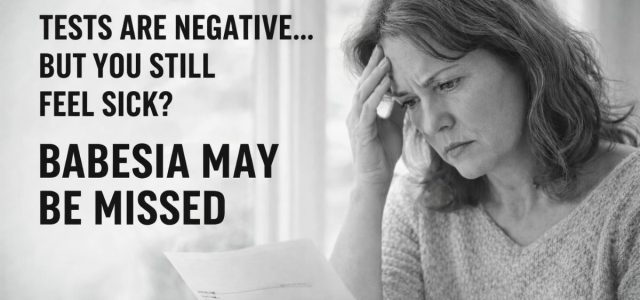
Can Babesia tests be negative even if you’re infected?
Yes—and this is one of the most common challenges in diagnosing tick-borne infections.
Patients may have symptoms consistent with Babesia, yet blood smears, PCR, and antibody tests come back negative.
In these cases, diagnosis may depend on clinical judgment—not just laboratory confirmation.
When Laboratory Confirmation Fails Clinical Reality
Investigators from ISDH and the Centers for Disease Control and Prevention (CDC) examined specimens from 14 patients diagnosed with Lyme disease and B. microti. They tested for Babesia infection by Giemsa-stained blood smears, PCR, and indirect fluorescent antibody (IFA) testing.
The only clinical manifestation consistent with Lyme disease included unspecified rashes in 3 patients. Anemia and fever, symptoms associated with Babesia, were identified in 2 patients.
None Met CDC Surveillance Criteria
Investigators concluded that none of the patients “fulfill the national surveillance case definition for non–transfusion-associated babesiosis,” writes Brown from ISDH.
Two of the 12 patients had a B. microti IFA titer of 1:64, but this is considered insufficient evidence by the CDC for diagnosis. All other testing was negative.
The CDC and ISDH concluded that their “laboratory-based investigation does not suggest a cluster of Lyme disease or babesiosis cases among these patients.”
This raises an important clinical question: were the original diagnoses wrong—or was the testing performed at a time when infection could no longer be detected?
Why Babesia Tests Can Be Negative
There are several reasons why laboratory confirmation of B. microti may fail.
First, specimens were collected long after symptom onset, when blood smears and PCR are often negative.
“Patient specimens were collected a median of 172 days (range = 22–348 days) after reported illness onset date,” writes Brown.
This timing matters. PCR detects circulating Babesia DNA, and blood smears depend on visible parasitemia. Months after onset—especially after treatment—parasite levels may be too low to detect.
Treatment Effects on Laboratory Results
Investigators also evaluated specimens after patients had already received an average of three antimicrobial agents.
Treatment and delayed testing may significantly alter results. If patients had received atovaquone and azithromycin, parasite burden could decline enough to make PCR and blood smears negative.
Although antibodies may persist after treatment, titers may not meet the CDC surveillance threshold of 1:256. Two patients had titers of 1:64, suggesting possible exposure that did not meet reporting criteria.
Limitations of the Investigation
Investigators did not fully examine the clinical reasoning behind the original Babesia diagnoses.
“ISDH did not conduct patient interviews or chart reviews; demographic and clinical data were obtained from the CDC specimen submission form,” states Brown.
This is a major limitation. Treating physicians may have relied on exposure history, symptom patterns, treatment response, and supporting laboratory findings—none of which were fully evaluated.
When Babesia Clinical Diagnosis Is Appropriate
Brown concludes that Lyme disease and babesiosis should be considered in the differential diagnosis for patients with compatible illness and exposure to I. scapularis ticks.
This case series underscores the importance of not relying solely on laboratory confirmation when tick-borne co-infections are suspected—especially when testing is delayed or patients have already been treated.
Babesia diagnosis may depend on clinical judgment, not just surveillance-based laboratory criteria.
CDC Surveillance Criteria vs Clinical Diagnosis
The CDC surveillance definition for babesiosis requires parasites on blood smear, a positive PCR, or an IFA antibody titer of at least 1:256.
These criteria were designed for public health surveillance—not for individual clinical care.
Clinical diagnosis is different. It considers the full picture, including symptoms, exposure risk, laboratory trends, and response to treatment.
Frequently Asked Questions
Can you have Babesia with negative laboratory tests?
Yes. Testing may be negative if it is delayed, if parasitemia is low, or if the patient has already received treatment.
Why would Babesia tests be negative after treatment?
Treatment can reduce parasite burden enough to make PCR and blood smears negative.
When should doctors make a clinical Babesia diagnosis?
When patients have compatible symptoms, possible tick exposure, and a clinical picture consistent with Babesia—even if testing is negative.
What is the difference between CDC surveillance criteria and clinical diagnosis?
CDC criteria are meant for reporting. Clinical diagnosis considers the full patient picture.
Should Babesia treatment wait for positive lab results?
Not always. If suspicion is high, empiric treatment may be appropriate.
Clinical Takeaway
Babesia can remain a clinical diagnosis—even when laboratory testing is negative.
Delayed testing, prior treatment, and low parasite levels can all contribute to false-negative results.
Clinical judgment remains essential in patients with compatible symptoms and exposure risk.
Related Reading
- Lyme Disease Testing and Diagnosis
- Understanding Lyme Disease Test Accuracy
- Babesia and Lyme: What Patients Need to Know
- Babesia Testing: Why Negative Results Don’t Always Mean Negative
- Why I Treat Babesia Even if Tests Are Negative
- Case Report: Various Clinical Presentations of Babesia
- Sweats May Be a Sign of Babesia
- Citizen Scientists Help Uncover Growing Risk of Babesia
References
- Brown JA, Allman R, Herwaldt BL, et al. Notes from the Field: Reference Laboratory Investigation of Patients with Clinically Diagnosed Lyme Disease and Babesiosis – Indiana, 2016. MMWR Morb Mortal Wkly Rep. 2018;67(41):1160-1161.
Dr. Daniel Cameron, MD, MPH
Lyme disease clinician with over 30 years of experience and past president of ILADS.
Symptoms • Testing • Coinfections • Recovery • Pediatric • Prevention