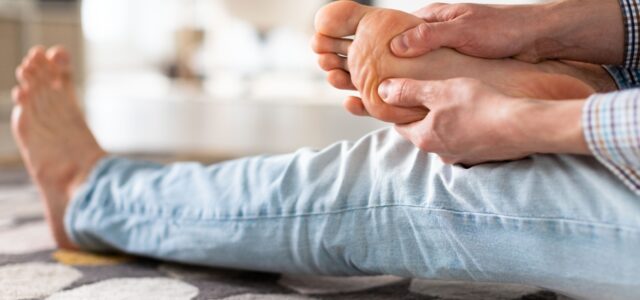
Severe Foot Pain May Be a Neurological Symptom of Lyme Disease
BURNING FOOT PAIN?
WHEN LYME DISEASE
AFFECTS THE NERVES
Hello, and welcome to another Inside Lyme Podcast. I am your host Dr. Daniel Cameron.
In this episode, I discuss the case of a 36-year-old man with severe neuropathic foot pain associated with post-treatment Lyme disease syndrome (PTLDS).
Severe Neuropathic Pain Due to Lyme Disease
I first read about this case in the journal Neuromodulation by Karri and colleagues.
A 36-year-old man suffered from chronic pain associated with post-treatment Lyme disease syndrome (PTLDS).
Individuals with PTLDS may remain ill with:
- Pain
- Cognitive impairment
- Fatigue
- Neurological symptoms
The patient described severe neuropathic pain in both feet and rated the pain at 10 out of 10 despite methadone treatment.
The treating physicians assumed the tick-borne infection had resolved and elected not to continue antibiotics.
Instead, they focused on symptom management.
Why Lyme Disease Foot Pain Can Be Difficult to Treat
The patient’s pain remained severe despite trials of:
- Gabapentin
- Duloxetine
- Bupropion
- Narcotic medications
“The patient was unhappy with associated adverse effects, especially drowsiness and recurrent constipation,” the authors wrote.
Neuropathic pain associated with Lyme disease may significantly impair sleep, mobility, concentration, and daily functioning.
For more on neurological symptoms, see neurologic Lyme disease.
Surgical Treatment for Severe Lyme Neuropathy
Two surgical procedures were ultimately performed to help manage the patient’s pain.
First, surgeons implanted a spinal cord stimulator in the dorsal root ganglion to interrupt pain signaling before it reached the brain.
The patient’s pain level improved from 10 out of 10 to approximately 3 out of 10.
The doctors later implanted a pulse generator in the right paraspinal-flank area.
Following the second procedure, the patient reported pain levels dropping to 0–2 out of 10.
Narcotic medications were rarely needed afterward, and the patient was able to return to work as a healthcare provider.
According to Becker’s Spine Review, spinal cord stimulator implantation can be costly, with estimated expenses exceeding tens of thousands of dollars.
Ongoing Questions About PTLDS Pain
The authors stressed the need for new approaches to pain management for patients with persistent Lyme disease symptoms.
Questions remain regarding:
- The underlying cause of persistent neuropathic pain
- The role of inflammation or nerve injury
- Whether additional antimicrobial therapy may help selected patients
- How to balance symptom management with long-term treatment risks
For more on persistent symptoms, see persistent Lyme disease mechanisms.
Questions Addressed in the Podcast
- Have you seen severe pain in Lyme disease?
- What types of pain occur in Lyme disease?
- What treatments are available for Lyme disease pain?
- What is post-treatment Lyme disease syndrome (PTLDS)?
- What symptoms are associated with PTLDS?
- Why is PTLDS controversial?
- What concerns exist regarding surgical pain management approaches?
- Could additional antibiotics have helped resolve the neuropathic pain?
Clinical Takeaway
Severe neuropathic foot pain may occur in some Lyme disease patients and can persist despite standard treatment.
Persistent neurological symptoms and PTLDS-related pain remain difficult clinical challenges requiring individualized evaluation and management.
Karri, J., & Bruel, B. (2021). Dorsal root ganglion stimulation for post-Lyme disease chronic peripheral neuropathic pain. Neuromodulation, 24(4), 794–795.
Kumar, K., & Bishop, S. (2009). Financial impact of spinal cord stimulation on the healthcare budget: A comparative analysis of costs in Canada and the United States. Journal of Neurosurgery: Spine, 10(6), 564–573.
Thanks for listening to another Inside Lyme Podcast.
You can read more about these cases in my show notes and on my website at DanielCameronMD.com.
As always, your likes, comments, reviews, and shares help spread awareness about Lyme disease.
Please remember that the advice given is general and not intended as specific medical advice for any individual patient. If you require medical guidance, consult an experienced healthcare professional.
Dr. Daniel Cameron, MD, MPH
Lyme disease clinician with over 30 years of experience and past president of ILADS.
Symptoms • Testing • Coinfections • Recovery • Pediatric • Prevention

Thank you for sharing such a important voice note. Really makes Lyme disease points understanding.
Hello just listening to pod cast about neuropathic pain that comes with lyme im a 60 yr old women with chronic lyme and right now I’m going thru some things gut issues, migraines, bladder issues, an mostly my upper arm area and shoulder wowowo have I been in pain for months to where I’m crying all day due to pain pain rating was way over a 10 an have had mri an cray saying nothing just had injection for pain one week next week I had another injection for pain in front of shoulder now pain is tolerable but there an I’m also having neuropathy in my right thigh! My question is my lyme active and am I having this pain in my arm and shoulder due to my Lyme? Like us there infection in my arm of lyme junk! Like when they found in my knee when I had to have it drained! I believe I’m still very sick with Lyme and just maybe co infection also! Was bitten in 2018 then diagnosed 2021 after the fact fighting with the doc to listen to me for yrs until to late now infection has taken over my life! I’ve been really sick since last September 2024 December in ER an ever since been down hill so I looking for answer for my should an arm muscle pain could it be lyme an what to look for! Thanks thanks so much for your time!
tammy
I have patients who have relieved their pain after circling back to a persistent tick-borne infection
Problem is no one will treat if there is “no active infection.” At some point, Wouldn’t there just be damage done that can’t be healed?
I have patients who were not informed treatment for persistent infection years after the fact can be effective for some but not all