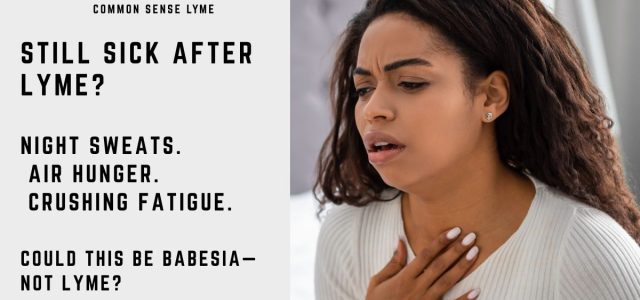
Babesia Symptoms and Treatment
Babesia is one of the most overlooked coinfections in Lyme disease and may explain persistent symptoms that do not improve with standard treatment.
Babesia can cause relapsing symptoms including night sweats, air hunger, chills, fatigue, and illness that does not fully respond to standard Lyme disease treatment.
Babesia is a malaria-like parasite transmitted by the same ticks that carry Borrelia burgdorferi. Co-infection rates may be substantial in endemic regions, yet Babesia often remains underrecognized.
For a broader overview, see our coinfections hub.
📖 New to Babesia? Start with:
Why Babesia and Lyme Is Worse Than You Think.
Babesia Symptoms
Babesia symptoms often overlap with Lyme disease but may follow a distinct clinical pattern.
- Night sweats with cyclical drenching episodes
- Air hunger or shortness of breath despite normal oxygen levels
- Profound fatigue disproportionate to activity
- Chills, fever, dizziness, and autonomic instability
These symptoms may reflect the parasite’s effect on red blood cells and oxygen transport.
Babesia symptoms may also contribute to autonomic dysfunction.
Related articles:
Night Sweats Babesia,
Babesia Air Hunger,
and
Babesia Symptoms.
Babesia Testing
Standard Babesia tests frequently miss chronic or low-level infection.
Blood smears may only detect high parasite loads, antibody levels can decline over time, and PCR testing may fail to identify certain species.
Clinical Insight: A negative blood smear or PCR test does not always rule out Babesia, particularly in patients with fluctuating symptoms or chronic illness patterns.
A negative test does not necessarily exclude the diagnosis. Clinical judgment remains important.
Related article:
Babesia Testing: Why Negative Results Don’t Always Mean Negative.
Babesia Treatment
Babesia requires different treatment than Lyme disease.
Standard Lyme antibiotics such as doxycycline do not effectively treat this parasite. Treatment commonly includes atovaquone plus azithromycin, although some patients require extended or alternative regimens.
Treatment duration depends on symptom severity, immune status, and whether the illness has become chronic.
Related articles:
Babesia Treatment Protocol,
Babesia Treatment Duration,
and
Babesia Relapse.
Babesia Co-infection
Babesia co-infection may help explain persistent or relapsing symptoms in patients who do not fully improve with Lyme disease treatment alone.
Patients with Babesia Lyme co-infection may experience more severe illness, prolonged recovery, and fluctuating symptom patterns.
Related articles:
When Lyme Treatment Fails: Could It Be Babesia?
and
Babesia Lyme Co-infection.
Blood Transfusion Risk
Babesia can also spread through blood transfusions. Although donor screening has improved, transfusion-associated babesiosis remains an important concern.
Related article:
Babesia Blood Transfusion.
Special Populations
Babesia may be more severe in older adults, immunocompromised patients, individuals without a spleen, pregnant women, and infants.
For these groups, delayed diagnosis can lead to prolonged illness and more serious complications.
Related articles:
Babesia Pregnancy
and
Babesia Immunocompromised.
Frequently Asked Questions
What is the difference between Babesia and Lyme disease?
Lyme disease is caused by bacteria, while Babesia is a parasite that infects red blood cells. The two illnesses require different treatments.
Can you have Babesia without Lyme disease?
Yes. Babesia can occur as a standalone infection, although co-infection with Lyme disease is common.
Why is Babesia often missed?
Testing limitations and overlapping symptoms contribute to delayed or missed diagnosis.
Can Babesia relapse?
Yes. Relapsing symptoms may occur, particularly in immunocompromised patients.
Clinical Takeaway
Babesia Lyme co-infection is common, frequently missed, and often responsible for persistent symptoms that do not improve with Lyme disease treatment alone.
Night sweats, air hunger, relapsing fatigue, and autonomic symptoms should raise suspicion for Babesia, particularly in patients who remain ill despite standard therapy.
Recognizing this parasite early may significantly improve treatment decisions and long-term recovery.
References:
- Krause PJ, McKay K, Thompson CA, et al. Disease-specific diagnosis of coinfecting tickborne zoonoses: babesiosis, human granulocytic ehrlichiosis, and Lyme disease. Clin Infect Dis. 2002;34(9):1184-1191.
- Diuk-Wasser MA, Vannier E, Krause PJ. Coinfection by Ixodes tick-borne pathogens: ecological, epidemiological, and clinical consequences. Trends Parasitol. 2016;32(1):30-42.
- Wormser GP, Dattwyler RJ, Shapiro ED, et al. The clinical assessment, treatment, and prevention of Lyme disease, human granulocytic anaplasmosis, and babesiosis. Clin Infect Dis. 2006;43(9):1089-1134.
- Vannier E, Gewurz BE, Krause PJ. Human babesiosis. Infect Dis Clin North Am. 2008;22(3):469-488.
- Levin AE, Krause PJ. Transfusion-transmitted babesiosis: is it time to screen the blood supply?. Curr Opin Hematol. 2016;23(6):573-580.
Dr. Daniel Cameron, MD, MPH
Lyme disease clinician with over 30 years of experience and past president of ILADS.
Symptoms • Testing • Coinfections • Recovery • Pediatric • Prevention
I was infected with Lyme disease with co-infections Bartonella and Babesia in the upper Midwest eight years ago. I was blown off by the clinic Up North because I am from Texas. Texas is just now starting to see Lyme. However, treatment been very challenging to obtain. I am extremely sensitive to drugs and some herbs (I’m told one in 2000). I’m now trying to deal with Babesia, but the herbs are worse than the disease if tolerated at all. My age is a factor so need to figure this out before it gets any more severe. I hit a wall last week physically and emotionally.
Thank you for sharing this—what you’re describing is something I hear from many patients, especially when symptoms are complex and treatment is difficult to tolerate.
I can’t offer individual medical advice here, but sensitivity to medications and challenges with infections like Babesia infection and Bartonella infection are real concerns that deserve careful, individualized care.
If you’ve hit a wall physically and emotionally, that’s important to recognize—this is where a thoughtful, step-by-step approach with a clinician experienced in complex tick-borne illness can make a difference.
I had the typical dish distinctive rash from a tick bite. The tick was imbedded into my flesh and we got that out but the tick itself was not distinctive by this point. I went to Urgent Care and the NP only wanted to give me 10 days doxycycline even though I insisted that I needed it longer due to having CVID. I called my immunologist and he upped the dose to 100 mg doxycycline 2BID for 30 days. After reading the article I’m wondering if I should’ve been tested for both Bordatella and Babesia. And if so, due to having CVID, what specific tests should be ordered since simple antibody testing is not reliable?
I have found it helpful to consider a co-infection